Direct Cinema

‘Essential’, ‘Unforgettable’, ‘Body Horror Classic’, ‘Feminist Cult Classic’, ‘Dark Comedy’, are some of the quotes being thrown around about ‘The Substance’, a new film by Coralie Fargeat, starring Demi Moore. The best description I’ve seen is the line in the teaser from New York Magazine, “An enraged scream in cinematic form”. Having been released during the season of America’s self immolating election, ‘The Substance’ is a testament to society’s desire to go backwards into thin fantasy worlds created to protect us from looking at ourselves.

The film is relentless and brutal and without compromise. Many viewers may be repulsed, or even traumatized, although I question if anything on the screen matches the daily horror displayed on the evening news. The film juxtaposes the sleazy spectacle of Donald Trump style beauty pageants with explosions of rage that reminded me of the movie ‘Carrie’, as well as the tortured physical metaphors often portrayed in the films of David Cronenberg.

Blending horror and comedy in a surrealistic mix of ‘pumped up’ visual extremes we see in television commercials and popular magazines, ‘The Substance’ pushes up against cinema’s most powerful operatic limits. The intent is to forcibly shock the viewer awake. Its images are grotesque and direct, and anyone not altered in their presence is either unconscious or braindead.

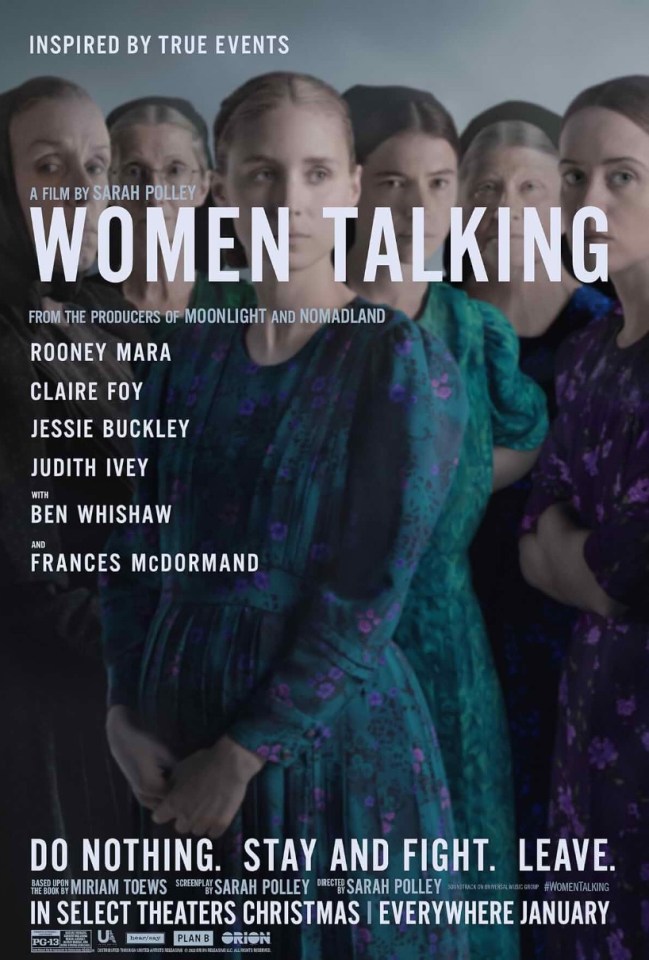
In the face of extremes of hate and violence pushed by those who wish to rule and profit, the floodgates of truly political art have opened in the mainstream. Films like ‘Barbie’, ‘Women Talking’ and ‘Poor Things’ speak directly to the atrocities of female oppression. ‘The Substance’ is one of those, and it isn’t trying to be reasonable or gentle in a world where the spectacle of politics has taken us to the edges of absolute chaos.

During the drawn out, horrifying and over-the top final cataclysm in ‘The Substance’ there’s a close up shot of a terrified little girl covered in blood. She’s been dressed up to echo the exotic sexual fantasies paraded before her on the stage, and her face displays the full horror children witness everyday in a world trapped in its fantasies and dominated by its own irrational fears.

Women Talking

In (2023) I managed to see most of the movies nominated for the Best Picture at the Academy Awards. (except ‘Elvis’ – I was never much into Elvis and am not particularly fond of biopics in general.)

That was the year ‘Everything Everywhere All At Once’ won the award.

Sarah Polley’s film ‘Women Talking’ was awarded ‘Best Adapted Screenplay’

I thought it deserved ‘Best Picture’ – at least.

When I saw it at the theater I wept tears from the beginning to the end. I just watched it again on Prime Video, and it had much the same effect, although I was able to draw back just a little bit and appreciate the pure technical perfection of the film. (It won the Movie Of The Year from the American Film Institute.)

No film in my memory has affected me so deeply. I’ve elevated it to my top three favorite films of all time. (It falls between ‘Wings Of Desire’ for its depth, ‘Drive’ for its technical perfection – ‘Women Talking’ has both, and the best acting ensemble I’ve ever witnessed). I haven’t seen a better movie before or since.

Coming into this election and all of the struggles it has brought to the surface, ‘Women Talking’ perfectly exposes the deepest and most universal issues at play in this nation and in the world.

Civil Wars

I just finished the remarkable new book by Nancy Pelosi, The Art Of Power. It was on the one hand an inspiring first hand account of indomitable courage and determination in the face of difficult odds and a history of the major political struggles I’ve witnessed since 1987. On the other hand it’s an account of a time of civility in politics and government that has frayed and all but collapsed since the rise of Trump.

I feel both pessimistic and useless in the face of what’s coming. I now find myself reading books about the lead up to wars; Eric Larson’s The Demon of Unrest, about the five months preceding the first American Civil War, and The Proud Tower, by Barbara’s Tuchman, about Europe and America before World War One. Each marked the necessary transition from one state of civilization to the next. I find that reading history helps me out of a state of helpless depression, perhaps it helps me to accept that what’s likely to happen has happened before.

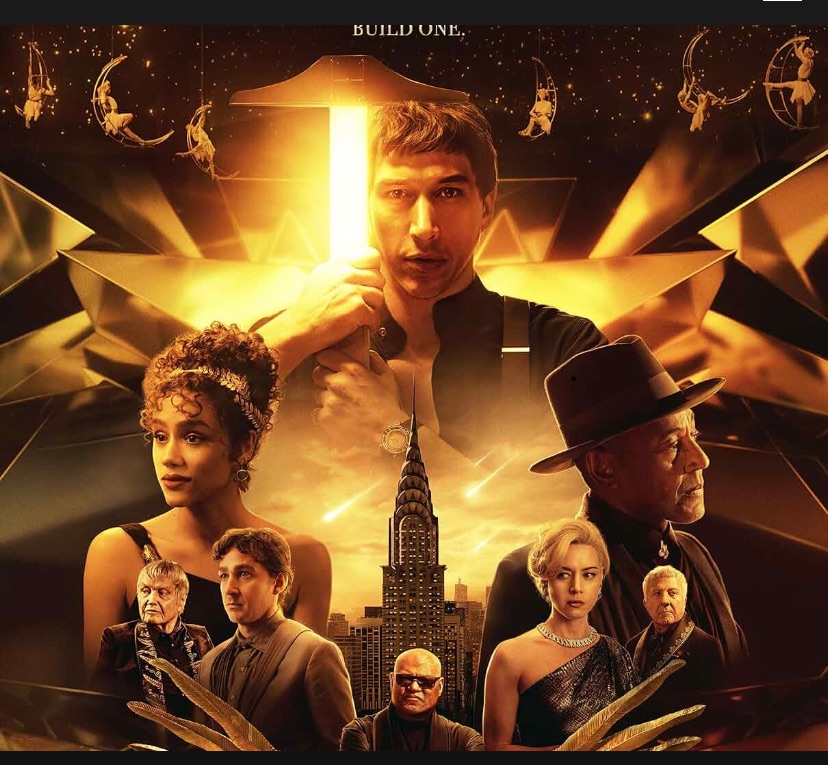
Yesterday I saw Coppola’s new and perhaps final film, Megalopolis, which is a rather surrealistic fable depicting the conflict between creativity and stagnation in a world of decadence and decline. It ends in a rather fanciful and/or hopeful conclusion, where creativity and progress apparently triumphs over our clinging to the past.

I was reminded of the film that has had a strong impact on me this year. Civil War depicts in realistic and down to earth terms a likely scenario should the USA descend once again into bloody conflict. In interviews, both the director and the actress Kirsten Dunst refer to Lee Miller, upon which her character is based, and the subject of the newly released Kate Winslet film, Lee She was a World War Two photographer who bore witness to some of the worst atrocities of that conflict.

I’ve come to believe that the likelihood of an election without violence and a peaceful transition of power is unlikely, no matter who wins, and the only thing you or I can do to alter events is to choose not to participate in the violence in word or deed. We must refuse to spread the hatred and fear being directed by so-called leaders, against the poor, the weak and the ‘others’ in order to advance a bid for supremacy and power. We must recognize the seeds of fascism that are being encouraged everyday, and deny them from taking root within us.

I’ll be driving up to Denver to take a flight to Cleveland to visit family on October 24th and will return to Santa Fe the day before the election. I wonder whether this trip will mark a rise or fall of the world we’ve known. Right now I’m not betting either way.

Barbie and Bella

It’s interesting that two of the most prominent films in the same year carry themes as ‘similar as ‘Barbie’ and ‘Poor Things’, while offering radically different and original approaches. Both are comedic fairytales that confront our common fantasies about female autonomy, while being directed toward different audiences and leaving us in different places.

Both films center on the theme of following a single character from a more or less one-dimensional state to the development of a self possessed personality. Both Bella and Barbie begin their journeys by learning how to walk. By the end one has achieved a state of dominance and autonomy, while the other is left more or less still at the beginning of the path.

‘Poor Things’ centers itself in the remarkable performances of its cast. (I was thrilled to see Hanna Schygulla as the elderly dowager that Bella encounters on the ship. I confess that she was my greatest screen crush in my younger years, and I’d recognize her smile anywhere.) This film dwells in an imaginary Victorian dreamworld, while dealing more forthrightly with intimate issues of control through sexual dominance and submission. The denouement is definitive and satisfying, while being entirely fanciful.

The central characters in ‘Barbie’ are actually the contemporary images and fantasies to which we’re exposed in consumer culture. Every scene saturates us with references to movies and television and advertising. Homages abound, from old MGM musicals to ‘The Matrix’. We move back and forth from imaginary ‘Barbieland’ to corporate and middle class Los Angeles, ensuring that even the most obtuse viewer is aware that it’s our own world being challenged. At the end of this movie the central character has only begun to face the real world, and we the audience are left exactly where we are.

It’s an opportunity to watch two stylistically different and excellent films approaching similar themes in the same year. ‘Poor Things’ reminds me of Terry Gillian’s ‘Brazil’, while ‘Barbie’ dwells more in the realm of Jean Luc Godard (if he were capable of doing a popular musical comedy).

Kerouac Mourns His Cat

I remember the oceans

the waters

the women

the moments filled with friends

every sin

I remember too much

I remember everything

mind twists the moments

Into tales

truth is no companion

no more room left here

for those left behind

loneliness rises like the tides

Can’t Get You Out Of My Head

Reflections On The Work Of Adam Curtis

Adam Curtis considers his films to be strictly journalism. 

Having unlimited access to the vast archives of the BBC library, Curtis snips and cuts the myriad fragments of visual history to arrange them around themes guided by his own narrative and analysis. To relegate these works to the narrow field of conventional reporting would be to entirely miss their import and effect. The subjects of his films dive deeply into the wilderness of inherent contradictions between reality and the artificial reproductions of reality, between fact and imagination, between linear narrative and memory, and the many ways we rearrange our perceptions of reality to serve our own agendas. His most recent work, the six part series titled Can’t Get You Out Of My Head focuses on the dialectic between historical and psychological forces that drive individuals into increased feelings of isolation and helplessness and the barriers to effective collective action.

The emotional power of well selected images poised in sharp juxtaposition has been  explored as long ago as in the montage techniques pioneered by early filmmakers like Sergei Eisenstein. The use of montage takes us out of the illusory realms of objectivity and well into the territory of ideological expression. Directors like Jean Luc Godard and the ‘underground’ filmmakers of the sixties made radical use of the technique to purposely challenge the conventions of narrative film. While their work was perceived at the time as radical, our immersion in the frenetic medium of television makes them appear prophetic. The rapid disorienting shift between scenarios, the intrusion of seemingly unrelated sequences in commercials and the use of sound as compliment and contrast has increased our ability to shift attention rapidly from one image to another without loosing the narrative thread. Adam Curtis takes advantage of the growing sophistication of our visual language while pushing the form further with each successive work, encouraging us to take larger leaps along with him.

(My favorite film makers of the sixties were the French New Wave’director Jean Luc Goddard and the English director, Nicholas Roeg. Being a contrarian by nature I was always thrilled at the premier of a Godard film on my college campus and particularly pleased when a third to half of the audience walked out in bewilderment or disgust. This I deemed an indication of the film’s success. Both Godard and Roeg used techniques of radical montage to pit direct and sometimes disjointed, emotionally charged images against the linear revelations of plot. Godard went the farthest, often rejecting the very structure of ‘beginning, middle and end’ in films like 2 Or 3 Things I Know About Her, Sympathy For The Devil and See You At Mao. Nicholas Roeg managed to corral these techniques into challenging narratives interrupted by out of synch and out of time sequences taking the viewer out of the linear present into realms of memory, imagination and pure emotion. His use of popular musical icons as actors in films like Performance and The Man Who Fell To Earth became immensely popular with the psychedelic generation. 

At least since 1992 with Pandora’s Box, followed by the more ambitious Century Of The Self and into the present Adam Curtis has employed montage with increasing ambition to deliver films that offer historical analysis along with imagery that comes across with devastating emotional impact. To Curtis the purpose of journalism is not merely to report, but to explain. His method is to distill and arrange out of the many sounds and images of a given historical period a presentation of coherent themes that persuade the viewer that his interpretation matches the reality. Journalism in this sense is the art of persuasion. 

Human beings are addicted to narrative. If presented with a random set of images our minds will eventually assemble them into stories. If we stare at a wall long enough our minds will weave narratives out of the imperfections in the paint. This is a key to the methods of psychological testing that is critiqued in much of Curtis’ work. Ironically perhaps, it’s the key to his own art and his approach to journalism. When the reporter in a war zone decides to point the lens of their camera they are continually selecting the elements of their own narrative. When Adam Curtis wades through the BBC archives the images he selects are made to fit the preconceived patterns of a story he wishes to tell. 

Episode four of his most recent work is titled ‘But what if the people are stupid.’ It’s primary theme is how our disillusionment with institutions born out of the emphasis on individualism in the sixties and seventies morphed into a retreat into nationalism in the eighties and nineties. Curtis pulls together accounts that range widely across the period, from the unsuccessful coup of the Gang Of Four in China to the somewhat tragic life of a transexual pioneer in England, the rise of Al Queda in Iraq, disappointment in the wake of the Live Aid effort and events that led to the crushing of protests in Tiananmen Square. All of these events are bracketed by accounts of psychological experiments carried on by Daniel Kahneman in the seventies leading to the thesis that people’s choices aren’t made primarily on a rational basis but are determined by their previous experiences and how they effect the deeper, mostly subconscious structures in the brain. By focusing on the personal dilemmas and contradictions faced by particular individuals against a backdrop of massive social movements Curtis dramatizes a specific and worldwide shift in our collective experience serving to frustrate our ability to organize coherent resistance to the growing power of elites. This sets us up for the next episode, ‘The Lordly Ones’, which explores the comforting national myths we construct to justify the blunders and atrocities carried out to maintain the rule of dominant capitalist elites over the rest of the world.

On the surface Curtis’ approach resembles that of an historian or archaeologist as much as that of a journalist. All are storytellers and agents of artifice, weaving our perceptions into coherent streams of interpretation and all deal with data fragments from moments gone by. The stories Adam Curtis chooses to tell center on the influence that modern psychology has  had on the manipulative techniques of advertising, the growth and dominance of consumerism, and most importantly the isolation of the individual in the shadow of the capitalist state, rendering concepts such as personal freedom and choice almost entirely irrelevant.

We’ve become helpless as collective societies to effectively act to change our circumstances. Instead, our every activity is measured, tabulated and arranged in predictive models that serve to anticipate and then to manipulate our behaviors. Human behavior has been programmed into machinery that uses algorithms to further the power and wealth of economic elites. Only by breaking free of the conceptual prison of the techno-capitalist state can we even begin to imagine a future that meets actual human needs.

Perhaps we expect that journalism and documentary gives us a more accurate glimpse of the real and the true. What we should have learned in an age of propaganda, ‘fake news’ and the Internet is that in the selection and manipulation of images just about any version of ‘reality’ can be made to appear as truth. In the view of Adam Curtis the true value of journalism is to ‘make sense’ of the world in new and original ways that evolve continually with our continual appetite for the new. This is the only way that we can cast off the oppressive chains of the past. We might do well to make his revolution our own.


Thoughtmaybe.com for access to a full catalogue of Adam Curtis Documentaries and many other worthwhile films.


An outstanding interview with Adam Curtis at: Jacobin.com

AN INVITATION

My Publishing Career

When I was in elementary school I was given for Christmas a small printing press  that could make stuff the size of business cards or raffle tickets. I started a number of membership organizations among my classmates that could be activated simply by asking for a card: ‘The Hoppity Hooper” Fan Club,’ ‘The Rocky and Bullwinkle Fan Club,’ and our final, three color masterpiece, a membership in ‘Camp Palumbo’ along with a small certificate of the official currency, the ‘Pazzuza.’ 

Later on my neighborhood friends and I, all bing in the same Boy Scout Troop, would take each issue of the Official Boy Scout Magazine paste in alternative headlines and captions cut out of other publications and turn Boys Life into what we thought was a hysterically funny parody inspired by Mad Magazine, a publication we really took seriously.   

In high school, myself and my high-minded friends published and repeatedly got in trouble for a series of independent journals printed via mimeograph machine and silk screen press at our local Peace Movement Offices. I continued this though college and after, until moving to Santa Fe, when I got a bit more seriously embedded in the writer’s world. 

In 1984, after attempting to convert reams of handwritten notes, poetry, short stories and essays into a publishable form into typewritten documents (a frustrating process) I took a class in the new Word Processing technology at the local community college. About midway through the course the teach came into class entranced by the release of the first Apple Macintosh computer. I don’t remember what he said but his trance was somehow infectious, and before the end of the year I’d acquired my own machine and the accompanying laser printer.

For a number of years I published articles and reviews in ‘The Journal for Humanistic Psychology,’ ‘Annals of The Earth’ and ‘Shaman’s Drum’ magazine. 911 happened. I was not particularly surprised that it happened but that didn’t make me less angry. So, I started a blog, called ‘The Arclist,’ which continued view email and website for the next 20 years. After the 2016 election the list pretty much was reduced with short headline introductions to various news and resistance links and very little else. Meanwhile the host site and software became contaminated and obsolete and harder to manage, until a couple of weeks ago I decided to abandon the list in email form and rethink the whole thing. 

I was diagnosed with cancer. This marked an opportunity to rethink everything. I went though my existing contact list and entered them into another email client service that I’d learned to navigate through as a business application. More up to date and flexible and easier to manage in creative ways, I’d like to take advantage of this by setting up a new version of the Arclist, more in the tradition of a Journal that accommodates creative ideas, creative projects and creative discussions between interested folks. I think we are all somewhat anxious to move beyond obsessive focus on the disasters of this past year and turn our attention to future possibilities. Perhaps this could provide an opportunity.

I have a list of names that I’ve gleaned from my contact list. Many of you were part of the previous mailing list or were listed as a ‘friend’ on my Facebook page. Some of you might have gone away for any number of reasons. Some of you may not wish to hear from me ever again. Before engaging the new list I want to send a formal invitation for you to respond, either positively of negatively, and I will then formally activate or delete your membership. If your answer is ‘YES,’ and I hope it is, I will begin sending out my creations, or forwarding others, on some semi-regular basis.

Meanwhile, I’ve attached to this invitation a sampling of the sort of stuff you might expect to receive on the New ARCLIST. Should you wish to subscribe and get the material on this site in our email just send a reply to remelcher@arclist.com, or leave a Reply at the bottom of this page.    


My Favorite Podcasts (Current) 12/13/20

Not included are podcasts I’ve favored In the past but I’m no longer following regularly (this American Life, Masters of Scale) or podcasts that were short form or serialized or no longer being produced (‘Studio 360,’ ‘The Ballad of Billy Balls’). By ‘current’ I only mean current, and this list will continue to shift from day to day as I get turned on to new podcasts.

History

Throughline

One of NPR’s Most Popular Daytime Shows, this hour long documentary style delves into all of the corners of history we are never/rarely taught in school. To fully understand the present events in the context of historical realities the show is unmatched. The two hosts are from first and second generation Iranian and Palestinian families, which may give a clue  to the unique depth of their approach to telling stories.

The United States of Anxiety

A little scary but enlightening as it focuses on the areas in American history that indicate the conflicts that have split the body politic from the beginnings of the USA.

This Day in Esoteric Political History

Somewhat oddly named, focusing each day on a single event (many of which I’d never heard of) at a particular moment in American History, a lively and educated discussion of the event’s historical environment and its influence and indications in the present.

Politics

Hacks On Tap

Political strategists from both sides of the ‘aisle’ toss around their critiques and projections about both parties. Anchored by David Axelrod (Democrat) and Mike Murphy (very ‘anti-Trump’ Republican), with a variety of chummy guests, the analysis is delivered with a good deal of humor and real ‘insider’ knowledge of how political campaigns actually work.

FiveThirtyEight

I’ve been listening to these guys since 2015. A relief from the general alarmist nature of political news and analysis. Sometimes a bit over-the-top ‘wonky,’ I favor 538 for a strictly data-based view of political realities balanced by a crew of mostly contrarians in one form or another. I simply like these guys. As I was about to write this review, unfortunately the departure of Clare Malone is a great loss. Relative newcomer Harry Bacon Junior has brought a similar contrarian sensibility and a much needed black perspective to the panel, Malone brought an equally important feminist and Midwestern (Ohio) perspective. 

The Ticket

One of the better interview shows from The Atlantic. Host Isaac Dovere chooses subjects that are generally slightly out of the mainstream news but closer to actual events. Always new information and insights.

The Axe Files

Long form, one hour interviews of a range of public figures, illuminating their biographies and focusing on their positions in regards to contemporary politics. David Axelrod, currently head of The U. Of Chicago School of Politics and once Obama’s chief campaign adviser, is relentless in his ability to get beyond easy rhetoric to the true nature and personality of his guests.

Amicus

A bit alarmist in the ‘Slate’ style this is the best way to keep up with the arguments, decisions and implications for the future of the Judicial branch of government.

Intelligence Squared

Both sides of every question, thoroughly and respectfully debated. Particularly helpful to those in the habit of considering the ‘other side’ to be totally without brains or merit. (Note: This applies only to arguments that actually apply when a et of common facts are agreed upon.) 

Reporting

The Daily

The New York Times, in its breadth and depth of coverage is still at the top of the media heap. This podcast offers a sampling every morning, with a single news story or interview and a short headline summary. On Sunday an archived ‘feature story’ is read in entirety. I highly recommend checking out the Dec. 6th edition: “The Social Life of Trees.” 

Global News Podcast – BBC

I start the day with this one, as the focus isn’t obsessively on America and it’s ridiculous politics, it’s coverage is delivered with an almost universally cheerful, or at least less apocalyptic stance. Given all of the ‘Brexit’ angst in Briton these days, I suppose several hundred years more of living history kind of levels out ones perspective on the present.

The New Yorker Radio Hour

I wasn’t sure just where to place this since the coverage is as much news as it is cultural commentary. I decided that since the coverage is essentially ‘journalistic’ in approach, this fits.

Business/Journalism

Pivot

Two of the most knowledgeable people on the fringes of Big Tech, Kara Swisher and Scott Galloway make a ‘perfect couple’ with their insights into current and future trends in business, investing and the politics around technical innovation and culture. Punctuated by personal banter and good natured kidding these two have been going at it for a couple of years of successful and popular podcasting. Swisher, the journalist, keeps things on track while almost cagily draws out brilliant insights from Scott, the NYU business professor and investor. Guests are featured with back and forth interviews by both Kara and Scott.

The Professor G Show

Scott Galloway’s own podcast (see above), where he calms down while proving himself a capable interviewer, while giving himself some time to deliver, John Oliver style, some incredibly insightful, critical, and sometimes inspiring ranting about ethics in politics and business.

Sway

Kara Swisher’s new interview show from The New York Times where she is featured as a regular Opinion columnist. The NYT is managing a very successful and profitable switch into the digital medium. Swisher is a digital candidate for the Maureen Dowd chair of journalism. Her interviews so far have included a diversity of subjects (from Dowd herself to Hillary Clinton to Jane Goodall).

Science

New Scientist Weekly

Friendly, British, delivered with a touch of humor, the most up-to-date international coverage of the scientific progress on Covid-19, and the latest questions and discoveries in scientific research.

Philosophy

Hi-Phi Nation

Philosophy revealed through contemporary storytelling and interviews that reveal in our present dilemmas their deep roots in philosophical discourse. A uniquely illuminating approach and my ‘great discovery’ of the month.

Into the Zone

An original approach to ideas and storytelling from novelist Haru Kunzru, who focuses on how ‘opposites’ shape our world. While founded in stories from the ‘real’ world Kunzru’s approach is delightfully filled with literary twists and turns and metaphor. I was turned on to him in an interview with ‘The Book Review’ podcast (see below).

Storytelling/Literature

The New Yorker Fiction

I’ve been listening to this podcast for more than 10 years. It’s one of my main links to the world of short fiction. A writer each month gets to choose one of their favorite stories from another writer in the archive and to read it out loud. Afterwards the author/reader discusses the story with Fiction Editor Deborah Treisman, focusing on how the story inspired and influenced them.

Imaginary Worlds

Being a heavily invested fantasy, sci-fi and comic book geek, how could I miss this one. ‘How we create Imaginary World and why we suspend our disbelief.  ‘Nuff said!

The Book Review

From the New York Times Book Review, but less intimidating. It features author interviews plus short discussions and reviews of some of the latest books out on the shelf.

Poetry Off The Shelf

A refreshing break into the dimensions of pure sound and word. Poems are read, interviews and analysis are delivered. A little Poetry Magazine online.

Humor

Beef and Dairy Podcast Network

I cannot really desgribe this to you. It’s British and hllarious. Every episode begins nearthe absurd nand then carries one beyond…

Mission To Zyxx

By now an old stand-by for fans of imprvisational humor, sci-fi and those with a need to fill the void between space-based intergalactic blockbusters.

To the Super Bowl

So, this evening (Monday, Feb. 3rd) the REAL Super Bowl begins. Now that all of the Impeachment drama is coming to a close and the football drama is over for a year and we’ve watched the most expensive commercials ever made, perhaps we can get down to business of moving forward.

For the year’s total anticlimax there’s the State of The Union embarrassment taking place tomorrow, in which the Donald will…who knows what the Donald will do or say? The best approach in dealing with our Asshole in Chief is to ignore him as much as possible and go forward with our lives, using our thoughts and imaginations to conjure more palatable futures.

Rush Limbaugh is dying of lung cancer. That’ll take some of the wind out of the sails blowing toward oblivion. While Senators bloviated, the biggest news this week is that the Thwaite Glacier is getting ready to drop and could quickly raise the ocean levels by up to 3 feet. The impending drop of what scientists have dubbed the ‘Doomsday Glacier’ will only be the first of many. There goes one civilization, to be replaced by necessity with another.

I’ve spent the past three years stewing in the juices of my own anger and it has gotten me nowhere. The daily disaster has driven me to forget that the best way to observe the ongoing bombardment and spectacle of news and information is to step as far back from the sheer noise and confusion as possible. The news of the ‘moment’ is mostly made to sell personality and product rather than offering much in the way of useful information. What happens in the moment isn’t as important as our collective mediated response to it. The Reality we perceive in this digital world is of necessity always second hand.

We are each in the business of assembling a world that corresponds to our own predilections. For myself I’ve chosen to accept information primarily through online digital conversations, rather than merely accepting what is ‘broadcast.’ Avoiding antiquated mediums like television and radio or newspaper, I seriously engage with information only after it’s been processed through trusted networks of intelligence and discrimination, carefully evaluating the materials with which to assemble my own picture of the world. I’m a subscriber to reality, mostly through print and podcasts, and an occasional glance at headlines from selected inputs on Apple News or Flipboard or the front pages of newspapers.

When I encounter, as in the laundromat, televised news formats in real time I’m conscious that what I’m receiving is an agenda that has more to do with commerce than truth. This stuff, including all forms of mass public broadcast, from out and out propaganda to public radio, is safe to consume only to the degree that one is aware that every broadcaster has their own agenda. Whatever presents itself as absolute truth is only ideology.

Everyone I know who merely consumes ‘The News’ on television or radio appears to be driven crazy by it.

As a consuming culture many Americans are being consumed by cynicism, doubt and despair. The world we’ve constructed in our minds is one in continual emergency, to which we must react without being given a trusted set of tools to react with. Too many of us are swimming and drowning in a pool of helplessness where new alarms are shouting every day, “Danger! Danger!” After years of daily bombardment we are shell shocked and numb, unable to pierce the fog that obscures the future. Christians and New Agers await the Apocalypse, white supremacists look forward to their ‘boogaloo,’ conspiracy fetishists obsess over every revelation while screwing themselves into increasingly paranoid fantasies, and the rest of us deal with a growing sense of apprehension and dread.

Meanwhile, the world trundles on within webs of mind boggling complexity and we are swept along in rushing rivers of karma and consequence. So easy to imagine that we are either victims, or else we are fighting a constant war for particular outcomes. So easy for me to spew words into the void like weapons, effecting only to increase the chaos instead of offering clarity or hope.

Well, it’s a new year and I’ve been mostly silent lately, after what has felt to me like constant struggle against overwhelming odds. It’s true that there is struggle. The need for change is obvious. The change that’s needed however, can only come about through a change of channels. I’ve been paying too much attention to the idiots waving the flags, and too little time spent in a world where human beings are meant to live, one that’s woven through our minds and our imaginations, where we tell each other stories and look at dire situations as problems to be solved. This is the only kind of world where we have a chance to live beyond our fears. It’s the only world where we can construct the necessary bonds that will hold this ship together.

Let’s try something different for a change.

In Defense Of The OSCARS

One of the most prominent features of OSCAR season is the sheer volume of snarky commentaries by everyone from the film snobs of academia and the New York media to the ideological ranting of political junkies on Crooked Media podcasts. Now, I admit I’m a film junky if there ever was one. I fell in love with film in High School and watching Jean Luc Godard movies in college. I’ve been to film festivals. I even helped to get a couple off the ground. I subscribe to MUBI. I live in one of the best little towns in the USA for viewing the full range of diversity in the world of film. I’ve rubbed shoulders with filmmakers and with the snarky elite and have myself been among the snarkiest.

Every year we read and listen to dozens of movie critics complaining about the terrible choices the Academy makes in terms of the ‘art’ of film. Traditionally, reviewers focus on how the nominees are chosen more on the basis of popular taste and promotional hype rather than on true and timeless artistic value. They point out that the awards are more a self-congratulatory celebration of the mainstream industry than a tribute to true quality. More glamour than grit.

Fair enough. The awards are after all a mainstream Hollywood event, and the voting is been done by predominantly male and mostly white industry insiders. The spectacle of wealthy Hollywood royalty in gowns and tuxedos frolicking on the carpet brings up for some a bit of class resentment. Yet, for anyone who enjoys the movies on almost any level the Oscars are like the Super Bowl. (It’s a long ceremony and I confess that I just watch the highlights on YouTube the next day.)

Notably in the past couple of years, and this year in particular the selections have been deliberately widened to include a bit more diversity. In the top categories are films directed by women and minorities, films including both spectacular Hollywood extravaganzas and more modest independent productions, films by old Hollywood hands and first timers, films about both gays and straights, and even that touch the edges of politically sensitive subjects.

But in the year of Trump, to venture into politically relevant waters is to open the doors for even greater explosions of criticism and pent up resentment directed against an industry that has done much to support and maintain a status quo that we’ve all grown uncomfortable with. The movies and television after all are the mirror and lens through which a culture sees itself these days and most of us are addicted to the screen in one form or another.

This is one of the years when I actually managed to see most of the films nominated for major Academy Awards (7 out of 9) and enjoyed all of them to various degrees. Of those nominated for Best Picture my personal favorites were ‘Dunkirk’ and ‘The Shape of Water.’ My favorite performance was Sally Hawkins in ‘The Shape of Water.’ This isn’t what I want to write about.

When I opened my ‘New Yorker’ app the day after the ceremony I came across what struck me as a bitter diatribe against the Oscars by their film critic, Richard Brody. I confess that I found it mostly appalling, and now It’s my turn to snark back. Brody’s essay to my mind appears to abandon an appreciation of the art and spectacle of film to replace art criticism with ideological rant. It struck me as little more than an ideological tantrum filled with invective and spite, perhaps triggered because the author’s choice of best film didn’t get the prize, or maybe it was just part of the collective hangover we all have after a year of Trump, looking for a convenient outlet for letting off steam.

To begin Brody goes after the winners for being ‘flashy’ and ‘showy’ and “flaunting design…and drama.” This represents to him “…the Academy’s brazen self-celebration of the old-school pomp of classic moviemaking, as well as the Academy’s general obliviousness to the moment.” I wonder exactly to what ‘moment’ he is referring, and what, beside ‘design and drama’ is the missing element by which we should judge these films. Movies, after all, are artifacts of design and drama that attempt to evoke feelings of empathy and emotion and maybe a little intellectual awakening. These are the elements of a visual medium that differentiates itself from unpolished ideological bluster. As a popular art form, like opera or theater, it avails itself of whatever formal means is at it’s disposal. Even a director like Godard, who attempted more than anyone to blend film and political discourse, understood that his audience comes to be entertained as well as enlightened. No matter how modest the production value or unpolished the performance, film is an inherently spectacular medium when seen in a theater where the lights are low and the figures on the screen are 15 feet tall.

In his next paragraph Brody credits the Academy for honoring those in the industry that have been subjected to sexual harassment and violence, and then criticizes the presentation for “…keeping the tone of the proceedings cheerful, optimistic, and, above all, commercial.” Then he dumps on Kumail Nanjiani’s “…exhortation of Hollywood professionals to pursue diversity not only because it’s the right thing to do but because it’s profitable to do so.” The real crime of Hollywood is “…the intersection of doing good while getting rich.” When reading this I thought of one of Sam Rockwell’s comments about being in a lot of ‘indie’ films and being happy to have been in one that people actually come to see.

So now we get to the nitty-gritty of Brody’s objections: Hollywood is corrupt because while it may tell some valuable stories, it makes money while doing so.

After praising Francis McDormand for her acceptance speech and tribute to women in the industry, he goes on to dump invective on the film she starred in, Three Billboards in Ebbing, Missouri, which he characterizes as “…cavalierly, brazenly racist, not because it depicts racists but because it treats the very subject of race and the political effect of race on black individuals as a mere backdrop for the personal growth of white characters.” Yes, the film was a drama about angry white people in Missouri, and black characters, although treated sympathetically, were marginal to the plot revolving around three white central characters. Is this now the criteria for ‘blatant’ racism in film? Have you ever been to a small town in the Ozarks?

Then he goes on to stomp on The Shape of Water, which won the Best Film Oscar.

“It’s a movie that struggles, by means of ludicrously and garishly overwrought decorative and narrative complications, to endorse an absolutely minimal baseline of recognition of the “other.” It’s exactly the sort of wan and impotent message of bland tolerance that gets Hollywood to join hands in a chorus of self-congratulation.”

This is to me exhibits a degree of obliviousness to the actual nature of the film medium that I find astonishing. Brody attacks the director, Guillermo del Toro, essentially for his style of addressing current social issues through allegory and fairytale, claiming that this adds a level of sentimentality that avoids the seriousness of real issues. The writer is so wrapped up in his ideological cocoon that he apparently isn’t able to actually see the film he’s watching. The ‘fairytale’ elements of this movie, instead of obscuring the issues, make them more universal and timeless. The ‘sixties’ in this film are a stylized version of the film images of that time, not of the ‘real’ sixties, and by juxtaposing romantic images of our film memories with characters and situations that would not then have been portrayed so plainly del Toro subtly ‘tricks’ us into a fresh way to view the present. And aren’t all movies in some sense ‘fairytale’ reconstructions of real life?

Of course to Mr. Brody this summons a vision of that ‘classic’ Hollywood filmmaking that he apparently abhors. This is a style that approaches its themes much like Opera, incorporating elements of fantasy, stylization and pure emotion in order to construct something that conveys universal feelings and values and stands up to time. He criticizes del Toro’s film for being a ‘surrogate’ version of Guess Who’s Coming to Dinner, which is somewhat ironic given that the movie on the top of his own ‘year’s best film’ list, Gordon Peele’s Get Out pays deliberate homage to that very film, portraying the situation of an interracial relationship, albeit with radically different consequences.

I saw Get Out and liked it. It was an outstanding film, particularly as a first film written and directed by director Gordon Peele. I didn’t think it was one of the best movies I’d seen all year, though I particularly liked the performance by actor Daniel Kaluuya. (I first saw him in the Fifteen Million Merits episode of the series, ‘Black Mirror,” one of the best things I’ve ever seen on the small screen.) “The predatory destructiveness of white people’s self-love for their good feelings…” may indeed be the subject of the film, as Brody claims, challenging white folks inherent sense of privilege and an inability to see the humanity in the “other,” but at the same time it avoids taking itself too seriously. I would also add that by the writer/directors own admission it’s an homage to the Hollywood tradition of Grade B horror films that he grew up with.

We come back to the problem of the movies themselves. “The history of Hollywood is, in part, a history of depredation, of abuse, yet the celebration of Hollywood’s traditions and the assertion of continuity between the classic era and today’s movies was on view in the ceremony from the outset…” Well, yeah. The history of Hollywood is also the history of the evolution of an art form and a mode of storytelling that involves whole communities of artists, technicians, promoters and business people. As with every business in America, there has been and continues to be abuse and injustice, the disenfranchised having to struggle for rights and representation, and its share of the good, the bad and the ugly. There has also been progress, not only in the world of film but in the world that it attempts to mirror.

Finally, Brody refers to the real root of all this resentment, which arises out of “the…shock of life under a depraved new Administration…” and what he perceives as Hollywood’s weak and misdirected response to the depredations that we all now face. Instead of making films that are a direct assault on all of America’s failings and injustices it continues to make movies with the intention of making money. “Ultimately, the self-deception that Hollywood fears most involves the box office, which dropped six per cent in 2017.” The “most frightening foe” for Hollywood, he claims, is Netflix.

True, the structure of the industry is being radically challenged. Streaming services are threatening the Multiplex and the mainstream theaters are seeing a decline in attendance for everything but the cgi blockbusters. At the same time more movies are being made than ever before on every scale and are being seen by many more people in many formats, both inside and outside of Hollywood. The long form of extended television series has given actors and directors a whole new narrative structure to explore. The transport and projection of movies is evolving exponentially. Some aspects of the business will fail and some will thrive, but the people who love and make movies are creative and resilient and what inspires them is a uniquely human endeavor, the telling of stories, and this will always endure.

So if the people who make the movies indulge in a little ‘brazen self-celebration’ in between telling our stories, and they try and entertain us in the process, I don’t begrudge them. Tomorrow a lot of them will get up early and start setting up the lights, the cameras and the magic.

Hollywood’s Brazen Self-Celebration at the 2018 Oscars

Winter Is Coming – Part One

More than a decade ago I published the following article on the Arclist and in the magazine “Annals of the Earth” that compared the fantasy narratives of Tolkien’s “Lord of the Rings” and George Martin’s “Song of Ice and Fire” which had just published it’s fourth volume and which I was advocating to my friends and associates at the time. This was long before anything was said about the series being made into a film. Martin’s imaginary world is dark and complex, without the clear definitions of good and evil presented in the worlds of Harry Potter and Frodo Baggins. It was in fact a pioneering work in the emerging genre of what was being called “adult fantasy” which meant that it has an uncomfortable resemblance to the actual world we inhabit.

Before television’s recent so-called ‘golden age’ and the rise of the cable series franchise a work that did justice to Martin’s expansive vision would have indeed been impossible. The success and emerging dominance of the extended narrative form has bridged the gap between the literary form of the novel and the realm of visual storytelling.

As much as I regarded George R. R. Martin’s work as the best in it’s genre I could not have anticipated the phenomenal success of the HBO series “Game of Thrones” based on, and now actually extending the cycle of narratives taking place in the Imaginary world of Westeros and lands to East. Not only has the series succeeded as the most ambitious cinematic production ever attempted for television, it has become a cultural meme that dominates whole sections of bookstores, is referred to in political and cultural commentaries and taken over vast sectors of Internet culture.

In the piece I wrote in 2005 my argument was that, as “Lord of the Rings” represented the ‘climactic’ work of an age dominated by literature and the rise of industrial technology. As a cinematic production it made more extensive use of digital technology than anything that came before and thus it marks the transition from a primarily mechanical/chemical/industrial process of filmmaking into an almost entirely electronic medium. “The Song of Ice and Fire” is a ‘formative’ work that announces the birth of a new ecology of consciousness and communication. It is produced entirely within the digital medium of television and not for theaters, so it represents a further step into a more intimate form of storytelling. I believe that my argument is supported by the immense popularity of this cultural artifact that crosses the generations from those of us raised by television onto the new denizens of a ‘digital’ age.

It will be enlightening to further explore the particular qualities that have elevated George R. R. Martin’s tale far beyond the boundaries of fantastic literature. To start with I’ll republish here, slightly edited for clarity, the original article entitled “Winter Is Coming.”

Meanwhile, there are weekly “Game of Thrones” parties everywhere.

_________________________________________________________________________
Begin forwarded message:

From: Ralph Melcher <melcher@nets.com>
Subject: [Arclist] Winter Is Coming
Date: November 1, 2005 at 8:35:09 PM MST
To: Arclist <Arclist@cybermesa.com>

I look forward this fall to the release of “A Feast For Crows,” the fourth book by George R. R. Martin in his cycle of medieval modern fantasy epics collectively titled “A Song of Ice and Fire.” Martin, perhaps immodestly, displays the same middle initials as J.R.R.Tolkien, while departing radically from Tolkien in his construction of a world based as much on history as on myth. (England’s “War of the Roses” provided inspiration for a tale of two battling royal families) Where Tolkien weaves an apocalyptic tale of a Manichaean clash between ultimate good and evil in which most of his characters appear more as classical archetypes than familiar people, Martin’s narrative proceeds through revelation of the evolving perceptions of a cast of very recognizable human characters. In Tolkien’s world every character’s move is the culmination of larger forces with origins deep in the mythical history to which he dedicated his creative life. As massive and ambitious as his popular masterpiece “The Lord of the Rings,” it was a small piece in a much larger and more ambitious tapestry that traced the mythical prehistory of humanity all the way back to the time of creation. George Martin’s intentions are modest in comparison, that is to tell a good yarn with engaging characters recognizable by modern readers. As different as these works appear, they each represent significant milestones in the evolution of a literary genre, as well as exposing the underlying foundations of the cultures out of which they emerge.

The cultural historian William Irwin Thompson, in his many explorations into cultural ecology, presents a critique of literature as cultural artifacts, in which there are three stages of that correspond to the unfolding of consciousness. The kinds of text that define particular stages in this model are the formative, dominant and climactic. “The formative work enters into a new ecological niche of consciousness through the work of solitary and shamanistic pioneers; the dominant work stabilizes the mentality through the work of an institutional elite; and the climactic work consummates and finishes the mentality for all time through the work of an individualistic genius.” (2)

Although Thompson cites James Joyce’s “Finnegan’s Wake” as most clearly epitomizing the climactic work of the (last) age, I would argue that Tolkien’s epic more clearly and definitively fills that niche for a number of reasons, not least of which is it’s spectacular success as a genuine artifact of mass culture. Tolkien lived and wrote his myth while witnessing the titanic struggles of a century defined by the rising power of technology and industrialization. In opposition to the dominance of machine culture he identified with attempts to maintain some vestige of traditional memory and culture. The author was clearly conscious of the scope of the intent to summarize an age. He states in a quote, cited by David Day, “I was from early days grieved by the poverty of my own beloved country (England): it had no stories of its own, not of the quality that I sought, and found in legends of other lands. There was Greek, and Celtic, and Romance, Germanic, Scandinavian, and Finnish; but nothing English, save impoverished chapbook stuff…I had in mind to make a body of more or less connected legend, ranging from the large and cosmogonic, to the level of romantic fairy-story…which I would dedicate simply to England; to my country.”(3)

David Day goes on to compare Tolkien’s undertaking as the equivalent of Homer first inventing Greek mythology single handedly before embarking on the “Illiad” and “Odyssey”. His argument is founded in a rather culture centric idea that England was the fount and seed carrier for much that reflected the transition from the medieval European world of moral absolutism to a transatlantic culture that worshiped progress and modernity. Tolkien’s work is reflected in it’s ambition by that of Richard Wagner’s “Ring Cycle,” which was a similar attempt to both crown and transcend the operative form. “The Lord of the Rings” is a text that depicts in markedly Christian terms the final battle between good and evil, in which an agrarian civilization faces down the rising power of the machine. After many heroic struggles humanity emerges forever transformed, while the ancient powers and principalities of an older time are either defeated or simply fade away. Tolkien both sums up the moral landscape of a pre-modern civilization while proclaiming its ultimate replacement by a new world order in which the heroic tribal quest ultimately leads to a new bourgeois world of trade and acquisition governed by new rules and individual initiative. At the end of the tale, the heroes disappear in the west while Merry and Sam and Pippin take up the settled life of the Shire.

What better characterization of the historical nature of the twentieth century, where ancient tribal mythologies mingled with the ascending powers of technocracy and fueled the rise of new orders and empires that clashed in climactic conflagrations that involved the entire civilized world? Ultimately, at the end of two massive wars the nation state was subdued by a new order embodied in globalized commerce and transnational communication, where the centers of power were continually challenged and then overtaken by explosive evolutionary forces generated near the boundaries of the known. At the the century’s transition a reaction has set in as people seek retreat in familiar rules and in texts of a world that is rapidly passing away. Tolkien’s fantasy wistfully recounts the passing of a time when the simple desire for comfort, family and the hearth, represented by the hobbits of the shire, was sufficient. The ‘War of the Ring’ represents nothing less than our collective passage into a new age and a new order where values must be forged anew with little assistance from the guardians of the past.

Tolkien’s work portrays in many ways the rise and final conflagration put forth in the Judeo-Christian paradigm of creation and apocalypse. His work that invents cultures, races and language echoes the birth and rise of nation states. As in the Christian mythos, all things proceed toward a final apocalypse that results in the ascension of the savior-king as ruler of a new order and at least a temporary peace governed by principals of honor, charity and love.

If, as Thompson proposes, the solitary and shamanistic explorations of Shakespeare’s “King Lear” and “The Tempest,” Cervantes’s “Don Quixote,” and Descartes’s “Discourse on Method,”(4) created the formative texts of the new mentality that replaced the medieval Mediterranean with the modern Atlantic cultural ecologies, then Tolkien’s “Lord of the Rings” surely fills the bill for “the work of an individualistic genius” which characterizes a climactic work that “consummates and finishes the mentality for all time.”  Interesting as well is the fact that Tolkien’s tale truly came into its’ own as a work that achieved mass popularity when it was turned into a movie; and not just any movie, but one that marked the transition from film as primarily an optical/mechanical artifact at the pinnacle of the industrial process, to the fully realized digital creation of total worlds out of the imagination.

George Martin’s novels can be seen in this light as a preliminary shamanic exploration into a new level of culture. Its’ structure owes more to television than to the classic film or novel. Martin began his career writing television scripts for popular shows like “The Twilight Zone” and “Outer Limits.” The importance of his background in television perhaps can be found in the quality of the epic feature film, where background is as much a character as the actors within the frame. Television, due to its intimacy as a virtual presence in the modern household as well as the size and shape of the screen (a limitation growing obsolete), has evolved around the close-up, or talking head. Television narratives are generally driven by a succession of character portraits which emphasize individual points-of-view, and which change rapidly from one to another in a sequence of abrupt cuts.

Martin similarly unfolds his epic tale in a sequence of intimate character sketches functioning like a sequence of various camera positions. Every chapter is named for a single character, and as the narrative proceeds our feeling for each character deepens with each mention of their name. The books could actually be read as a score of separate tales, each about separate characters, all woven together through a tapestry in time. In a sense, Martin’s story begins where Tolkien’s leaves off, in an age dominated by men, where evil and virtue are no longer the province of externalized forces embodied by magical beings, but carried in the heart and mind of every individual. One could say that “The Song of Ice and Fire” is a postmodern fantasy, where the battle between good and evil is played out in the choices each person makes in a moment of crisis based on their own unique perception of right and wrong. Yet, underlying the human drama and giving it ultimate shape is a much larger unfolding, determined not by good and evil, darkness and light, but by the immense and irrevocable powers of the natural world. The destinies of men are less a factor of their own moral virtue than the result of the ultimate relationship between society and the complex and inevitable cycles of summer and winter.

In the world of Westeros the timing of the seasons is unpredictable, every summer lasting more than a decade followed by an equally long cold winter. In a sense the summer fosters the powers of the day while winter brings forth the demons of the night. These cycles are long enough that generations forget the fact that all that is will inevitably change. The ultimate lesson to be learned is that the castles and kingdoms built by men are only as strong as their memories for, although the precise timing is unpredictable there are plenty of signs and warnings for those who can remember. It’s on this stage of the inevitable cycles of the natural world that the dramas and struggles of human society are waged, and we are made conscious that the quest for temporal power meets final judgment in the face of what is to come. If there is ultimate virtue it’s in the value people place on wisdom and long term vision over short term ambition and greed.

Two families epitomize the poles of this very human struggle. In the north are the Starks of Winterfell, whose family motto is “Winter is Coming.” Their demeanor is conservative, their colors white and grey, their values shaped by necessity and tradition. In the south, near the colorful fountains of trade and culture and civilization is the ‘Iron Throne.’ There dwells the Lannisters, hungry for wealth and power and jealous of all those who would challenge their rule over the lands of men. Within this tale the common order of classical heroic fantasy is followed more or less faithfully, as the outsiders in both families emerge as heroic figures in the story which unfolds. When the seasons begin to change, awakening long forgotten dangers out of the northern wastes, and as another force driven by fire and signaled by the rebirth of dragons rises in the south, one gets a sense that the synthesis of human aspirations with the seemingly implacable forces of transition can only be found by those less invested in things as they are.

As I look on at the absurd struggles raging across our lands in a time when a future filled with the present and looming crisis of war, pandemics, climate change, water shortage, overpopulation and the rest, I find the Stark motto, “Winter Is Coming,” to be a succinct characterization of the realities we collectively face in our world, as a species and a civilization. Many of us are outsiders with little at stake in the petty power struggles of politicians and our so-called leadership. We find ourselves in a shamanic role, as observers on the periphery of social events, living in a reality that challenges the assumptions of powers-that-be, transcending the narrow limits of an obsolete world-view. Tolkien’s magnificent epic leaves us with a challenge, to face the future as moral and responsible human beings, without the crutch of certainty provided by ancient texts and ancient prophecy. We are in a new world after all. George R. R. Martin offers a rather dire tale of the consequences of short sightedness while giving us hope that we may find a way, as we always have, through new leadership and pragmatic vision. Our constant temptation is to dwell on what we lack, and to be trapped in a struggle that keeps us bound to a world that is passing away. Our salvation lies not in belief but in clarity, and our faith must be found not in the past but in the future.

___________

1. Martin, George R. R. Martin’s cycle: A Song of Ice and Fire, includes: A Game of Thrones (1996), A Clash of Kings (1999), A Storm of Swords (2000) and A Feast for Crows (2005).

2. Thompson, William Irwin, Coming Into Being: Artifacts and Texts in the Evolution of Consciousness, St. Martin’s Press, 1996 (p. 233).

3. Day, David, Tolkien: The Illustrated Encyclopedia, Simon & Schuster, 1993.

4. Thompson, William Irwin, Coming Into Being. St. Martin’s Press, 1996 (p. 143).

#   #   #   #   #   #   #   #   #   #   #   #   #   #   #   #   #   #   #   #   #   #   #   #   #   #
You can’t stop the signal.
http://internet.cybermesa.com/~melcher/

Sent from my iPad