Starting Out (Pynchon as Parenthesis) Part One
“It’ll get easier. Someday it’ll all be done by machine. Information machines.” – Gravity’s Rainbow

I’m stranded in this Sargasso moment, awash above the blank pages in a sea of bewilderment, bordering too often on despair or at least demoralization, questioning who we are and what we are to do, placing words on screen or paper that appear too often useless. How can I meet the YouTube moment, while whole contraptions made out of outmoded words float like garish headlines against images appearing for short moments and then gone, while the world arranges itself around another passing crisis. What is it that endures against the nihilistic forces that stalk across the earth like a million metaphorical monsters, puncturing every dream and aspiration for no apparent purpose outside of the blind and momentary pleasure of watching things explode.

In my local community I’m like a ghost. What do I have to communicate besides brittle hope or the pain of loss? So much is lost to stupidity and greed. The question is, what remains?

I find some escape in the oceanic and ancient desert landscapes of this beautiful state as it flows past my car windows. I indulge in the exquisite paragraphs of my favorite writers, the best of them having been with me almost as long as I can remember.

I grew up in a post-war world of weekly air raid sirens and useless nuclear drills. I’d seen pictures of the bombs going off above Hiroshima and Nagasaki, and watched as ex Nazi Werner von Braun, on Disney, explained the nuclear reaction using ping pong balls and mousetraps. I endlessly fantasized about fallout shelters. My family drove past fields full of surplus tanks and obsolete aircraft on our way to church, all of this hardware useless in a war of total obliteration. I watched movies at Saturday matinees that featured mutant monsters wandering through the wreckage of civilizations. Most of my nightmares were of inescapable destruction.

The fathers of my generation gathered in VFW halls. They shared the fellowship of men and women who’d survived through a holocaust. They were often reluctant to reveal to their children any details of the horrors they’d encountered and survived. With fascination, we gleaned fragments and artifacts of memory from books and photographs. We watched television documentaries, roughly cut in black and white, narrated by Walter Cronkite or Edward R. Murrow, of battles and bombardments and ruined cities. There were the romanticized exploits in popular movies staring our favorite movie stars, portraying sacrifice, heroism and always victory. There were the morality plays of the TV westerns that dominated the evenings. As boys our favorite backyard fantasies featured plastic guns and makeshift arsenals. We retreated from history into our imaginations, and I guess it served as our defense against a backdrop of terror.

Amidst the doom and gloom and people taking themselves too seriously, there were other things to think about. Our childhoods, like every childhood, were filled with discovery and wonder. A fresh world of technological possibilities was opening all around us. Television itself was new. We launched ourselves into space, and the pace of ambition and invention was rapidly altering the landscape.

We thought about careers and success, and believed in times of growing tolerance and opportunities. Still, many of us found ourselves stranded in a marsh of questions and indecision. As the decades passed, we entered an extended interval of useless and dangerous conflict, of burning cities, assassination of our heroes, and a rising sense that civilization itself had an uncertain future. For those who stepped off the shores of safe and sound behavior, the plunge into unknown waters took a healthy sense of humor and a strong dose of aspiration, or at least enough momentum to move forward.

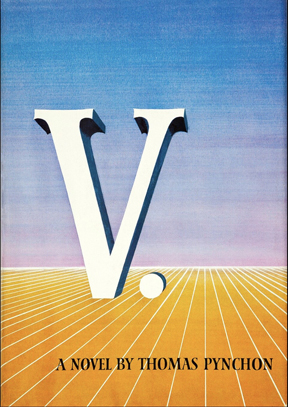
When I was 17 years old, I often wandered through the fiction racks in the downtown branch of the Carnegie library in my hometown, Cleveland. One day amid a display of the latest contemporary novels, I looked upon a thick and serious hardcover volume, with a single letter, V. , as its title. The letter stood monumental, upon a surrealistic plane of parallel lines converging toward a vanishing point, beneath an empty blue sky. In the foreground, in smaller letters below, the words proclaimed, A NOVEL BY THOMAS PYNCHON. Something about that image and title suited the world as I’d begun to see it, a mysterious and isolating landscape of endless searching and uncertainty. Like Pynchon’s characters in this, his first novel, my friends and I moved among bewildering scenarios with sensibilities that blended both hopefulness and paranoia. Like Pynchon’s Whole Sick Crew , we wandered amid the moral confusion that followed the chaos and tragedy of a World War. Underneath it all there lingered the frightening suspicion that everything that might have made sense to our parents was on the edge of coming apart.

Thomas Pynchon writes in the words of a prophet, a comedian, a poet of times of transition, when one world collapses into another, and people find themselves somewhat lost, seeking some kind of anchor in the tempest. His novels are mysteries. They take us, along with their sketchily drawn protagonists, to witness worlds both bizarre and familiar, packed with lush detail, profoundly beautiful and monstrously grotesque, full of both darkness and hilarity. His characters, as they search for patterns that might reveal some sense of ultimate purpose, skirt the edges of discovery, driven forward by circumstance, picking up messages and signs that hopefully provide clues, or at least an indication of direction. Each of his novels takes us through the beauty and violence of landscapes in a different period of history. We hang out with Benny Profane and Herbert Stencil in the 1950’s, with Oedipa Maas through the Los Angeles real estate boom of the 60’s, Tyrone Slothrop in the zones of Europe at the end of World War Two, Zoyd Wheeler navigating Reagan’s War On Drugs, Charles Mason and Jeremiah Dixon measuring the border that would split America against itself, and the world between spirit and reason in the 1700’s, the Chums Of Chance exploring the realms of fantasy and possibility at the 1893 Columbian Exhibition, flying ever forward toward the ‘War To End All Wars’. Thousands of characters make their appearances, however brief. The style is said to be encyclopedic, and it is, dealing not merely with characters and events, but with the sensibilities of every moment, where the mythical blends into the factual, the imaginative informs the real. He surveys the fleeting joys, horrors, and absurdities of all times. We shift among as many points of view as there are situations, and at times his people might even break into songs and poetry, even limericks, to change or illuminate the mood. Pynchon’s writing challenges and even breaks many of the conventions of prose, as if he’s daring us to trade in our box of expectations for a new sense of freedom.

There are dozens of essays and books written about and/or inspired by Pynchon, and as many interpretations of his work. I can offer my own, although it’s continually under revision. Like a trickster he challenges us to see through the patterns of history into worlds always in flux, driven as much by imagination as intent, old orders always collapsing while new ones arrive, never quite reaching a conclusion. We see humanity in a constant struggle between opposing urges of freedom and control, and beneath all the hopes, the curiosity and the paranoia, finding no final answer beyond the absolute mystery of beginnings and endings, and everything inbetween.

Pynchon is one of the most influential writers of his generation. He certainly influenced me. Through the years every one of his reviewers and readers has attempted to plumb the mysteries and meanings that thread through his voluminous work. The worlds he creates are both beautiful and monstrous, and each is a maze littered with both absurdity and wisdom. Pynchon himself is a cipher, almost never photographed and he’s never sat for an interview. As far as I know he’s never offered explanations outside of his work, thus leaving any conclusions fully to the reader.

My personal enjoyment is in his magnificent sentences, lush and long, often the length of a whole page or paragraph, exquisite and wanting to roll off the tongue, more like poetry than prose, or maybe something in between. They are filled with the beautiful, the mundane, the grotesque, the enigmatic and the profound, and the sheer adventure in reading them has gotten me through some very difficult times.

Here’s an example, from Against The Day.

Yashmeen’s white tall figure, parasol over her shoulder, already a ghost in full sunlight, went fading into the crowds flowing in and out through the trees between the quay and the Piazza Grande…

Plum and pomegranate trees were coming into flower, incandescently white and red. The last patches of snow had nearly departed the indigo shadows of south-facing stone walls, and sows and piglets ran oinking cheerfully in the muddy streets. Newly parental swallows were assaulting humans they considered intrusive. At a cafe off Katunska Ulica near the marketplace, Cyprian, sitting across a table from the cooing couple (whose chief distinction from pigeons, he reflected, must be that pigeons were more direct about shitting on one), at great personal effort keeping his expression free of annoyance, was visited by a Cosmic Revelation, dropping from the sky like pigeon shit, namely that Love, which people like Bevis and Jacintha no doubt imagined as a single Force at large in the world, was in fact more like the 333,000 or however many different forms of Brahma worshipped by the Hindus—the summation, at any given moment, of all the varied subgods of love that mortal millions of lovers, in limitless dance, happened to be devoting themselves to. Yes, and ever so much luck to them all.

February 22, 2025 at 6:09 AM

We aren’t helpless. All of what’s against us is part of what Naomi Klein calls ‘The Shock Doctrine’, and others call ‘Flooding The Zone’. The object is to bombard people with a sense of constant crisis, so that we become numbed, disoriented, confused and discouraged, and ultimately we loose focus and give in to despair.

A counter to this is embracing a wider vision, one that no longer perceives the world as if our particular national perspective is the only lens available. The world is changing rapidly and far too quickly for anyone to exert enduring dominance and control. We are watching the diminishing of outmoded institutions like the nation state and moving gradually (and painfully) toward a different alignment of the global order. Rather than hurling bombs and nukes back and forth, the economic and political universe, under the pressures of climate change and new technologies is rapidly reorganizing itself.

Resistance to the domination of any religion, ideology, or so-called ‘superpower’ is arising everywhere. In every nation and in every person, all of the old boundaries and alliances are being daily challenged.

We don’t have to be overwhelmed. The whole world is rapidly being forced awake. We must become attuned and direct our attention toward helpful and healing efforts going on in the world. Human beings are endlessly creative. Although we often struggle to open our vision to new worlds and a new order, we’ve never failed to see our way through.

We are no longer isolated. No one is. The world is one interwoven economic organism. Like the Internet, a vast and excellent living protoplasm, woven in networks, designed to reorganize and reroute itself around anything that blocks its way, anything that wounds or damages. Designed to defy apocalypse and to survive.

It has started. We’ve been attacked from within. Blood will be shed. Blood must be shed. That’s the price…the sacrifice. It will be the young on the streets and the old in their homes. The center will not hold, because we all dwell in the periphery. A new center will arise in each of us. The center and the whole will be the same.

Welcome to the Revolution. Welcome to the World.

Direct Cinema

‘Essential’, ‘Unforgettable’, ‘Body Horror Classic’, ‘Feminist Cult Classic’, ‘Dark Comedy’, are some of the quotes being thrown around about ‘The Substance’, a new film by Coralie Fargeat, starring Demi Moore. The best description I’ve seen is the line in the teaser from New York Magazine, “An enraged scream in cinematic form”. Having been released during the season of America’s self immolating election, ‘The Substance’ is a testament to society’s desire to go backwards into thin fantasy worlds created to protect us from looking at ourselves.

The film is relentless and brutal and without compromise. Many viewers may be repulsed, or even traumatized, although I question if anything on the screen matches the daily horror displayed on the evening news. The film juxtaposes the sleazy spectacle of Donald Trump style beauty pageants with explosions of rage that reminded me of the movie ‘Carrie’, as well as the tortured physical metaphors often portrayed in the films of David Cronenberg.

Blending horror and comedy in a surrealistic mix of ‘pumped up’ visual extremes we see in television commercials and popular magazines, ‘The Substance’ pushes up against cinema’s most powerful operatic limits. The intent is to forcibly shock the viewer awake. Its images are grotesque and direct, and anyone not altered in their presence is either unconscious or braindead.

In the face of extremes of hate and violence pushed by those who wish to rule and profit, the floodgates of truly political art have opened in the mainstream. Films like ‘Barbie’, ‘Women Talking’ and ‘Poor Things’ speak directly to the atrocities of female oppression. ‘The Substance’ is one of those, and it isn’t trying to be reasonable or gentle in a world where the spectacle of politics has taken us to the edges of absolute chaos.

During the drawn out, horrifying and over-the top final cataclysm in ‘The Substance’ there’s a close up shot of a terrified little girl covered in blood. She’s been dressed up to echo the exotic sexual fantasies paraded before her on the stage, and her face displays the full horror children witness everyday in a world trapped in its fantasies and dominated by its own irrational fears.

Civil Wars

I just finished the remarkable new book by Nancy Pelosi, The Art Of Power. It was on the one hand an inspiring first hand account of indomitable courage and determination in the face of difficult odds and a history of the major political struggles I’ve witnessed since 1987. On the other hand it’s an account of a time of civility in politics and government that has frayed and all but collapsed since the rise of Trump.

I feel both pessimistic and useless in the face of what’s coming. I now find myself reading books about the lead up to wars; Eric Larson’s The Demon of Unrest, about the five months preceding the first American Civil War, and The Proud Tower, by Barbara’s Tuchman, about Europe and America before World War One. Each marked the necessary transition from one state of civilization to the next. I find that reading history helps me out of a state of helpless depression, perhaps it helps me to accept that what’s likely to happen has happened before.

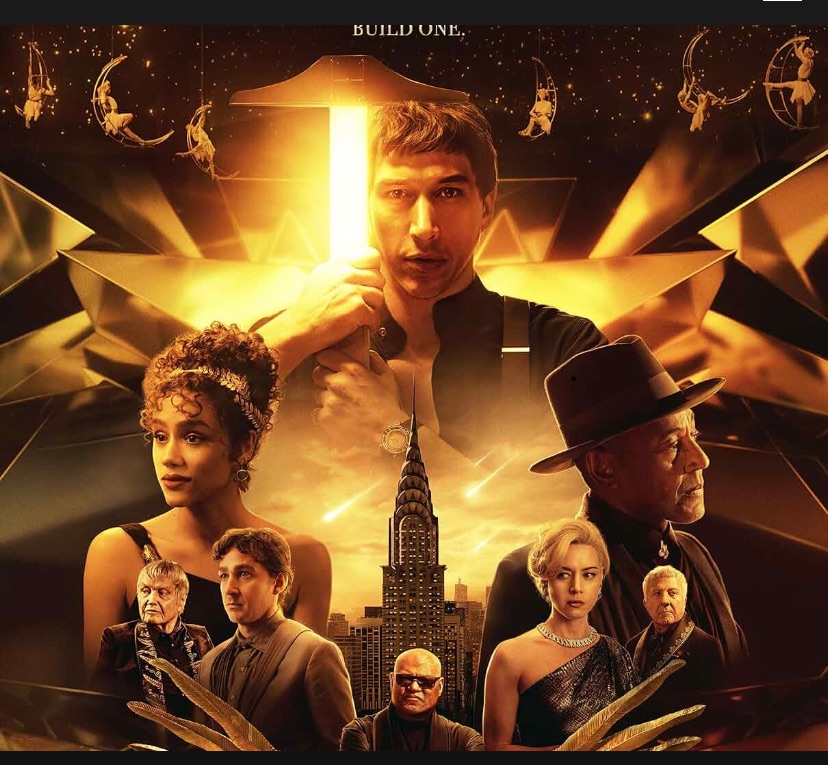
Yesterday I saw Coppola’s new and perhaps final film, Megalopolis, which is a rather surrealistic fable depicting the conflict between creativity and stagnation in a world of decadence and decline. It ends in a rather fanciful and/or hopeful conclusion, where creativity and progress apparently triumphs over our clinging to the past.

I was reminded of the film that has had a strong impact on me this year. Civil War depicts in realistic and down to earth terms a likely scenario should the USA descend once again into bloody conflict. In interviews, both the director and the actress Kirsten Dunst refer to Lee Miller, upon which her character is based, and the subject of the newly released Kate Winslet film, Lee She was a World War Two photographer who bore witness to some of the worst atrocities of that conflict.

I’ve come to believe that the likelihood of an election without violence and a peaceful transition of power is unlikely, no matter who wins, and the only thing you or I can do to alter events is to choose not to participate in the violence in word or deed. We must refuse to spread the hatred and fear being directed by so-called leaders, against the poor, the weak and the ‘others’ in order to advance a bid for supremacy and power. We must recognize the seeds of fascism that are being encouraged everyday, and deny them from taking root within us.

I’ll be driving up to Denver to take a flight to Cleveland to visit family on October 24th and will return to Santa Fe the day before the election. I wonder whether this trip will mark a rise or fall of the world we’ve known. Right now I’m not betting either way.

Barbie and Bella

It’s interesting that two of the most prominent films in the same year carry themes as ‘similar as ‘Barbie’ and ‘Poor Things’, while offering radically different and original approaches. Both are comedic fairytales that confront our common fantasies about female autonomy, while being directed toward different audiences and leaving us in different places.

Both films center on the theme of following a single character from a more or less one-dimensional state to the development of a self possessed personality. Both Bella and Barbie begin their journeys by learning how to walk. By the end one has achieved a state of dominance and autonomy, while the other is left more or less still at the beginning of the path.

‘Poor Things’ centers itself in the remarkable performances of its cast. (I was thrilled to see Hanna Schygulla as the elderly dowager that Bella encounters on the ship. I confess that she was my greatest screen crush in my younger years, and I’d recognize her smile anywhere.) This film dwells in an imaginary Victorian dreamworld, while dealing more forthrightly with intimate issues of control through sexual dominance and submission. The denouement is definitive and satisfying, while being entirely fanciful.

The central characters in ‘Barbie’ are actually the contemporary images and fantasies to which we’re exposed in consumer culture. Every scene saturates us with references to movies and television and advertising. Homages abound, from old MGM musicals to ‘The Matrix’. We move back and forth from imaginary ‘Barbieland’ to corporate and middle class Los Angeles, ensuring that even the most obtuse viewer is aware that it’s our own world being challenged. At the end of this movie the central character has only begun to face the real world, and we the audience are left exactly where we are.

It’s an opportunity to watch two stylistically different and excellent films approaching similar themes in the same year. ‘Poor Things’ reminds me of Terry Gillian’s ‘Brazil’, while ‘Barbie’ dwells more in the realm of Jean Luc Godard (if he were capable of doing a popular musical comedy).

Things Fall Apart

‘The Morning Show’ on Apple TV is the best and most pertinent political drama I’ve watched since Aaron Sorkin’s ‘The West Wing’. Both deal with power in the hands of people presented as ordinary human beings. Sorkin’s drama was of a different time and climate. It expressed the lingering idealism of the baby boomer generation. In a later show, ‘The Newsroom’, Sorkin explored the confluence of politics and media. As in ‘The West Wing there’s the sense of an omniscient moral order, watched over by benign patriarchal authorities, represented by Jeff Daniels and Sam Waterston, that invariably delivers on the side of truth and Justice (Law and Order).

‘The Morning Show’ is a product of another century, when that very authority is under question and uncertainty reigns in the shadows of every institution. Its political and interpersonal machinations are at least as complex as those in another show of the era, ‘Succession’. Both deal with issues of power and authority, but ‘Succession’ takes a more comedic approach, while ‘The Morning Show’ more aggressively and tragically addresses the real world.

In ‘Succession’ the patriarch and his entourage are portrayed as fools, inhabiting an environment of almost cartoonishly excessive wealth and power. This is not a place where people have jobs, it’s where they have ‘positions’ somewhere within the arcane mazes of control. It’s a world drenched in male ego, where both men and women thrive and survive only by ruthlessly manipulating each other to gain the approval of the king. It’s ultimately a game of abject surrender, in which a gaggle of fools gambol just at the boundaries where comedy and tragedy meet. In the end nothing in that world has substantially changed, and we go home satisfied that everyone pretty much got served what they deserve.

Inspired by the real life sexual abuse scandals that emerged during the MeToo scandals that lead to the fall of power brokers at Fox News, ‘The Morning Show’ doesn’t hold back in aggressively challenging the power of the king and the patriarchy. It takes the path of tragedy, in which the hubris and foolishness of each player is met with individual consequences.

‘The Morning Show’ is about struggle and a heroic journey toward redemption. Every character is brought to the edge of a precipitous fall, and is severely tested with the choice between pure survival and risking everything for the pursuit of clarity. As in classic tragedy a sacrifice of innocence is required in order to bring down the king. No one emerges unscathed.

At the end of the first season we’ve witnessed the inevitable fall, and are left with a little grief mixed with a sense of possibilities. The show leaves us with a hopeful motto, ‘sic semper tyrannies’, which translates, ‘thus always to tyrants’.

photo by Gabriel Melcher

Halas

In the afternoons, following a day grappling with my high school insecurities, I’d stroll down the street from school to visit my friend Bill Halas at his home. Sometimes I’d bike over there in the evenings. Bill’s mother accepted me as an addition to a household that once included a husband and five older siblings. She and Bill, the latecomer, were both avid cooks and gardeners and active readers, sharing sophisticated tastes in music and art. Bill’s father passed away when he was very young, and when I met him his older siblings had long departed the household. Having an extraordinarily precocious and active mind his life had taken a rather solitary trajectory, his mother being the most reliable companion and sometimes his intellectual adversary. My own teenaged life was made unusual by the experience of being recruited for a special government program that took poor kids with high IQ’s out of their normal milieu and sent them to spend the summer living on college campuses. Our friendship flourished. Together we navigated the complexities of a rapidly changing world in the late 60’s, our bond growing from a shared sense of alienation and a drive for mutual discovery.

We met amidst a shifting cultural landscape with war, race riots, and assassinations unfolding in real time on our television screens. Popular culture was shifting radically from the segregated milieu of radio and the movies. Grasping for alternatives, we immersed ourselves in diverse music genres, from jazz to classical to experimental, and engaged in earnest discussions on philosophy and politics. We wandered the city smoking cigarettes rolled with pipe tobacco. We agreed and disagreed on everything. Sometimes we took his mother’s little Honda on road trips across the northern Ohio countryside, making up poetry inspired by highway signs (‘Pass With Care’).

I was the idealist and Bill was the purist, who took everything down to its roots. When I first met him he was experimenting with hydroponics. When he became interested in weaving he built his own loom and wove his own cloth and made his own hats. When he took up photography he began by studying its history, then building his own pinhole camera. Finally, he took up his brother’s old Nikon and developed the photos in his dad’s basement darkroom. My own nature was less grounded, tending toward the pursuit of imaginative utopian speculation and obscure strains of idealistic thinking. I felt compelled to understand the whole of everything, and very path I took led me down side roads, making it difficult to pursue a single course or become a model student.

Bill’s political awareness was way ahead of my own. He travelled to Chicago with his brother in 1968 to demonstrate at the Democratic convention and brought back photos and first hand accounts from the fringes of the police riot that we’d all watched on television. Later in our high school career we conspired with like minded friends to create an alternative journal that we mimeographed at the local anti-war office. We passed out leaflets and marched in circles chanting slogans in downtown Cleveland and attended meetings of a small radical organization led by a retired teacher and veteran of the Lincoln Brigade who fought in the Spanish Civil War.

888

Our friendship endured beyond high school as we pursued separate paths in college, delving into alternative communities and exploring the back-to-the-land movement. Bill’s quest for self-sufficiency and my search for spiritual revelation led us on distinct journeys. During those years in the early seventies everything everywhere was in flux and was being questioned, and for both of us the quest took us out of the proscribed path of college and career.

After we’d both left school we got together for a road trip east, tracking down old classmates and exploring alternative possibilities. We proceeded to Boston, where we met a friend of Bill on a sidewalk near Harvard Square. A large expansive figure closely resembling the British actor Peter Ustinov (with a beard), he sold carnations on the street, playing a concertina and disarming prospective customers with a performance that came right out of magical fairytales. We spent that evening at his lodgings in the attic of an unheated and condemned three story house in Roxbury. The next morning we crawled out of our sleeping bags to get breakfast at a nearby cafe. Our appetite for squalor satiated, we made our way out of the city and headed back to the Midwest.

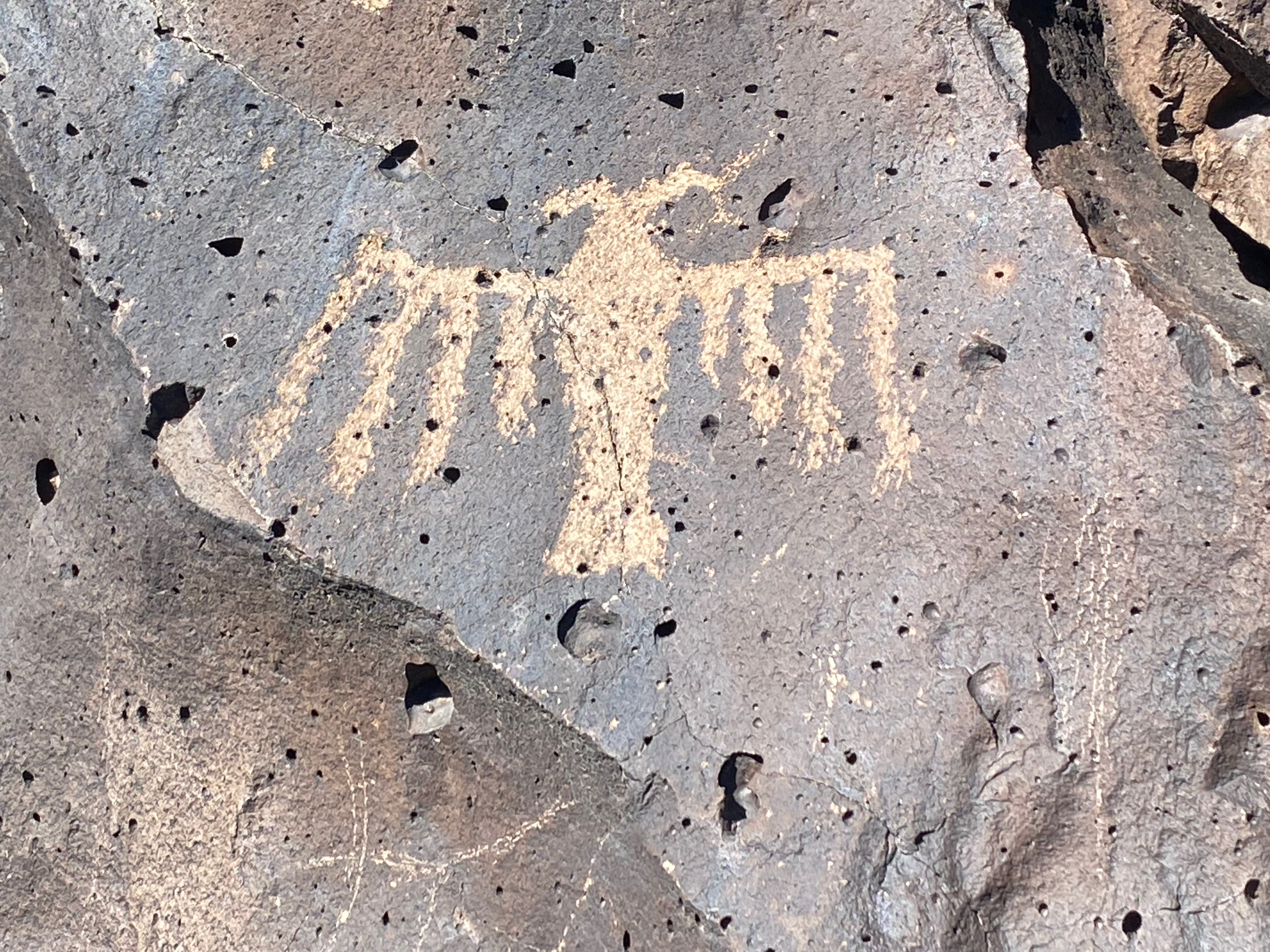
Eventually, after making a long pilgrimage to the West I moved to Denver. Occasionally, while visiting my family back east I’d get together with Bill and he’d demonstrate for me whatever new endeavor had absorbed his interest. Over time these became increasingly esoteric even for my taste, involving dowsing and ley lines evidence for antedeluvian alien carvings left behind in rocks and boulders. He poured over old maps illustrating the mysterious energetic pathways determining the placing of streets and structures in small towns all over Ohio.

Our contacts dwindled over the years, and the last I heard from Bill was through letters filled with further interpretations of ancient artifacts and faces found in the rocks. I’d heard he was in contact with the Edgar Cayce people in Virginia and intended to build his own private settlement on a plot of land that his brother owned in Vermont. After at a year of hearing nothing I found out from his mother that he’d fallen out of communication with everyone. In a last message to his older brother, Bill had mentioned spotting a brown bear on the plot of land. After months of trying to track down his whereabouts the family concluded that he’d disappeared without a trace. For the sake of closure they accepted that he’d probably been eaten by the bear.

I don’t know what really happened to Bill Halas. All I’m sure of is that

All I know is that we shared a moment in time, embarking on uncompromising journeys, determined to face the mysteries of the world, whether in the rocks, the forest, or the primal currents beneath.”

Peter Zeihan As Clickbait

I was recently sent the recent Peter Zeihan book, The End Of The World Is Just The Beginning: Mapping The Collapse Of Globalization. Upon reading it I feel compelled to offer my critique. Aside from the rather dismissive and generally smart-ass style with which the author delivers his doom prophecies, the book is very informative in terms of outlining the complex systems and their interrelationships that currently run the world, and it offers valuable pointers toward highlighting the system’s strengths and weaknesses. At the same time it’s a vivid illustration of the trap of over reliance on statistical data when addressing complex systems. I’ve rarely encountered an argument that rests on so many facts that work against the very case that the book is making. Not only is it full of contradictory and sometimes questionable assumptions, the data that backs the world view the author delivers could equally support the likelihood of continued globalization as it can for its dissolution.

The fulcrum of Ziehan’s argument hangs on two assumptions:

1.) Aging populations and declining birth rates will result in a worldwide demographic collapse that will upset the patterns of production, distribution and consumption that fueled the economic boom times since World War Two.

A 1968 best seller by Paul and Anne Ehrlich,The Population Bomb delivered, in a similarly apocalyptic tone, a revival of the 18th century theory by Thomas Malthus, that the growth of population with the rise of prosperity, particularly among the poor, would inevitably exceed humanity’s ability to grow enough food. While Zeihan’s argument runs exactly in the opposite direction, both prognostications rely on a set of ever-shifting statistics to make their case.1 Food production since the time of Malthus has continually outpaced the growth of population. Problems with global starvation and famine are due less to population increase than to the unplanned consequences of war and the inequitable distribution.

Over the course of my many decades of living on the planet under the constant threat of extinction, I’ve been presented with so many predictions of impending catastrophe that I’ve lost count. From the Rapture to nuclear war to DDT and Y2K and global anarchy, the predictable constant is that in times of anxiety and change these prognostications sell books and provide rich fodder for talk radio. Attempts to reduce enormously complex systems to fit into the terms of one or two basic assumptions invariably fail to meet anyone’s predictive timescales. Demographics are one single factor among countless others that can affect outcomes, leaving aside our ever shifting politics and human resourcefullness, our ever advancing technologies affecting the ways we live and work and talk to one another, and our dawning collective awareness of the effects of climate change, to name a few.

2.) Zeihan’s second assumption is that the American Empire will simply give up on the world ‘Order’ that it has helped establish and maintain since the World Wars. Apparently America will simply conclude that it’s simply too much trouble and expense to continue enforcing the peace and we’ll withdraw into our geopolitical fortress. After all, we’re geographically in a position to grow our own food and make our own shit and let the rest of the world go to hell. Aside from espousing an incredibly arrogant, if not popular view of American exceptionalism, the very fact that our economic prosperity has been fostered by our multicultural ties and the intricate trade and military relationships we’ve constructed over these many decades makes it extremely unlikely that we will or can turn away. Even if we attempted such a thing, undoubtedly other entities or alliances would take our place, and we’d be shuffled a little lower in the deck of international authority.

Which brings us to China2. Having read and listened to a number of accounts from inside China. (I highly recommend the ‘Drum Tower’ podcast from ‘The Economist’ magazine for a more down to earth view of Chinese politics and culture.3) Zeihan spares no opportunity to dump on China, leaving an impression that its the very model of his overall thesis that most of the rest of the world is doomed in economic terms, while the USA and North America will pull through rather nicely. In reality, for anyone that takes a closer look through the paranoid cloud of American propaganda, it appears that China’s problems, both economic and demographic, are practically a mirror image of similar problems being felt in both America and Europe. In many cases the realities in China (the biggest crisis right now is too few opportunities for young people – not too many) are largely distinguished by the fact that, unlike the USA they are actually able to quickly respond in dealing with them. China ain’t going anywhere, and neither is America, or Europe, except perhaps in the fevered ‘click bait’ imagination of people like Zeihan. These major blocks of world power are so inextricably interdependent that the likelihood of any of them being left behind in the foreseeable future is vanishingly small.

For several years I was on the mailing list of ‘STRATFOR’, the organization that Peter Zeihan once worked for. Like Zeihan they have a world view that sticks closely to the ‘geography is fate’ interpretation of world history promoted by conservative scholars like the very prolific Robert Johnson (‘Modern Times’, ‘The Birth Of The Modern’, and histories of America, the Jews, Christianity, Ireland, plus biographies of Churchill, Jesus, Darwin, George Washington and others – a few of which I’ve read and been impressed by.). I agree that, so far, global history has been largely determined by access to the oceans. From the conquest of the great ‘pirate’ empires of the 15th – 16th centuries right up to the rise of ‘globalization’, this view has been accurate. However, we are all now swimming in a different ocean, one that’s linked by the instantaneous communication and management of economics and resources through the ubiquitous ocean of digital media. This is now where business is driven, wars are made, alliances are formed and broken.

I remember Stratfor’s frequent skepticism that Europe could ever manage to hold together. Virtually none of their predictions have held true over the years. The recent Soviet invasion has catalyzed an opposite movement toward increased solidarity rather than further fragmentation. America, meanwhile, is showing increasing signs of weakness as it breaks into regional conflicts and rising paranoia. It has made it almost impossible for the nation to deal substantially with basic problems like poverty, endemic racism and rising political violence. Meanwhile China not only holds together, it exerts increasing global influence as it steps into the weakening breach of American influence in Africa, South America and the Middle East.

Every nation is an ongoing experiment in how to manage growth and change in an increasingly complex web of global relations. Not one gots it completely right or completely wrong, and every error is an opportunity to learn. Peter Zeihan grossly underestimates, in my opinion, the capabilities, creativity and ingenuity of people in general, especially anyone who isn’t living in North America. Unfortunately, in much of his writing I hear echoes of the Trump crowd, mindlessly shouting USA!!!USA!!!USA!!!

The proposition that America will withdraw from the world in some form of neo-isolationism is one that nearly every fact and trend sighted in Zeihan’s book actually makes less, rather than more likely. His theory of collapse, requires a kind of bunker mentality in which every nation stands essentially on its own and only the strongest will thrive or even survive.

History doesn’t tend to move backwards, and the sort of decivilization that Zeihan predicts, in a world as interdependent as the world he describes, no nation, especially one as central to the function of the whole intricate mechanism as the United States, can afford to go its separate way. America’s economy, as much as China’s or England’s or Argentina’s or the Philippines’ or Russia’s, is a ‘global’ economy. Oceans and hemispheres that once divided the world into separate kingdoms and empires are no longer effective barriers against the changes that affect us all.

No one can deny that there will be profound disruptions that will reshape the political, military and economic landscapes in the coming decades. To anyone paying attention, it’s evident that our modes of consumption and governance will be forced to adapt and evolve in ways that we only dimly imagine. We will face wars, famine, pandemics, climate events, natural disasters and shortages of things we’ve taken for granted. Every political entity will be confronted with its own contradictions. In the long run the question is whether these changes and challenges drive us, as global citizens, further apart or force us to recognize our absolute interdependence. Zeihan’s book assumes the former. I don’t necessarily disagree with his statement, “Shortage forces people – forces countries – to look after their own needs.” I would add that history also shows that in the face of shortages and disasters people, and perhaps nations, also awaken to their common needs.

(I have to add that Zeihan’s understanding of global agriculture is particularly weak. Statements like “You can have organic farming or environmentally friendly foods. You cannot have both”, are simply absurd. It’s been demonstrated again and again, in China and America and all over the globe, that the per hectare production of food grown using intensive sustainable methods on smaller scale farms generally exceeds that of the industrialized monoculture farming promoted worldwide and dominated by corporate culture, while leading to much less long term environmental devastation.)

The kind of hair-on-fire apocalyptic messaging delivered by Zeihan and others certainly sells books. Apocalyptic visions have aleways had an appeal in the popular imagination, and are guaranteed to gather attention from Joe Rogan audiences, talk radio hosts, and down various YouTube rabbit holes. The ‘paranoid style of American politics’ 4 has always had particular appeal in uncertain times, when folks are stirred up by the direction things are going.

As for American exceptionalism, that’s so much a refrain in Peter Zeihan’s view of the world, I’m reminded of the Sergio Leone quote:

“I began to understand that ‘America’ in reality belonged to the whole world and not just to Americans. The idea of America had already been invented by the philosophers, the vagabonds, the dispersed of this earth, long before the Spanish ships got there. Those whom we call Americans have only rented it for a time. If they behave badly, we can discover another ‘America’. The contract can be canceled at any time.”

  1. https://worldaffairs.blog/2022/07/09/debunking-peter-zeihans-shocking-and-popular-china-predictions/
  2. https://www.nextbigfuture.com/2023/01/here-is-what-peter-zeihan-got-wrong-on-the-joe-rogan-show.html
  3. Linkhttps://pca.st/podcast/21f082b0-377d-013b-efb0-0acc26574db2
  4. https://harpers.org/archive/1964/11/the-paranoid-style-in-american-politics/

Kerouac Mourns His Cat

I remember the oceans

the waters

the women

the moments filled with friends

every sin

I remember too much

I remember everything

mind twists the moments

Into tales

truth is no companion

no more room left here

for those left behind

loneliness rises like the tides

Trial

I just imbibed two healthy pints of Scotch Ale, a small handful of psychedelic mushrooms and a chunk of potent marijuana brownie…while printing 32 greeting cards so that I can replenish my rack at the grocery store and contribute to my gasoline fund for future trips into the present.

I’m hoping that some combination of the above will somehow blast me out of a sense of helplessness in the face of all the craziness and suffering, although I know it’s not really my responsibility and that I’ve done my part to advance this whole contraption…

I’ve been watching VICE NEWS documentaries looking into the darkest corners of the world, watching ‘Severance’ and ‘The Man Who Fell To Earth’, reading a Jonathan Franzen novel about a Christian youth group and reliving so many moments in the deep past in order to write about them, and writing about them, and wondering if this voluntary isolation from all the world matters anything at all.

I can only bear witness:

“This happened…this is what I felt.”