America In The Squeeze

Guns versus smartphones

I’m just turning 75. My life has been formed, and is almost completed, throughout a breathtakingly brief and cataclysmic era in global history. In future accounts it may be referred to as ‘The Neoliberal Era’, ‘The Era Of American Hegemony’, ‘The Age Of Economic Globalization’, or perhaps, as the cataclysm intensifies toward its resolution, ‘Capitalism’s Final Crisis’. There will be a few references to something called ‘The American Empire’. It will appear as a flicker between the centuries, and one of the shortest lived empires that ever endured.

We are at the beginning of a 2nd American Revolution, one that is long due. Whatever the outcome, it will radically reshape the outcomes for global civilization. The age of the nation state is gradually going out of phase with the needs of the physical world. There will be times of breakdown and struggle. We must reintegrate with the workd. This will take some time and will never be at an end. I believe that in the next phase there will still be nations, and languages and cultural boundaries. The dimensions of power will be altered in structure and better managed, through education and the cultivation of respect. The flows of the twin rivers will be, at least until the next glacial scale disruption, in better harmony, as each distinctive part realizes its necessity to the whole.

Technology presents new perceptual models of the world much faster than anything we can control or even keep up with. We are continually confused. The time has arrived for us all to take a deep dive into questioning who we are and who we want to be, and what are the ultimate stakes. Complacency is deadly. We’d been so long buried in our own work, forgetting our reasons for working, or what makes up the whole mechanism of our survival.

We generally see and enterpret the word ’revolution’ to refer to specific cataclysmic changes in the procession of historical events. To understand what moves these events it’s necessary to go beyond specific dates and times and logistical patterns, and embrace the flowing evolutionary trends, ever constant, ever shifting, beneath the surface of what we see.

There are two constant revolutions/evolutions going on at any given historical moment. One is economic, and the other is cultural. They are woven together in close procession, at times in harmony, and at other times they appear to flow in opposing directions. The economic evolution is by nature conservative, its primary focus to preserve stability. Economics is a measure of the river of things, the movement of necessities and the produce of our desires.

Cultural evolution is something broader and more ephemeral, and yet central to our sense of well being. Something within us is driven by an impulse to break the rules, to advance, and to enter new territories. We are curious and inspired. Culture is the river of our perceptions. They are sometimes clear and accurate, and at other times only marginally connected to the world beneath the fog.

These twin streams never stop moving, never stop changing. They are inseparably linked, either energizing or obstructing each other, acting over and through us like the ancient gods in Greek tales about siblings and rivals.

It’s becoming abundantly and existentially clear to much of humanity that survival depends on a true understanding of the role we play as part of a bigger organism. Globalization is the political term for an economic transition. We go from centralized industrial production to widely distributed supply chains stretching across oceans and continents. At its essence, this is like the early evolution of the cell. A number of independent organisms come together as a cooperative community and eventually merge into a single complex organism. A process called symbioses.

Along with economic revolutions, cultural revolutions advance at an unprecedented rate, driven by the tides of information that flow through the system, reshaping at every instance our perception of the world.

We are currently engaged in a third world war, which is a new kind of war, fought with numbers and ideas and conceptual systems playing across screens. The handheld weapon in this war is the smartphone in our pockets.

Things are moving very fast, worldwide…one event or action leads to others. People find out who their allies are. They’re encouraged to become more boldly resistant. A major university resists a government takeover. Prominent financial managers begin speaking out. Republican Town Meetings get rowdy. People, in general, are educating themselves. All of this builds toward an ultimate breakdown of life as usual.

Kilmer Abrego Garcia, like George Floyd before him, like Alfred Dreyfus long before all of this (see ‘Dreyfus Affair), is an unfortunate victim of history. On April 19th, demonstrations, even more enormous than on the 5th, will expand the focus beyond Musk and Trump to embrace and defend Garcia, and his young family, and ourselves, against the fascist brutality that landed him in a living hell.

Trump and company are waiting for an opportunity to gin up excuses to go after dissenters, with fierce repression, just as they did during the George Floyd era. Just like then, only more so, there’s an international reaction to their policies and cruelties, and they now feel cornered.

The American economy is now riding in the back of a cybertruck, under the control of the madman we gave the wheel, heading toward a Thelma and Louise denouement. I fully expect that we will go over that cliff, taking a good chunk of the world with us.

There is, at present, a very thin line standing between democracy and fascism in America, and the next few weeks will determine whether that line is holding. I’m talking about the Law, the Courts and the the Universities.

The 5th Estate, the Press and the Media are barely functional, not even willing, for the most part (except comedians), to call out fascism by its real name (they use the academic term, ‘authoritarianism’ – it’s elite and vague and sounds less threatening).

Social Media has taken up the slack of what remains of democracy and free speech, performing the role that pamphleteering did between the first American Revolution and the Civil War. I find myself no longer getting my news and analysis directly from newspapers or television, and the marketplace of ideas is boundless and international. This is a completely different realm of media, with a whole new set of rules, evolving constantly, that govern behavior and trust.

The vessel of our freedom is still encapsulated in words and institutions inspired and put into action more than two centuries past. If these barriers are breached, we will be in a new state of civil war. At that point another line of defense comes into play. There’s the police, the national guard, the military, led by educated commanders who’ve taken pledges to defend the Constitution and the law. These are forces composed of people from communities most affected by the actions of this administration. We will be in unknown territory.

We are in a Squeeze.

America will survive. The world will survive. The relationships between us all will be radically altered. We will have been through a deep process of self examination. Perhaps for the first time since the last World War, since FDR and long after, we will be forced into revisioning our entire political and economic culture.

My generation won’t be around to witness the conclusion of that process. But we will have been privileged to see its beginning, and to have learned much on the ride along the way.
February 22, 2025 at 6:09 AM

We aren’t helpless. All of what’s against us is part of what Naomi Klein calls ‘The Shock Doctrine’, and others call ‘Flooding The Zone’. The object is to bombard people with a sense of constant crisis, so that we become numbed, disoriented, confused and discouraged, and ultimately we loose focus and give in to despair.

A counter to this is embracing a wider vision, one that no longer perceives the world as if our particular national perspective is the only lens available. The world is changing rapidly and far too quickly for anyone to exert enduring dominance and control. We are watching the diminishing of outmoded institutions like the nation state and moving gradually (and painfully) toward a different alignment of the global order. Rather than hurling bombs and nukes back and forth, the economic and political universe, under the pressures of climate change and new technologies is rapidly reorganizing itself.

Resistance to the domination of any religion, ideology, or so-called ‘superpower’ is arising everywhere. In every nation and in every person, all of the old boundaries and alliances are being daily challenged.

We don’t have to be overwhelmed. The whole world is rapidly being forced awake. We must become attuned and direct our attention toward helpful and healing efforts going on in the world. Human beings are endlessly creative. Although we often struggle to open our vision to new worlds and a new order, we’ve never failed to see our way through.

We are no longer isolated. No one is. The world is one interwoven economic organism. Like the Internet, a vast and excellent living protoplasm, woven in networks, designed to reorganize and reroute itself around anything that blocks its way, anything that wounds or damages. Designed to defy apocalypse and to survive.

It has started. We’ve been attacked from within. Blood will be shed. Blood must be shed. That’s the price…the sacrifice. It will be the young on the streets and the old in their homes. The center will not hold, because we all dwell in the periphery. A new center will arise in each of us. The center and the whole will be the same.

Welcome to the Revolution. Welcome to the World.

Peter Zeihan As Clickbait

I was recently sent the recent Peter Zeihan book, The End Of The World Is Just The Beginning: Mapping The Collapse Of Globalization. Upon reading it I feel compelled to offer my critique. Aside from the rather dismissive and generally smart-ass style with which the author delivers his doom prophecies, the book is very informative in terms of outlining the complex systems and their interrelationships that currently run the world, and it offers valuable pointers toward highlighting the system’s strengths and weaknesses. At the same time it’s a vivid illustration of the trap of over reliance on statistical data when addressing complex systems. I’ve rarely encountered an argument that rests on so many facts that work against the very case that the book is making. Not only is it full of contradictory and sometimes questionable assumptions, the data that backs the world view the author delivers could equally support the likelihood of continued globalization as it can for its dissolution.

The fulcrum of Ziehan’s argument hangs on two assumptions:

1.) Aging populations and declining birth rates will result in a worldwide demographic collapse that will upset the patterns of production, distribution and consumption that fueled the economic boom times since World War Two.

A 1968 best seller by Paul and Anne Ehrlich,The Population Bomb delivered, in a similarly apocalyptic tone, a revival of the 18th century theory by Thomas Malthus, that the growth of population with the rise of prosperity, particularly among the poor, would inevitably exceed humanity’s ability to grow enough food. While Zeihan’s argument runs exactly in the opposite direction, both prognostications rely on a set of ever-shifting statistics to make their case.1 Food production since the time of Malthus has continually outpaced the growth of population. Problems with global starvation and famine are due less to population increase than to the unplanned consequences of war and the inequitable distribution.

Over the course of my many decades of living on the planet under the constant threat of extinction, I’ve been presented with so many predictions of impending catastrophe that I’ve lost count. From the Rapture to nuclear war to DDT and Y2K and global anarchy, the predictable constant is that in times of anxiety and change these prognostications sell books and provide rich fodder for talk radio. Attempts to reduce enormously complex systems to fit into the terms of one or two basic assumptions invariably fail to meet anyone’s predictive timescales. Demographics are one single factor among countless others that can affect outcomes, leaving aside our ever shifting politics and human resourcefullness, our ever advancing technologies affecting the ways we live and work and talk to one another, and our dawning collective awareness of the effects of climate change, to name a few.

2.) Zeihan’s second assumption is that the American Empire will simply give up on the world ‘Order’ that it has helped establish and maintain since the World Wars. Apparently America will simply conclude that it’s simply too much trouble and expense to continue enforcing the peace and we’ll withdraw into our geopolitical fortress. After all, we’re geographically in a position to grow our own food and make our own shit and let the rest of the world go to hell. Aside from espousing an incredibly arrogant, if not popular view of American exceptionalism, the very fact that our economic prosperity has been fostered by our multicultural ties and the intricate trade and military relationships we’ve constructed over these many decades makes it extremely unlikely that we will or can turn away. Even if we attempted such a thing, undoubtedly other entities or alliances would take our place, and we’d be shuffled a little lower in the deck of international authority.

Which brings us to China2. Having read and listened to a number of accounts from inside China. (I highly recommend the ‘Drum Tower’ podcast from ‘The Economist’ magazine for a more down to earth view of Chinese politics and culture.3) Zeihan spares no opportunity to dump on China, leaving an impression that its the very model of his overall thesis that most of the rest of the world is doomed in economic terms, while the USA and North America will pull through rather nicely. In reality, for anyone that takes a closer look through the paranoid cloud of American propaganda, it appears that China’s problems, both economic and demographic, are practically a mirror image of similar problems being felt in both America and Europe. In many cases the realities in China (the biggest crisis right now is too few opportunities for young people – not too many) are largely distinguished by the fact that, unlike the USA they are actually able to quickly respond in dealing with them. China ain’t going anywhere, and neither is America, or Europe, except perhaps in the fevered ‘click bait’ imagination of people like Zeihan. These major blocks of world power are so inextricably interdependent that the likelihood of any of them being left behind in the foreseeable future is vanishingly small.

For several years I was on the mailing list of ‘STRATFOR’, the organization that Peter Zeihan once worked for. Like Zeihan they have a world view that sticks closely to the ‘geography is fate’ interpretation of world history promoted by conservative scholars like the very prolific Robert Johnson (‘Modern Times’, ‘The Birth Of The Modern’, and histories of America, the Jews, Christianity, Ireland, plus biographies of Churchill, Jesus, Darwin, George Washington and others – a few of which I’ve read and been impressed by.). I agree that, so far, global history has been largely determined by access to the oceans. From the conquest of the great ‘pirate’ empires of the 15th – 16th centuries right up to the rise of ‘globalization’, this view has been accurate. However, we are all now swimming in a different ocean, one that’s linked by the instantaneous communication and management of economics and resources through the ubiquitous ocean of digital media. This is now where business is driven, wars are made, alliances are formed and broken.

I remember Stratfor’s frequent skepticism that Europe could ever manage to hold together. Virtually none of their predictions have held true over the years. The recent Soviet invasion has catalyzed an opposite movement toward increased solidarity rather than further fragmentation. America, meanwhile, is showing increasing signs of weakness as it breaks into regional conflicts and rising paranoia. It has made it almost impossible for the nation to deal substantially with basic problems like poverty, endemic racism and rising political violence. Meanwhile China not only holds together, it exerts increasing global influence as it steps into the weakening breach of American influence in Africa, South America and the Middle East.

Every nation is an ongoing experiment in how to manage growth and change in an increasingly complex web of global relations. Not one gots it completely right or completely wrong, and every error is an opportunity to learn. Peter Zeihan grossly underestimates, in my opinion, the capabilities, creativity and ingenuity of people in general, especially anyone who isn’t living in North America. Unfortunately, in much of his writing I hear echoes of the Trump crowd, mindlessly shouting USA!!!USA!!!USA!!!

The proposition that America will withdraw from the world in some form of neo-isolationism is one that nearly every fact and trend sighted in Zeihan’s book actually makes less, rather than more likely. His theory of collapse, requires a kind of bunker mentality in which every nation stands essentially on its own and only the strongest will thrive or even survive.

History doesn’t tend to move backwards, and the sort of decivilization that Zeihan predicts, in a world as interdependent as the world he describes, no nation, especially one as central to the function of the whole intricate mechanism as the United States, can afford to go its separate way. America’s economy, as much as China’s or England’s or Argentina’s or the Philippines’ or Russia’s, is a ‘global’ economy. Oceans and hemispheres that once divided the world into separate kingdoms and empires are no longer effective barriers against the changes that affect us all.

No one can deny that there will be profound disruptions that will reshape the political, military and economic landscapes in the coming decades. To anyone paying attention, it’s evident that our modes of consumption and governance will be forced to adapt and evolve in ways that we only dimly imagine. We will face wars, famine, pandemics, climate events, natural disasters and shortages of things we’ve taken for granted. Every political entity will be confronted with its own contradictions. In the long run the question is whether these changes and challenges drive us, as global citizens, further apart or force us to recognize our absolute interdependence. Zeihan’s book assumes the former. I don’t necessarily disagree with his statement, “Shortage forces people – forces countries – to look after their own needs.” I would add that history also shows that in the face of shortages and disasters people, and perhaps nations, also awaken to their common needs.

(I have to add that Zeihan’s understanding of global agriculture is particularly weak. Statements like “You can have organic farming or environmentally friendly foods. You cannot have both”, are simply absurd. It’s been demonstrated again and again, in China and America and all over the globe, that the per hectare production of food grown using intensive sustainable methods on smaller scale farms generally exceeds that of the industrialized monoculture farming promoted worldwide and dominated by corporate culture, while leading to much less long term environmental devastation.)

The kind of hair-on-fire apocalyptic messaging delivered by Zeihan and others certainly sells books. Apocalyptic visions have aleways had an appeal in the popular imagination, and are guaranteed to gather attention from Joe Rogan audiences, talk radio hosts, and down various YouTube rabbit holes. The ‘paranoid style of American politics’ 4 has always had particular appeal in uncertain times, when folks are stirred up by the direction things are going.

As for American exceptionalism, that’s so much a refrain in Peter Zeihan’s view of the world, I’m reminded of the Sergio Leone quote:

“I began to understand that ‘America’ in reality belonged to the whole world and not just to Americans. The idea of America had already been invented by the philosophers, the vagabonds, the dispersed of this earth, long before the Spanish ships got there. Those whom we call Americans have only rented it for a time. If they behave badly, we can discover another ‘America’. The contract can be canceled at any time.”

  1. https://worldaffairs.blog/2022/07/09/debunking-peter-zeihans-shocking-and-popular-china-predictions/
  2. https://www.nextbigfuture.com/2023/01/here-is-what-peter-zeihan-got-wrong-on-the-joe-rogan-show.html
  3. Linkhttps://pca.st/podcast/21f082b0-377d-013b-efb0-0acc26574db2
  4. https://harpers.org/archive/1964/11/the-paranoid-style-in-american-politics/

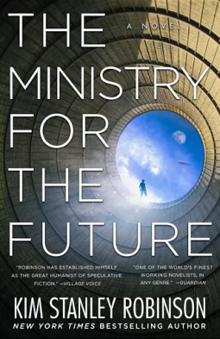
The Ministry For The Future – A Review

The Ministry For The Future
by Kim Stanley Robinson

Kim Stanley Robinson’s ‘The Ministry For The Future’ is much more than a novel. It’s a book on Revolution, the closest thing to an ecological manifesto I’ve ever read. As a work of fiction it’s even more ambitious than his much acclaimed ‘Mars’ trilogy, which could be seen as an early preparation for this book. Like the Mars books it unveils a complex weave of systems embracing every aspect from molecular biology and atmospheric science to human psychology to political and economic philosophy.

But ‘Ministry’ has no interplanetary or futuristic disguise. This is a book about the present and the immediate future of our civilization, specifically projected over the next 30 years. There are chapters on ecology, economics, geology, political philosophy, environmental devastation, human exploitation, mass extinction and geoengineering. There are chapters addressing all forms of resistance and revolution and the inevitable dismantling of capitalism through systemic collapse, civil disobedience, sabotage and assassination. Central to everything is informed speculation on the likely consequences of climate change and the forces that have already been set in motion.

The future is a puzzle and we need a framework in order to make coherent sense of our daily diet of news in the present. The philosopher Slavoj Zizek once said, “It is easier for us to imagine the end of the world than to imagine the end of capitalism.” At a time when such visioning becomes increasingly urgent, Robinson’s novel is a bold attempt to see our way to the other side of disaster.

Perhaps not since Karl Marx has there been such a bold and compressed dissection and set of proposals for the total reorganization of society toward a sustainable future.

The Ministry For The Future

A Conversation with KIM STANLEY ROBINSON: