America In The Squeeze

Guns versus smartphones

I’m just turning 75. My life has been formed, and is almost completed, throughout a breathtakingly brief and cataclysmic era in global history. In future accounts it may be referred to as ‘The Neoliberal Era’, ‘The Era Of American Hegemony’, ‘The Age Of Economic Globalization’, or perhaps, as the cataclysm intensifies toward its resolution, ‘Capitalism’s Final Crisis’. There will be a few references to something called ‘The American Empire’. It will appear as a flicker between the centuries, and one of the shortest lived empires that ever endured.

We are at the beginning of a 2nd American Revolution, one that is long due. Whatever the outcome, it will radically reshape the outcomes for global civilization. The age of the nation state is gradually going out of phase with the needs of the physical world. There will be times of breakdown and struggle. We must reintegrate with the workd. This will take some time and will never be at an end. I believe that in the next phase there will still be nations, and languages and cultural boundaries. The dimensions of power will be altered in structure and better managed, through education and the cultivation of respect. The flows of the twin rivers will be, at least until the next glacial scale disruption, in better harmony, as each distinctive part realizes its necessity to the whole.

Technology presents new perceptual models of the world much faster than anything we can control or even keep up with. We are continually confused. The time has arrived for us all to take a deep dive into questioning who we are and who we want to be, and what are the ultimate stakes. Complacency is deadly. We’d been so long buried in our own work, forgetting our reasons for working, or what makes up the whole mechanism of our survival.

We generally see and enterpret the word ’revolution’ to refer to specific cataclysmic changes in the procession of historical events. To understand what moves these events it’s necessary to go beyond specific dates and times and logistical patterns, and embrace the flowing evolutionary trends, ever constant, ever shifting, beneath the surface of what we see.

There are two constant revolutions/evolutions going on at any given historical moment. One is economic, and the other is cultural. They are woven together in close procession, at times in harmony, and at other times they appear to flow in opposing directions. The economic evolution is by nature conservative, its primary focus to preserve stability. Economics is a measure of the river of things, the movement of necessities and the produce of our desires.

Cultural evolution is something broader and more ephemeral, and yet central to our sense of well being. Something within us is driven by an impulse to break the rules, to advance, and to enter new territories. We are curious and inspired. Culture is the river of our perceptions. They are sometimes clear and accurate, and at other times only marginally connected to the world beneath the fog.

These twin streams never stop moving, never stop changing. They are inseparably linked, either energizing or obstructing each other, acting over and through us like the ancient gods in Greek tales about siblings and rivals.

It’s becoming abundantly and existentially clear to much of humanity that survival depends on a true understanding of the role we play as part of a bigger organism. Globalization is the political term for an economic transition. We go from centralized industrial production to widely distributed supply chains stretching across oceans and continents. At its essence, this is like the early evolution of the cell. A number of independent organisms come together as a cooperative community and eventually merge into a single complex organism. A process called symbioses.

Along with economic revolutions, cultural revolutions advance at an unprecedented rate, driven by the tides of information that flow through the system, reshaping at every instance our perception of the world.

We are currently engaged in a third world war, which is a new kind of war, fought with numbers and ideas and conceptual systems playing across screens. The handheld weapon in this war is the smartphone in our pockets.

Things are moving very fast, worldwide…one event or action leads to others. People find out who their allies are. They’re encouraged to become more boldly resistant. A major university resists a government takeover. Prominent financial managers begin speaking out. Republican Town Meetings get rowdy. People, in general, are educating themselves. All of this builds toward an ultimate breakdown of life as usual.

Kilmer Abrego Garcia, like George Floyd before him, like Alfred Dreyfus long before all of this (see ‘Dreyfus Affair), is an unfortunate victim of history. On April 19th, demonstrations, even more enormous than on the 5th, will expand the focus beyond Musk and Trump to embrace and defend Garcia, and his young family, and ourselves, against the fascist brutality that landed him in a living hell.

Trump and company are waiting for an opportunity to gin up excuses to go after dissenters, with fierce repression, just as they did during the George Floyd era. Just like then, only more so, there’s an international reaction to their policies and cruelties, and they now feel cornered.

The American economy is now riding in the back of a cybertruck, under the control of the madman we gave the wheel, heading toward a Thelma and Louise denouement. I fully expect that we will go over that cliff, taking a good chunk of the world with us.

There is, at present, a very thin line standing between democracy and fascism in America, and the next few weeks will determine whether that line is holding. I’m talking about the Law, the Courts and the the Universities.

The 5th Estate, the Press and the Media are barely functional, not even willing, for the most part (except comedians), to call out fascism by its real name (they use the academic term, ‘authoritarianism’ – it’s elite and vague and sounds less threatening).

Social Media has taken up the slack of what remains of democracy and free speech, performing the role that pamphleteering did between the first American Revolution and the Civil War. I find myself no longer getting my news and analysis directly from newspapers or television, and the marketplace of ideas is boundless and international. This is a completely different realm of media, with a whole new set of rules, evolving constantly, that govern behavior and trust.

The vessel of our freedom is still encapsulated in words and institutions inspired and put into action more than two centuries past. If these barriers are breached, we will be in a new state of civil war. At that point another line of defense comes into play. There’s the police, the national guard, the military, led by educated commanders who’ve taken pledges to defend the Constitution and the law. These are forces composed of people from communities most affected by the actions of this administration. We will be in unknown territory.

We are in a Squeeze.

America will survive. The world will survive. The relationships between us all will be radically altered. We will have been through a deep process of self examination. Perhaps for the first time since the last World War, since FDR and long after, we will be forced into revisioning our entire political and economic culture.

My generation won’t be around to witness the conclusion of that process. But we will have been privileged to see its beginning, and to have learned much on the ride along the way.

Halas

In the afternoons, following a day grappling with my high school insecurities, I’d stroll down the street from school to visit my friend Bill Halas at his home. Sometimes I’d bike over there in the evenings. Bill’s mother accepted me as an addition to a household that once included a husband and five older siblings. She and Bill, the latecomer, were both avid cooks and gardeners and active readers, sharing sophisticated tastes in music and art. Bill’s father passed away when he was very young, and when I met him his older siblings had long departed the household. Having an extraordinarily precocious and active mind his life had taken a rather solitary trajectory, his mother being the most reliable companion and sometimes his intellectual adversary. My own teenaged life was made unusual by the experience of being recruited for a special government program that took poor kids with high IQ’s out of their normal milieu and sent them to spend the summer living on college campuses. Our friendship flourished. Together we navigated the complexities of a rapidly changing world in the late 60’s, our bond growing from a shared sense of alienation and a drive for mutual discovery.

We met amidst a shifting cultural landscape with war, race riots, and assassinations unfolding in real time on our television screens. Popular culture was shifting radically from the segregated milieu of radio and the movies. Grasping for alternatives, we immersed ourselves in diverse music genres, from jazz to classical to experimental, and engaged in earnest discussions on philosophy and politics. We wandered the city smoking cigarettes rolled with pipe tobacco. We agreed and disagreed on everything. Sometimes we took his mother’s little Honda on road trips across the northern Ohio countryside, making up poetry inspired by highway signs (‘Pass With Care’).

I was the idealist and Bill was the purist, who took everything down to its roots. When I first met him he was experimenting with hydroponics. When he became interested in weaving he built his own loom and wove his own cloth and made his own hats. When he took up photography he began by studying its history, then building his own pinhole camera. Finally, he took up his brother’s old Nikon and developed the photos in his dad’s basement darkroom. My own nature was less grounded, tending toward the pursuit of imaginative utopian speculation and obscure strains of idealistic thinking. I felt compelled to understand the whole of everything, and very path I took led me down side roads, making it difficult to pursue a single course or become a model student.

Bill’s political awareness was way ahead of my own. He travelled to Chicago with his brother in 1968 to demonstrate at the Democratic convention and brought back photos and first hand accounts from the fringes of the police riot that we’d all watched on television. Later in our high school career we conspired with like minded friends to create an alternative journal that we mimeographed at the local anti-war office. We passed out leaflets and marched in circles chanting slogans in downtown Cleveland and attended meetings of a small radical organization led by a retired teacher and veteran of the Lincoln Brigade who fought in the Spanish Civil War.

888

Our friendship endured beyond high school as we pursued separate paths in college, delving into alternative communities and exploring the back-to-the-land movement. Bill’s quest for self-sufficiency and my search for spiritual revelation led us on distinct journeys. During those years in the early seventies everything everywhere was in flux and was being questioned, and for both of us the quest took us out of the proscribed path of college and career.

After we’d both left school we got together for a road trip east, tracking down old classmates and exploring alternative possibilities. We proceeded to Boston, where we met a friend of Bill on a sidewalk near Harvard Square. A large expansive figure closely resembling the British actor Peter Ustinov (with a beard), he sold carnations on the street, playing a concertina and disarming prospective customers with a performance that came right out of magical fairytales. We spent that evening at his lodgings in the attic of an unheated and condemned three story house in Roxbury. The next morning we crawled out of our sleeping bags to get breakfast at a nearby cafe. Our appetite for squalor satiated, we made our way out of the city and headed back to the Midwest.

Eventually, after making a long pilgrimage to the West I moved to Denver. Occasionally, while visiting my family back east I’d get together with Bill and he’d demonstrate for me whatever new endeavor had absorbed his interest. Over time these became increasingly esoteric even for my taste, involving dowsing and ley lines evidence for antedeluvian alien carvings left behind in rocks and boulders. He poured over old maps illustrating the mysterious energetic pathways determining the placing of streets and structures in small towns all over Ohio.

Our contacts dwindled over the years, and the last I heard from Bill was through letters filled with further interpretations of ancient artifacts and faces found in the rocks. I’d heard he was in contact with the Edgar Cayce people in Virginia and intended to build his own private settlement on a plot of land that his brother owned in Vermont. After at a year of hearing nothing I found out from his mother that he’d fallen out of communication with everyone. In a last message to his older brother, Bill had mentioned spotting a brown bear on the plot of land. After months of trying to track down his whereabouts the family concluded that he’d disappeared without a trace. For the sake of closure they accepted that he’d probably been eaten by the bear.

I don’t know what really happened to Bill Halas. All I’m sure of is that

All I know is that we shared a moment in time, embarking on uncompromising journeys, determined to face the mysteries of the world, whether in the rocks, the forest, or the primal currents beneath.”

Peter Zeihan As Clickbait

I was recently sent the recent Peter Zeihan book, The End Of The World Is Just The Beginning: Mapping The Collapse Of Globalization. Upon reading it I feel compelled to offer my critique. Aside from the rather dismissive and generally smart-ass style with which the author delivers his doom prophecies, the book is very informative in terms of outlining the complex systems and their interrelationships that currently run the world, and it offers valuable pointers toward highlighting the system’s strengths and weaknesses. At the same time it’s a vivid illustration of the trap of over reliance on statistical data when addressing complex systems. I’ve rarely encountered an argument that rests on so many facts that work against the very case that the book is making. Not only is it full of contradictory and sometimes questionable assumptions, the data that backs the world view the author delivers could equally support the likelihood of continued globalization as it can for its dissolution.

The fulcrum of Ziehan’s argument hangs on two assumptions:

1.) Aging populations and declining birth rates will result in a worldwide demographic collapse that will upset the patterns of production, distribution and consumption that fueled the economic boom times since World War Two.

A 1968 best seller by Paul and Anne Ehrlich,The Population Bomb delivered, in a similarly apocalyptic tone, a revival of the 18th century theory by Thomas Malthus, that the growth of population with the rise of prosperity, particularly among the poor, would inevitably exceed humanity’s ability to grow enough food. While Zeihan’s argument runs exactly in the opposite direction, both prognostications rely on a set of ever-shifting statistics to make their case.1 Food production since the time of Malthus has continually outpaced the growth of population. Problems with global starvation and famine are due less to population increase than to the unplanned consequences of war and the inequitable distribution.

Over the course of my many decades of living on the planet under the constant threat of extinction, I’ve been presented with so many predictions of impending catastrophe that I’ve lost count. From the Rapture to nuclear war to DDT and Y2K and global anarchy, the predictable constant is that in times of anxiety and change these prognostications sell books and provide rich fodder for talk radio. Attempts to reduce enormously complex systems to fit into the terms of one or two basic assumptions invariably fail to meet anyone’s predictive timescales. Demographics are one single factor among countless others that can affect outcomes, leaving aside our ever shifting politics and human resourcefullness, our ever advancing technologies affecting the ways we live and work and talk to one another, and our dawning collective awareness of the effects of climate change, to name a few.

2.) Zeihan’s second assumption is that the American Empire will simply give up on the world ‘Order’ that it has helped establish and maintain since the World Wars. Apparently America will simply conclude that it’s simply too much trouble and expense to continue enforcing the peace and we’ll withdraw into our geopolitical fortress. After all, we’re geographically in a position to grow our own food and make our own shit and let the rest of the world go to hell. Aside from espousing an incredibly arrogant, if not popular view of American exceptionalism, the very fact that our economic prosperity has been fostered by our multicultural ties and the intricate trade and military relationships we’ve constructed over these many decades makes it extremely unlikely that we will or can turn away. Even if we attempted such a thing, undoubtedly other entities or alliances would take our place, and we’d be shuffled a little lower in the deck of international authority.

Which brings us to China2. Having read and listened to a number of accounts from inside China. (I highly recommend the ‘Drum Tower’ podcast from ‘The Economist’ magazine for a more down to earth view of Chinese politics and culture.3) Zeihan spares no opportunity to dump on China, leaving an impression that its the very model of his overall thesis that most of the rest of the world is doomed in economic terms, while the USA and North America will pull through rather nicely. In reality, for anyone that takes a closer look through the paranoid cloud of American propaganda, it appears that China’s problems, both economic and demographic, are practically a mirror image of similar problems being felt in both America and Europe. In many cases the realities in China (the biggest crisis right now is too few opportunities for young people – not too many) are largely distinguished by the fact that, unlike the USA they are actually able to quickly respond in dealing with them. China ain’t going anywhere, and neither is America, or Europe, except perhaps in the fevered ‘click bait’ imagination of people like Zeihan. These major blocks of world power are so inextricably interdependent that the likelihood of any of them being left behind in the foreseeable future is vanishingly small.

For several years I was on the mailing list of ‘STRATFOR’, the organization that Peter Zeihan once worked for. Like Zeihan they have a world view that sticks closely to the ‘geography is fate’ interpretation of world history promoted by conservative scholars like the very prolific Robert Johnson (‘Modern Times’, ‘The Birth Of The Modern’, and histories of America, the Jews, Christianity, Ireland, plus biographies of Churchill, Jesus, Darwin, George Washington and others – a few of which I’ve read and been impressed by.). I agree that, so far, global history has been largely determined by access to the oceans. From the conquest of the great ‘pirate’ empires of the 15th – 16th centuries right up to the rise of ‘globalization’, this view has been accurate. However, we are all now swimming in a different ocean, one that’s linked by the instantaneous communication and management of economics and resources through the ubiquitous ocean of digital media. This is now where business is driven, wars are made, alliances are formed and broken.

I remember Stratfor’s frequent skepticism that Europe could ever manage to hold together. Virtually none of their predictions have held true over the years. The recent Soviet invasion has catalyzed an opposite movement toward increased solidarity rather than further fragmentation. America, meanwhile, is showing increasing signs of weakness as it breaks into regional conflicts and rising paranoia. It has made it almost impossible for the nation to deal substantially with basic problems like poverty, endemic racism and rising political violence. Meanwhile China not only holds together, it exerts increasing global influence as it steps into the weakening breach of American influence in Africa, South America and the Middle East.

Every nation is an ongoing experiment in how to manage growth and change in an increasingly complex web of global relations. Not one gots it completely right or completely wrong, and every error is an opportunity to learn. Peter Zeihan grossly underestimates, in my opinion, the capabilities, creativity and ingenuity of people in general, especially anyone who isn’t living in North America. Unfortunately, in much of his writing I hear echoes of the Trump crowd, mindlessly shouting USA!!!USA!!!USA!!!

The proposition that America will withdraw from the world in some form of neo-isolationism is one that nearly every fact and trend sighted in Zeihan’s book actually makes less, rather than more likely. His theory of collapse, requires a kind of bunker mentality in which every nation stands essentially on its own and only the strongest will thrive or even survive.

History doesn’t tend to move backwards, and the sort of decivilization that Zeihan predicts, in a world as interdependent as the world he describes, no nation, especially one as central to the function of the whole intricate mechanism as the United States, can afford to go its separate way. America’s economy, as much as China’s or England’s or Argentina’s or the Philippines’ or Russia’s, is a ‘global’ economy. Oceans and hemispheres that once divided the world into separate kingdoms and empires are no longer effective barriers against the changes that affect us all.

No one can deny that there will be profound disruptions that will reshape the political, military and economic landscapes in the coming decades. To anyone paying attention, it’s evident that our modes of consumption and governance will be forced to adapt and evolve in ways that we only dimly imagine. We will face wars, famine, pandemics, climate events, natural disasters and shortages of things we’ve taken for granted. Every political entity will be confronted with its own contradictions. In the long run the question is whether these changes and challenges drive us, as global citizens, further apart or force us to recognize our absolute interdependence. Zeihan’s book assumes the former. I don’t necessarily disagree with his statement, “Shortage forces people – forces countries – to look after their own needs.” I would add that history also shows that in the face of shortages and disasters people, and perhaps nations, also awaken to their common needs.

(I have to add that Zeihan’s understanding of global agriculture is particularly weak. Statements like “You can have organic farming or environmentally friendly foods. You cannot have both”, are simply absurd. It’s been demonstrated again and again, in China and America and all over the globe, that the per hectare production of food grown using intensive sustainable methods on smaller scale farms generally exceeds that of the industrialized monoculture farming promoted worldwide and dominated by corporate culture, while leading to much less long term environmental devastation.)

The kind of hair-on-fire apocalyptic messaging delivered by Zeihan and others certainly sells books. Apocalyptic visions have aleways had an appeal in the popular imagination, and are guaranteed to gather attention from Joe Rogan audiences, talk radio hosts, and down various YouTube rabbit holes. The ‘paranoid style of American politics’ 4 has always had particular appeal in uncertain times, when folks are stirred up by the direction things are going.

As for American exceptionalism, that’s so much a refrain in Peter Zeihan’s view of the world, I’m reminded of the Sergio Leone quote:

“I began to understand that ‘America’ in reality belonged to the whole world and not just to Americans. The idea of America had already been invented by the philosophers, the vagabonds, the dispersed of this earth, long before the Spanish ships got there. Those whom we call Americans have only rented it for a time. If they behave badly, we can discover another ‘America’. The contract can be canceled at any time.”

  1. https://worldaffairs.blog/2022/07/09/debunking-peter-zeihans-shocking-and-popular-china-predictions/
  2. https://www.nextbigfuture.com/2023/01/here-is-what-peter-zeihan-got-wrong-on-the-joe-rogan-show.html
  3. Linkhttps://pca.st/podcast/21f082b0-377d-013b-efb0-0acc26574db2
  4. https://harpers.org/archive/1964/11/the-paranoid-style-in-american-politics/

Cities On The Sea

For a child a backyard can be the wilderness, or the ocean or an island of mystery. For a young person on foot or on a bicycle the city is almost infinite. For a grownup with a car the city is an endless maze of turns and corners, backstreets and cul de sacs and the lifeless arteries of freeways and bypasses. For those whose life is made mostly of flyovers the city is a patch on the landscape, part of a network of patches connecting airports and terminals and waiting areas.

At each level details are missed or lost.

The child never tires of the cracks in paving stones or the creatures found among the grasses. The mysterious realm outside of safe boundaries is overcome by imagination without limits. A porch becomes a spaceship or the ramparts of a castle. Every angle and corner is explored repeatedly and new wonders are constantly revealed.

The world beyond fences and borders opens to foreign lands and neighborhoods and secret haunts beside creeks and rivers and under bridges. In every direction the familiar gives way to novel possibilities and pathways. There are people and places that reveal themselves like secrets and anyone who dares can find the hidden spaces populated by teenagers and wanderers and sometimes the homeless poor.

Cars take us far away into foreign places while detaching us from what we know or what we can really call home. We are caught up in the proscribed flow of traffic designed to conduct us past the details of place and time. We become tourists or commuters, always just passing through to arrive somewhere other than where we are. We begin to live in bubbles and we call this freedom.

Those who flyover begin to look elsewhere for a sense of being unconfined. Living in prisons of wealth or notoriety we dream of another existence outside or beyond the worlds we know. We dream of space colonies and going to Mars and look upon the earth as a place to transcend or to escape. We look at situations as confrontations or problems to be solved and tend to forget about both the earth and the oceans as places in which to thrive or to simply be.

Meanwhile the waters rise.

Jeff Bezos sees the salvation of the earth in building vast cities in an environment entirely hostile to all biological life. I understand both the impulse and the fascination. I’ve been addicted to dramas about outer space since I was a small boy. I consider myself somewhat of a ‘trekkie’ for whom science fiction is one of my favorite literary genres. Perhaps this is because of the metaphorical value it offers in representing our moral quandaries against the frontier background of an imaginary universe. Maybe it’s merely an offshoot of the magical thinking that filled my adolescent fantasies.

The myth of the frontier we are told, is a necessary creation of the human urge for freedom and novelty. Ironically, the realities of survival in outer space run absolutely counter to all but a momentary sense of real freedom. Whether we journey in a small capsule or a giant artificial metropolis we will find ourselves confined within a tin can in an airless void bombarded by deadly radiation. The rules of existence are many times more restrictive than anything we face on the surface of our own planet. Even if we find other worlds ‘out there’ that are compatible with some form of life the odds are extremely thin that it would be compatible with our own. Ironically, my favorite novel by my favorite writer of ‘hard’ science fiction, ‘Aurora’ by Kim Stanley Robinson, offers a sobering argument questioning the likely success of such an endeavor.

True, the endless mysteries of the universe are irresistible to our insatiable curiosity and I look eagerly forward to their continued exploration and unraveling. However, the idea that we can save or preserve our species’ existence by launching a significant bulk of our population into outer space appears to me increasingly absurd.

Even in terms of mysteries, not to mention frontiers, we live on a planet that’s more than 3/4 covered in water, and we know less about the depths of the oceans than we do about other planets in our solar system. Yet, water is not only the element that makes our carbon based life possible, it’s teeming with the material that makes it sustainable. Our rapidly rising crises of global warming, population density and urban decay are most profoundly influenced by conditions in the oceanic environment. The oceans, congruent with a thin layer of atmosphere, not only generate and regulate global climate conditions, but are the essential medium for the rise and spread of our civilization. It’s the impending rise of sea level that may be responsible for our eminent decline.

Given this rise, which we apparently have little collective will to do anything about, many of the world’s coastal urban areas and a not a few nations and principalities will be underwater by the end of the century. The rise in global temperature has already lead to long term drought, increasingly devastating weather and extreme weather events. The collapse of whole agricultural systems leads to the migration of populations and the civil unrest and wars that result. We are now forced to look toward shorter term and perhaps less visionary solutions than building inhabitable colonies in outer space.

Closer at hand, requiring less expenditure of energy and investment and more attainable with our present levels of technology are solutions that take advantage of the very environmental circumstances in which we are enmeshed. We can build cities on the seas.

While Bezos, Branson and Musk compete to leave the earth completely and Zuckerberg urges us to leave our bodies, current pioneers in the field of cohabitation with the seas are citizens of Africa, Japan, the Netherlands, and Kuwait. The Africans see the promise of the oceans, the Japanese are simply running out of room, the Dutch live in a nation below sea level and the Arabs have an excess of wealth to invest in massive engineering projects to extend their real estate to incorporate ocean, marsh and desert. These are just a few examples of the imagination going into claiming the ocean for future real estate. Similar and diverse projects like this are being proposed or built in many other places.

The problem is that many of these habitats are being built for the very rich as suburbs on the sea, with high end shopping malls, vacation villas and places where the winners in capitalism’s lottery can park their yachts. So far the largest man made presence in the ocean is the Great Pacific Garbage Patch. What needs to be conceived, designed and built should house, clothe and feed many of those displaced by the widening deserts, increasing floods and the resulting migrations and wars over shrinking territory. It’s precisely the widening divide between rich and poor that’s the corrosive leading to society’s unrest and failure.

The oceans are both the source of our lives and the life of our civilizations, and is the one resource that can never be fully subjugated or tamed. Desperate and afraid of what we’ve done to our earth we turn our wealth toward the heavens and are apparently willing to risk everything to escape our collective fate. We spend centuries hunting the keys to the mystery of life and death only to find that the mystery will never surrender to our terms and every attempt to transcend it leads us closer to our inevitable demise. Many of us feel helpless, so we build walls against the rising tides.

To those who wish to escape, I wish them well. Perhaps when they’ve travelled far enough they’ll find and bring back elements that can help us to thrive. To survive they’ll have to carry with them fragments of our living earth, the water and plants and air. Perhaps they will someday return with other treasures. In the process of their cold journeys maybe they’ll uncover secrets that will help us all to live. Will they ever find another place that feels like home? Not likely.

So flee you brave and wealthy men. You’ll remember us and the blue earth, and when you are drawn to return by the ocean’s breath perhaps you’ll be able to teach us the value and necessity of preserving our home. When William Shatner, one of the early captains of our imaginations, returned from his brief journey (via Bezos’ Blue Origin) beyond imagination and into the edges of the real void his tear filled comment was, “This is life and that’s death.”

Decades ago in the late sixties the Italian architect Paolo Soleri proposed the construction of aquatic cities, both free floating and adjacent to continental coasts. His designs are essentially modular in both vertical and horizontal directions. Starting from a central core that incorporates basic living, manufacturing and food production facilities, these cities would grow outward organically in concentric rings around a common core, to incorporate expanding populations and ever evolving priorities.

From his book on urban theory and design,

‘Arcology: The City In The Image Of Man’

”Life came out of the sea when the time was ripe for a next step toward complexity. Then the ecological flood came to cleanse the earth and let the “elected” few re-engage in the homogenesis of the earth. The biological flood invested in the human species is now edging man toward the same seas that eons ago saw the exodus of some of his creatures.”

”Ecologically the seas behave as a many layered medium. One could almost say that the earth has one layer of ecologies and the seas have a whole thickness of ecologies wrapped one around the other. It could also be observed that it is the element itself, water, that makes the biological “thickness” of the seas possible and that it is also the cause of their great homogeneity, stability, balance and diffusion. These elements of relative homogeneity, stability, balance and diffusion are the characteristics that, combined with fluidity, make sea arcology relevant.”

Once I lived on a beach along the west coast of Florida. There was a house, like a shack that had survived hurricanes and floods and now stood alone amid the retirement cabanas and motels. I would sit out on the porch in the shade under a billowing parachute awning and look out at the Gulf that every day showed a different color and mood, sometimes restless, sometimes calm, the warm ocean currents bringing close to shore the food for seagulls and pelicans. Sometimes I would wade out among the waves and look out over a seemingly endless expanse of water and sky, feeling humbled before the face of the deep.

Now I walk beneath the desert sun and think about the ocean. It’s as if it calls me back across these millions of years and many thousand generations. The desert plants echo the shapes of coral and anemone, and I reflect upon the life we lived before learning to scratch out our lives across the land. Now the land needs to heal and we need to relearn the lessons of the sea, of change, and of a life that’s forever born out of water.

R.E.M.

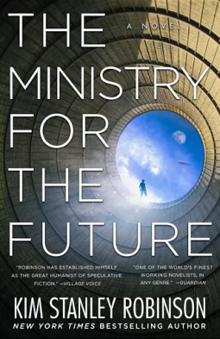
The Ministry For The Future – A Review

The Ministry For The Future
by Kim Stanley Robinson

Kim Stanley Robinson’s ‘The Ministry For The Future’ is much more than a novel. It’s a book on Revolution, the closest thing to an ecological manifesto I’ve ever read. As a work of fiction it’s even more ambitious than his much acclaimed ‘Mars’ trilogy, which could be seen as an early preparation for this book. Like the Mars books it unveils a complex weave of systems embracing every aspect from molecular biology and atmospheric science to human psychology to political and economic philosophy.

But ‘Ministry’ has no interplanetary or futuristic disguise. This is a book about the present and the immediate future of our civilization, specifically projected over the next 30 years. There are chapters on ecology, economics, geology, political philosophy, environmental devastation, human exploitation, mass extinction and geoengineering. There are chapters addressing all forms of resistance and revolution and the inevitable dismantling of capitalism through systemic collapse, civil disobedience, sabotage and assassination. Central to everything is informed speculation on the likely consequences of climate change and the forces that have already been set in motion.

The future is a puzzle and we need a framework in order to make coherent sense of our daily diet of news in the present. The philosopher Slavoj Zizek once said, “It is easier for us to imagine the end of the world than to imagine the end of capitalism.” At a time when such visioning becomes increasingly urgent, Robinson’s novel is a bold attempt to see our way to the other side of disaster.

Perhaps not since Karl Marx has there been such a bold and compressed dissection and set of proposals for the total reorganization of society toward a sustainable future.

The Ministry For The Future

A Conversation with KIM STANLEY ROBINSON:

Weird Tales

I became dismayed and extremely frustrated the other day when somebody for which I carry a lot of respect and affection parroted to me the same right wing propaganda that constantly proliferates on You Tube and Facebook. Both sources are essentially ‘Rabbit Holes,’ programmed to drive gossip, controversy and sensationalism while selling ads.

Between the paranoia and the propaganda, much of it not even generated in this country, our adversaries have gotten America’s number. We are a society that appears to be coming apart at the seams. Only the slightest encouragement is required to cause us to turn on one another like frightened dogs. Since Americans tend to trust our screens more than our actual experience we are VERY ripe for programming and manipulation. Tell a good yarn and it’s certain you’ll create a following. Provide a cliffhanger or sense of constant crisis and you can, like Trump, create a cult.

A cult functions like a cancer on the collective consciousness. Ideology is substituted for facts, programming takes the place of thinking, Individuals begin to function like robots. People once regarded as intelligent humans begin repeating the currently circulating memes and claims in a kind of science fiction nightmare that features suffocating hordes of mindless clones.

When a sufficient number are pulled into the myriad belief systems and ideologies that offer alternatives to the actual processing and evaluation of information, collective decision making becomes almost impossible. There can be no accord, because every position becomes an absolute. The quest for solutions becomes a battle between religions.

So, here we are America, trapped in our own tar pits of misinformation and increasingly obsessive fanaticism. As a nation we appear to be suffering various forms of mass psychosis, shouting at one another from totally different perceptions of reality.

The anxiety of the final days and weeks leading us toward our fate is that we don’t really know how bad is the disease. We know it’s pretty bad, and it’s spreading in waves, mostly driven by social media and those who profit from chaos. Everyday the stories and rumors get more imaginative and ridiculous, while people huddle in groups formed mainly to reinforce their own fears and premeditations.

Perhaps there are still enough Americans out there who are capable of rational decision making, who aren’t afraid of facts and data, who can make the mental leap to figure out that voting out of fear and insecurity will only lead to more of the same.

It’s hard to tell. Rational people find themselves trying to be heard above the noise, and the noise is everywhere. In the year 2020, with pandemic, racial tensions, climate change and election fever all appearing to peak at once, we will be forced to see more clearly, once the dust settles, just who and what peers back at us in the mirror.

Continue reading “Weird Tales”

Stretching

I’ve in the last week picked up a copy of a book composed by Timothy Leary and associates back in 1994, two years before Leary’s death in 1996, and around the time when I was imbedded in the post-psychedelic New Age culture of art and speculation that nested in and around Santa Fe, New Mexico. I’d actually passed by Doctor Tim in person as he toured as guest speaker and celebrity for some sort of exploratory consciousness fair that took place at the city’s main Convention Center.

I am certainly no stranger to Leary’s thought and his writings. From the time when he was advocating from an eminent platform at Harvard for boundary breaking explorations of consciousness via LSD and Psylocibn, to the time when I spent days trying to process my own headlong perceptual journeys out to the boundaries of consciousness and beyond. I travelled along parallel paths while Leary made his way through prison and exile and paranoia and the trials that came along with pop stardom and self deification.

When I walked into my dormitory room at Case Western Reserve one night, getting off on some form of chemically induced revery I heard Leary’s voice come over the radio, telling me to, “Sit down Ralph.” He then took me on a guided verbal tour of my brain, the universe and the whole history of human DNA. It turns out that the ‘Ralph’ in the recording, played that night over the student station was of Leary at Harvard conducting an LSD session with one of his grad students, Ralph Metzner. I didn’t learn this until years later, and in the meanwhile carried it around with me like the inner knowledge of some secret synchronistic initiation, a mystery for which I sought no further solution.

The book I’m reading is one I wasn’t particularly familiar with, lent to me by a friend. It’s called “Chaos & Cyber Culture.” By 1994 Leary as visionary prophet had been largely discredited by both popular and serious academic culture. He had spent time in prison, in Europe and in North Africa, in flight from the American police, hobnobbing with revolutionary elites and movie stars and science fiction writers, hounded by governments and ideologues of the Left and the Right. The 60’s dream of storming the barricades of capitalist/consumer culture had long ago faded or been absorbed and replaced by the high octane quest for new meaning and new wealth accelerated by revolutions in technology and communication.

Society was itself going through the initial stages of the sort of destabilization one encounters on an acid trip. Timothy Leary, along with many former prophets and outlaws and explorers were now mere flotsam in massively circulating currents of change. He was gone before the currents would peak and then break into fading fragments after September of 2001.

The book is a collection of words and images splattered across pages designed in the mode of a psychedelic version of The Whole Earth Catalog. There are dozens of typefaces in all sizes floating in the form of giant quotes and poster graphics and images from the past and the future. There are interviews and conversations with the likes of William Gibson and William Burroughs and David Byrne and all sorts of artifacts assembled around a political documentary and summary of sorts of Leary’s broad visions of past, present and possible future.

Other than in worlds of extreme science fiction I haven’t read anything like this in years. Drawing on history, art, mysticism, biology, psychology, computer science and literature, framed with over-the-top optimism regarding the future of civilization and human consciousness, Leary’s vision has no boundaries, and in reading I grow increasingly aware of how much my vision and that of my culture has narrowed over these past four decades. As a nation and as a world we’ve become increasingly ruled by fear and apprehension, which by nature is a narrowing of consciousness to the primitive state of flight or fight that responds robotically to a wider and wider range of stimuli.

We sit in our cocoons of political power and economic anxiety and anticipate the worst. We are a shell-shocked population with eyes and ears open to more and more information but with less ability to integrate it into something that makes sense. We live in a world of chaos, awaiting signs of the next real ‘strange attractor’ that we hope can assemble all of this mess into meaning. We’ve entered a historic and geological period where the shocks come in accelerating waves of war, recession, natural disasters and forced migrations, and our response is to reach out to the person who promises to protect us and shield us and make it all right. Increasingly we realize that the future can’t be controlled by any power wielded by the few for the supposed welfare of the many. Individually we awake once again to the knowledge that the portraits we perceive of the world around us are painted mostly by ourselves.

At first this makes us all feel incredibly alone, until we make an effort to explore and find new ways to make contact with one another, not as crowds or constituents or mobs or armies, but as fully responsible human beings. Our challenge always, is to create entirely new realities for ourselves, through our storytelling and our imagining, that are fluid and adaptable enough to deal with the constant change that our world throws at us. We have the tools to do it, and our task is to awake to our possibilities and to summon the courage to face and dismiss those who would build walls out of our fear.

To the Super Bowl

So, this evening (Monday, Feb. 3rd) the REAL Super Bowl begins. Now that all of the Impeachment drama is coming to a close and the football drama is over for a year and we’ve watched the most expensive commercials ever made, perhaps we can get down to business of moving forward.

For the year’s total anticlimax there’s the State of The Union embarrassment taking place tomorrow, in which the Donald will…who knows what the Donald will do or say? The best approach in dealing with our Asshole in Chief is to ignore him as much as possible and go forward with our lives, using our thoughts and imaginations to conjure more palatable futures.

Rush Limbaugh is dying of lung cancer. That’ll take some of the wind out of the sails blowing toward oblivion. While Senators bloviated, the biggest news this week is that the Thwaite Glacier is getting ready to drop and could quickly raise the ocean levels by up to 3 feet. The impending drop of what scientists have dubbed the ‘Doomsday Glacier’ will only be the first of many. There goes one civilization, to be replaced by necessity with another.

I’ve spent the past three years stewing in the juices of my own anger and it has gotten me nowhere. The daily disaster has driven me to forget that the best way to observe the ongoing bombardment and spectacle of news and information is to step as far back from the sheer noise and confusion as possible. The news of the ‘moment’ is mostly made to sell personality and product rather than offering much in the way of useful information. What happens in the moment isn’t as important as our collective mediated response to it. The Reality we perceive in this digital world is of necessity always second hand.

We are each in the business of assembling a world that corresponds to our own predilections. For myself I’ve chosen to accept information primarily through online digital conversations, rather than merely accepting what is ‘broadcast.’ Avoiding antiquated mediums like television and radio or newspaper, I seriously engage with information only after it’s been processed through trusted networks of intelligence and discrimination, carefully evaluating the materials with which to assemble my own picture of the world. I’m a subscriber to reality, mostly through print and podcasts, and an occasional glance at headlines from selected inputs on Apple News or Flipboard or the front pages of newspapers.

When I encounter, as in the laundromat, televised news formats in real time I’m conscious that what I’m receiving is an agenda that has more to do with commerce than truth. This stuff, including all forms of mass public broadcast, from out and out propaganda to public radio, is safe to consume only to the degree that one is aware that every broadcaster has their own agenda. Whatever presents itself as absolute truth is only ideology.

Everyone I know who merely consumes ‘The News’ on television or radio appears to be driven crazy by it.

As a consuming culture many Americans are being consumed by cynicism, doubt and despair. The world we’ve constructed in our minds is one in continual emergency, to which we must react without being given a trusted set of tools to react with. Too many of us are swimming and drowning in a pool of helplessness where new alarms are shouting every day, “Danger! Danger!” After years of daily bombardment we are shell shocked and numb, unable to pierce the fog that obscures the future. Christians and New Agers await the Apocalypse, white supremacists look forward to their ‘boogaloo,’ conspiracy fetishists obsess over every revelation while screwing themselves into increasingly paranoid fantasies, and the rest of us deal with a growing sense of apprehension and dread.

Meanwhile, the world trundles on within webs of mind boggling complexity and we are swept along in rushing rivers of karma and consequence. So easy to imagine that we are either victims, or else we are fighting a constant war for particular outcomes. So easy for me to spew words into the void like weapons, effecting only to increase the chaos instead of offering clarity or hope.

Well, it’s a new year and I’ve been mostly silent lately, after what has felt to me like constant struggle against overwhelming odds. It’s true that there is struggle. The need for change is obvious. The change that’s needed however, can only come about through a change of channels. I’ve been paying too much attention to the idiots waving the flags, and too little time spent in a world where human beings are meant to live, one that’s woven through our minds and our imaginations, where we tell each other stories and look at dire situations as problems to be solved. This is the only kind of world where we have a chance to live beyond our fears. It’s the only world where we can construct the necessary bonds that will hold this ship together.

Let’s try something different for a change.

A Strange Year

I was laid off once from a computer software company with the boss saying to me, “You’re kind of a liberal arts sort of guy.” He had a point, and it was true that I didn’t really fit in with the climate and culture of the place. What he wanted was more on the STEM side of things. More about numbers and programs and accounting and less about words and magic. I’ve always had trouble with numbers but have never veered from a fascination with the hidden underside of things.

This was a year when all of the lessons I should have learned were taken out of the theoretical realm and brought rather severely to earth. The barriers between the worlds of wishful thinking and the awful realities that threaten our planet no longer held. It was time to put aside hopeful speculation and face down some awful truths.

It was a bad year for dilettantes. From January on it was as if, after the numb horror of events had begun to give way to the appalling normalcy of daily assault, an enormous dark sinkhole had opened in the collective psyche, and absolutely everything was sucked down into its depths so that all one looked at was somehow infected by the dread and anger that issued out of an unavoidable hellmouth, like something in a painting by Heironymous Bosch.

Now that we are past the initial shock and have accommodated ourselves somehow to the steady degradation of our public life we can perhaps leave it to unfold (and degrade) without the need to push or pull. It will unfold anyway, and perhaps someday the dirty tide will recede a bit of its own accord and meanwhile we can take stock of what’s going on in the world that lives inside of us.

I’ve always been compelled to take in everything there is in order to see the links between. To pursue one object or another to the end of its particular tunnel is an activity left to those so inclined, while my own interest is to follow the branches as they lead back from twig to trunk, fascinated less by the fleeting detail than by how it all connects. I could be called a ‘dilettante’ or perhaps a philosopher or something equally ‘iffy’ in terms of consistently reliable income streams. In the long run this generally places me somewhere at the ‘bleeding edge,’ or slightly on the outside of things that occupy most people from moment to moment. I often feel as if I’m looking on, observing with fascination, from some distance this or that quest for particulars and rarely feel fully engaged with those who spend most of their time in the weeds. Instead of attending to the particular I’m obsessed with the thread that connects this particular to another, and anot!
her, along the long and almost mystical yarn that comes from the past and stretches ahead to the future.

In this old year waning and new year dawning I’ve decided to go ‘cold turkey’ in terms of politics, hoping to free up energy for something a bit more connected to larger and longer streams that portend the creative or at least the positive. This past year felt like a full-on war, fought with words and images rather than missiles and bombs. All the words flung back and forth hammering relentlessly at any sense of civility or even responsibility, for the purpose of differentiating ‘us’ from ‘them,’ breaking the branch from the tree. All having a deeply corrosive effect on the bonds that make us feel connected in a way that makes some kind of collective sense. Most of us are reduced to sitting helplessly observing, trying to apply the old rules of civility to a situation where they’ve apparently become irrelevant. We are like mad children in some re-enactment of ‘Lord of The Flies,’ let loose to trample the bonds of the social order like they are brittle fur!
niture left around for us to trash.

I tell myself in better moments, when my mind isn’t so mired in the details of our day-of-horror unfolding, that out of chaos comes creativity. On other days I want to join in with the trashing.

Why should I even care? Even if politics and war are more entertaining than any other sport I could name, its become the sport by which we the people tear each other to pieces. My new thought is that I should stop being concerned or finding myself in any way responsible for the outcomes. My fellow citizens after all, dug this grave for themselves. Why should I not allow them to shit in their own hole and then lie down in it? Even if I must share the hole with them (there is no true escaping in this world), perhaps I can hold my nose and look away toward the sky.

Not so easy this for me, to be mired and yet to turn away as if nothing’s amiss. It’s like a sports addict deciding to turn off ESPN and ignoring the Super Bowl, the World Series, the Olympics. Actually not so hard for me to imagine, as I’ve ignored these things for most of my life, politics being my ‘sport’ and the one interest that ties me to the things that apparently matter to the people around me from day to day.

I’ll turn to my only real audience, which is this presence inside of me, this all-judging voice that measures the world that I see and most of all that measures me. Instead of the usual ‘Politico,’ ‘FiveThirtyEight,’ Pod Save America,’ today I listen to ‘The Paris Review,’ and ‘The New Yorker Radio Hour.’ Instead of Netflix I find myself in books: Jack Kerouac’s Scroll, Haruki Murakami, Dave Hickey. I am edified and entertained, inspired even. I rearrange my apartment, twice.

Then, of course, there are all the counter voices, telling me, “You’re being irresponsible and arrogant. How can you be so uninvolved when the country is going to shit? You have to be INVOLVED, even if it’s only being aware and passing your awareness on. And I realize there is no way to be uninvolved, as the slippage we all feel is like some gravimetric beacon bending every current and pulling everything toward itself. We are all at some level compelled to respond, as we walk an ever narrowing collective path toward the future.

And of course, all things are political. “We’re either part of the solution or part of the problem.” Is there no escape? Of course there isn’t. The world moves on and we come around on our endless loops of self-doubt and over-confidence, trying to find that median place called ‘decision.’ We decide, we move on, we face the crisis brought about by yesterday’s decisions.

Amazingly, these two days off without once checking the news beyond the headlines, which are reliably and predictably grim, begin to feel like an actual weekend (even though my ‘weekend’ days these days are in the middle of the week). I realize that for the past year I’ve been living outside of myself, disembodied, a ghost on social media, juiced on the rage I see and feel all around me there, feeding it back in return, almost forgetting that I ever had a real life or that there are real people out there who are just living.

And yet, over the year I’ve written over a thousand words, mostly captions and short comments, an occasional thumb-length essay, and always in reaction to something OUT THERE. You can look at my Facebook page and find a running chronicle of anger and despair that’s book length and illustrated, a veritable museum exhibit of the Year in snapshots. But, very little of what you see goes beneath the armor. It’s merely a chronicle of suffering, as if every move we made was constrained by the straitjackets of fear and rage.

I fell into the very traps I’ve been warned to avoid and have warned others about. In my studies of magic and media and the dangers of astral space (where ideas and images are born and fed) I was aware of the potentials for getting lost in the endless gulf that opens between imagination and matter. Into that gulf is where the ‘enemy’ projects his tricks, his spells, his signals of doom. The tragedy is that we gave him the biggest platform from which he could play his tricks.

So we were played.

On the bright side, I learned to write with my thumb. This was entirely written and edited on my iPhone.

Arclist

Sex and Politics: The Resistance

Fox News is, more than anything else media headquarters for patriarchal resistance and institutional racism in America, just as the Republican Party is headquarters for it’s political arm. In the past few months Fox has lost their former ringleader (Roger Ailes), their leading female commentator (Megan Kelly), and now their biggest moneymaker (Bill O’Reilly) due to a pervasive climate of inappropriate sexual behavior and harassment.

Given that the prevailing attitudes at Fox and in the Republican Party are basically throwbacks to an era of ‘Madmen,’ which educated and aware Americans have grown out of, but Fox/Republicans and their constituency have not, this should be no surprise. While commentators like O’Reilly rail at manufactured bugaboos under the banner of attacking ‘political correctness,’ women broadcasters at Fox are evaluated according to their measurements and how closely they match some male’s beauty pageant ideal. Intelligence and competence must be overmatched by ample exposure of ‘legs and cleavage’ and the job description should read: Applicants preferred: blond and buxom (and very white).’

When news becomes a front for sensationalism and entertainment and government becomes nothing more than performance art the abuse of persons follows inevitably out of the abuse of truth. We have gone very far down that road, but the dumping of Bill O’Reilly demonstrates that the popular and political resistance in the Age of Trump is mounting and is indeed effective. While the forces of reaction circle the wagons a wave is growing with every abuse, every revelation of corruption and every broken promise.

New York Times: ‘Bill O’Reilly Is Forced Out’