Starting Out (Pynchon as Parenthesis) Part One
“It’ll get easier. Someday it’ll all be done by machine. Information machines.” – Gravity’s Rainbow

I’m stranded in this Sargasso moment, awash above the blank pages in a sea of bewilderment, bordering too often on despair or at least demoralization, questioning who we are and what we are to do, placing words on screen or paper that appear too often useless. How can I meet the YouTube moment, while whole contraptions made out of outmoded words float like garish headlines against images appearing for short moments and then gone, while the world arranges itself around another passing crisis. What is it that endures against the nihilistic forces that stalk across the earth like a million metaphorical monsters, puncturing every dream and aspiration for no apparent purpose outside of the blind and momentary pleasure of watching things explode.

In my local community I’m like a ghost. What do I have to communicate besides brittle hope or the pain of loss? So much is lost to stupidity and greed. The question is, what remains?

I find some escape in the oceanic and ancient desert landscapes of this beautiful state as it flows past my car windows. I indulge in the exquisite paragraphs of my favorite writers, the best of them having been with me almost as long as I can remember.

I grew up in a post-war world of weekly air raid sirens and useless nuclear drills. I’d seen pictures of the bombs going off above Hiroshima and Nagasaki, and watched as ex Nazi Werner von Braun, on Disney, explained the nuclear reaction using ping pong balls and mousetraps. I endlessly fantasized about fallout shelters. My family drove past fields full of surplus tanks and obsolete aircraft on our way to church, all of this hardware useless in a war of total obliteration. I watched movies at Saturday matinees that featured mutant monsters wandering through the wreckage of civilizations. Most of my nightmares were of inescapable destruction.

The fathers of my generation gathered in VFW halls. They shared the fellowship of men and women who’d survived through a holocaust. They were often reluctant to reveal to their children any details of the horrors they’d encountered and survived. With fascination, we gleaned fragments and artifacts of memory from books and photographs. We watched television documentaries, roughly cut in black and white, narrated by Walter Cronkite or Edward R. Murrow, of battles and bombardments and ruined cities. There were the romanticized exploits in popular movies staring our favorite movie stars, portraying sacrifice, heroism and always victory. There were the morality plays of the TV westerns that dominated the evenings. As boys our favorite backyard fantasies featured plastic guns and makeshift arsenals. We retreated from history into our imaginations, and I guess it served as our defense against a backdrop of terror.

Amidst the doom and gloom and people taking themselves too seriously, there were other things to think about. Our childhoods, like every childhood, were filled with discovery and wonder. A fresh world of technological possibilities was opening all around us. Television itself was new. We launched ourselves into space, and the pace of ambition and invention was rapidly altering the landscape.

We thought about careers and success, and believed in times of growing tolerance and opportunities. Still, many of us found ourselves stranded in a marsh of questions and indecision. As the decades passed, we entered an extended interval of useless and dangerous conflict, of burning cities, assassination of our heroes, and a rising sense that civilization itself had an uncertain future. For those who stepped off the shores of safe and sound behavior, the plunge into unknown waters took a healthy sense of humor and a strong dose of aspiration, or at least enough momentum to move forward.

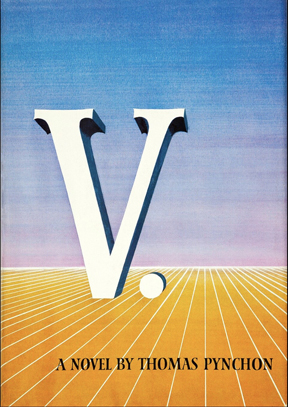
When I was 17 years old, I often wandered through the fiction racks in the downtown branch of the Carnegie library in my hometown, Cleveland. One day amid a display of the latest contemporary novels, I looked upon a thick and serious hardcover volume, with a single letter, V. , as its title. The letter stood monumental, upon a surrealistic plane of parallel lines converging toward a vanishing point, beneath an empty blue sky. In the foreground, in smaller letters below, the words proclaimed, A NOVEL BY THOMAS PYNCHON. Something about that image and title suited the world as I’d begun to see it, a mysterious and isolating landscape of endless searching and uncertainty. Like Pynchon’s characters in this, his first novel, my friends and I moved among bewildering scenarios with sensibilities that blended both hopefulness and paranoia. Like Pynchon’s Whole Sick Crew , we wandered amid the moral confusion that followed the chaos and tragedy of a World War. Underneath it all there lingered the frightening suspicion that everything that might have made sense to our parents was on the edge of coming apart.

Thomas Pynchon writes in the words of a prophet, a comedian, a poet of times of transition, when one world collapses into another, and people find themselves somewhat lost, seeking some kind of anchor in the tempest. His novels are mysteries. They take us, along with their sketchily drawn protagonists, to witness worlds both bizarre and familiar, packed with lush detail, profoundly beautiful and monstrously grotesque, full of both darkness and hilarity. His characters, as they search for patterns that might reveal some sense of ultimate purpose, skirt the edges of discovery, driven forward by circumstance, picking up messages and signs that hopefully provide clues, or at least an indication of direction. Each of his novels takes us through the beauty and violence of landscapes in a different period of history. We hang out with Benny Profane and Herbert Stencil in the 1950’s, with Oedipa Maas through the Los Angeles real estate boom of the 60’s, Tyrone Slothrop in the zones of Europe at the end of World War Two, Zoyd Wheeler navigating Reagan’s War On Drugs, Charles Mason and Jeremiah Dixon measuring the border that would split America against itself, and the world between spirit and reason in the 1700’s, the Chums Of Chance exploring the realms of fantasy and possibility at the 1893 Columbian Exhibition, flying ever forward toward the ‘War To End All Wars’. Thousands of characters make their appearances, however brief. The style is said to be encyclopedic, and it is, dealing not merely with characters and events, but with the sensibilities of every moment, where the mythical blends into the factual, the imaginative informs the real. He surveys the fleeting joys, horrors, and absurdities of all times. We shift among as many points of view as there are situations, and at times his people might even break into songs and poetry, even limericks, to change or illuminate the mood. Pynchon’s writing challenges and even breaks many of the conventions of prose, as if he’s daring us to trade in our box of expectations for a new sense of freedom.

There are dozens of essays and books written about and/or inspired by Pynchon, and as many interpretations of his work. I can offer my own, although it’s continually under revision. Like a trickster he challenges us to see through the patterns of history into worlds always in flux, driven as much by imagination as intent, old orders always collapsing while new ones arrive, never quite reaching a conclusion. We see humanity in a constant struggle between opposing urges of freedom and control, and beneath all the hopes, the curiosity and the paranoia, finding no final answer beyond the absolute mystery of beginnings and endings, and everything inbetween.

Pynchon is one of the most influential writers of his generation. He certainly influenced me. Through the years every one of his reviewers and readers has attempted to plumb the mysteries and meanings that thread through his voluminous work. The worlds he creates are both beautiful and monstrous, and each is a maze littered with both absurdity and wisdom. Pynchon himself is a cipher, almost never photographed and he’s never sat for an interview. As far as I know he’s never offered explanations outside of his work, thus leaving any conclusions fully to the reader.

My personal enjoyment is in his magnificent sentences, lush and long, often the length of a whole page or paragraph, exquisite and wanting to roll off the tongue, more like poetry than prose, or maybe something in between. They are filled with the beautiful, the mundane, the grotesque, the enigmatic and the profound, and the sheer adventure in reading them has gotten me through some very difficult times.

Here’s an example, from Against The Day.

Yashmeen’s white tall figure, parasol over her shoulder, already a ghost in full sunlight, went fading into the crowds flowing in and out through the trees between the quay and the Piazza Grande…

Plum and pomegranate trees were coming into flower, incandescently white and red. The last patches of snow had nearly departed the indigo shadows of south-facing stone walls, and sows and piglets ran oinking cheerfully in the muddy streets. Newly parental swallows were assaulting humans they considered intrusive. At a cafe off Katunska Ulica near the marketplace, Cyprian, sitting across a table from the cooing couple (whose chief distinction from pigeons, he reflected, must be that pigeons were more direct about shitting on one), at great personal effort keeping his expression free of annoyance, was visited by a Cosmic Revelation, dropping from the sky like pigeon shit, namely that Love, which people like Bevis and Jacintha no doubt imagined as a single Force at large in the world, was in fact more like the 333,000 or however many different forms of Brahma worshipped by the Hindus—the summation, at any given moment, of all the varied subgods of love that mortal millions of lovers, in limitless dance, happened to be devoting themselves to. Yes, and ever so much luck to them all.

AN INVITATION

My Publishing Career

When I was in elementary school I was given for Christmas a small printing press  that could make stuff the size of business cards or raffle tickets. I started a number of membership organizations among my classmates that could be activated simply by asking for a card: ‘The Hoppity Hooper” Fan Club,’ ‘The Rocky and Bullwinkle Fan Club,’ and our final, three color masterpiece, a membership in ‘Camp Palumbo’ along with a small certificate of the official currency, the ‘Pazzuza.’ 

Later on my neighborhood friends and I, all bing in the same Boy Scout Troop, would take each issue of the Official Boy Scout Magazine paste in alternative headlines and captions cut out of other publications and turn Boys Life into what we thought was a hysterically funny parody inspired by Mad Magazine, a publication we really took seriously.   

In high school, myself and my high-minded friends published and repeatedly got in trouble for a series of independent journals printed via mimeograph machine and silk screen press at our local Peace Movement Offices. I continued this though college and after, until moving to Santa Fe, when I got a bit more seriously embedded in the writer’s world. 

In 1984, after attempting to convert reams of handwritten notes, poetry, short stories and essays into a publishable form into typewritten documents (a frustrating process) I took a class in the new Word Processing technology at the local community college. About midway through the course the teach came into class entranced by the release of the first Apple Macintosh computer. I don’t remember what he said but his trance was somehow infectious, and before the end of the year I’d acquired my own machine and the accompanying laser printer.

For a number of years I published articles and reviews in ‘The Journal for Humanistic Psychology,’ ‘Annals of The Earth’ and ‘Shaman’s Drum’ magazine. 911 happened. I was not particularly surprised that it happened but that didn’t make me less angry. So, I started a blog, called ‘The Arclist,’ which continued view email and website for the next 20 years. After the 2016 election the list pretty much was reduced with short headline introductions to various news and resistance links and very little else. Meanwhile the host site and software became contaminated and obsolete and harder to manage, until a couple of weeks ago I decided to abandon the list in email form and rethink the whole thing. 

I was diagnosed with cancer. This marked an opportunity to rethink everything. I went though my existing contact list and entered them into another email client service that I’d learned to navigate through as a business application. More up to date and flexible and easier to manage in creative ways, I’d like to take advantage of this by setting up a new version of the Arclist, more in the tradition of a Journal that accommodates creative ideas, creative projects and creative discussions between interested folks. I think we are all somewhat anxious to move beyond obsessive focus on the disasters of this past year and turn our attention to future possibilities. Perhaps this could provide an opportunity.

I have a list of names that I’ve gleaned from my contact list. Many of you were part of the previous mailing list or were listed as a ‘friend’ on my Facebook page. Some of you might have gone away for any number of reasons. Some of you may not wish to hear from me ever again. Before engaging the new list I want to send a formal invitation for you to respond, either positively of negatively, and I will then formally activate or delete your membership. If your answer is ‘YES,’ and I hope it is, I will begin sending out my creations, or forwarding others, on some semi-regular basis.

Meanwhile, I’ve attached to this invitation a sampling of the sort of stuff you might expect to receive on the New ARCLIST. Should you wish to subscribe and get the material on this site in our email just send a reply to remelcher@arclist.com, or leave a Reply at the bottom of this page.    


My Favorite Podcasts (Current) 12/13/20

Not included are podcasts I’ve favored In the past but I’m no longer following regularly (this American Life, Masters of Scale) or podcasts that were short form or serialized or no longer being produced (‘Studio 360,’ ‘The Ballad of Billy Balls’). By ‘current’ I only mean current, and this list will continue to shift from day to day as I get turned on to new podcasts.

History

Throughline

One of NPR’s Most Popular Daytime Shows, this hour long documentary style delves into all of the corners of history we are never/rarely taught in school. To fully understand the present events in the context of historical realities the show is unmatched. The two hosts are from first and second generation Iranian and Palestinian families, which may give a clue  to the unique depth of their approach to telling stories.

The United States of Anxiety

A little scary but enlightening as it focuses on the areas in American history that indicate the conflicts that have split the body politic from the beginnings of the USA.

This Day in Esoteric Political History

Somewhat oddly named, focusing each day on a single event (many of which I’d never heard of) at a particular moment in American History, a lively and educated discussion of the event’s historical environment and its influence and indications in the present.

Politics

Hacks On Tap

Political strategists from both sides of the ‘aisle’ toss around their critiques and projections about both parties. Anchored by David Axelrod (Democrat) and Mike Murphy (very ‘anti-Trump’ Republican), with a variety of chummy guests, the analysis is delivered with a good deal of humor and real ‘insider’ knowledge of how political campaigns actually work.

FiveThirtyEight

I’ve been listening to these guys since 2015. A relief from the general alarmist nature of political news and analysis. Sometimes a bit over-the-top ‘wonky,’ I favor 538 for a strictly data-based view of political realities balanced by a crew of mostly contrarians in one form or another. I simply like these guys. As I was about to write this review, unfortunately the departure of Clare Malone is a great loss. Relative newcomer Harry Bacon Junior has brought a similar contrarian sensibility and a much needed black perspective to the panel, Malone brought an equally important feminist and Midwestern (Ohio) perspective. 

The Ticket

One of the better interview shows from The Atlantic. Host Isaac Dovere chooses subjects that are generally slightly out of the mainstream news but closer to actual events. Always new information and insights.

The Axe Files

Long form, one hour interviews of a range of public figures, illuminating their biographies and focusing on their positions in regards to contemporary politics. David Axelrod, currently head of The U. Of Chicago School of Politics and once Obama’s chief campaign adviser, is relentless in his ability to get beyond easy rhetoric to the true nature and personality of his guests.

Amicus

A bit alarmist in the ‘Slate’ style this is the best way to keep up with the arguments, decisions and implications for the future of the Judicial branch of government.

Intelligence Squared

Both sides of every question, thoroughly and respectfully debated. Particularly helpful to those in the habit of considering the ‘other side’ to be totally without brains or merit. (Note: This applies only to arguments that actually apply when a et of common facts are agreed upon.) 

Reporting

The Daily

The New York Times, in its breadth and depth of coverage is still at the top of the media heap. This podcast offers a sampling every morning, with a single news story or interview and a short headline summary. On Sunday an archived ‘feature story’ is read in entirety. I highly recommend checking out the Dec. 6th edition: “The Social Life of Trees.” 

Global News Podcast – BBC

I start the day with this one, as the focus isn’t obsessively on America and it’s ridiculous politics, it’s coverage is delivered with an almost universally cheerful, or at least less apocalyptic stance. Given all of the ‘Brexit’ angst in Briton these days, I suppose several hundred years more of living history kind of levels out ones perspective on the present.

The New Yorker Radio Hour

I wasn’t sure just where to place this since the coverage is as much news as it is cultural commentary. I decided that since the coverage is essentially ‘journalistic’ in approach, this fits.

Business/Journalism

Pivot

Two of the most knowledgeable people on the fringes of Big Tech, Kara Swisher and Scott Galloway make a ‘perfect couple’ with their insights into current and future trends in business, investing and the politics around technical innovation and culture. Punctuated by personal banter and good natured kidding these two have been going at it for a couple of years of successful and popular podcasting. Swisher, the journalist, keeps things on track while almost cagily draws out brilliant insights from Scott, the NYU business professor and investor. Guests are featured with back and forth interviews by both Kara and Scott.

The Professor G Show

Scott Galloway’s own podcast (see above), where he calms down while proving himself a capable interviewer, while giving himself some time to deliver, John Oliver style, some incredibly insightful, critical, and sometimes inspiring ranting about ethics in politics and business.

Sway

Kara Swisher’s new interview show from The New York Times where she is featured as a regular Opinion columnist. The NYT is managing a very successful and profitable switch into the digital medium. Swisher is a digital candidate for the Maureen Dowd chair of journalism. Her interviews so far have included a diversity of subjects (from Dowd herself to Hillary Clinton to Jane Goodall).

Science

New Scientist Weekly

Friendly, British, delivered with a touch of humor, the most up-to-date international coverage of the scientific progress on Covid-19, and the latest questions and discoveries in scientific research.

Philosophy

Hi-Phi Nation

Philosophy revealed through contemporary storytelling and interviews that reveal in our present dilemmas their deep roots in philosophical discourse. A uniquely illuminating approach and my ‘great discovery’ of the month.

Into the Zone

An original approach to ideas and storytelling from novelist Haru Kunzru, who focuses on how ‘opposites’ shape our world. While founded in stories from the ‘real’ world Kunzru’s approach is delightfully filled with literary twists and turns and metaphor. I was turned on to him in an interview with ‘The Book Review’ podcast (see below).

Storytelling/Literature

The New Yorker Fiction

I’ve been listening to this podcast for more than 10 years. It’s one of my main links to the world of short fiction. A writer each month gets to choose one of their favorite stories from another writer in the archive and to read it out loud. Afterwards the author/reader discusses the story with Fiction Editor Deborah Treisman, focusing on how the story inspired and influenced them.

Imaginary Worlds

Being a heavily invested fantasy, sci-fi and comic book geek, how could I miss this one. ‘How we create Imaginary World and why we suspend our disbelief.  ‘Nuff said!

The Book Review

From the New York Times Book Review, but less intimidating. It features author interviews plus short discussions and reviews of some of the latest books out on the shelf.

Poetry Off The Shelf

A refreshing break into the dimensions of pure sound and word. Poems are read, interviews and analysis are delivered. A little Poetry Magazine online.

Humor

Beef and Dairy Podcast Network

I cannot really desgribe this to you. It’s British and hllarious. Every episode begins nearthe absurd nand then carries one beyond…

Mission To Zyxx

By now an old stand-by for fans of imprvisational humor, sci-fi and those with a need to fill the void between space-based intergalactic blockbusters.