Direct Cinema

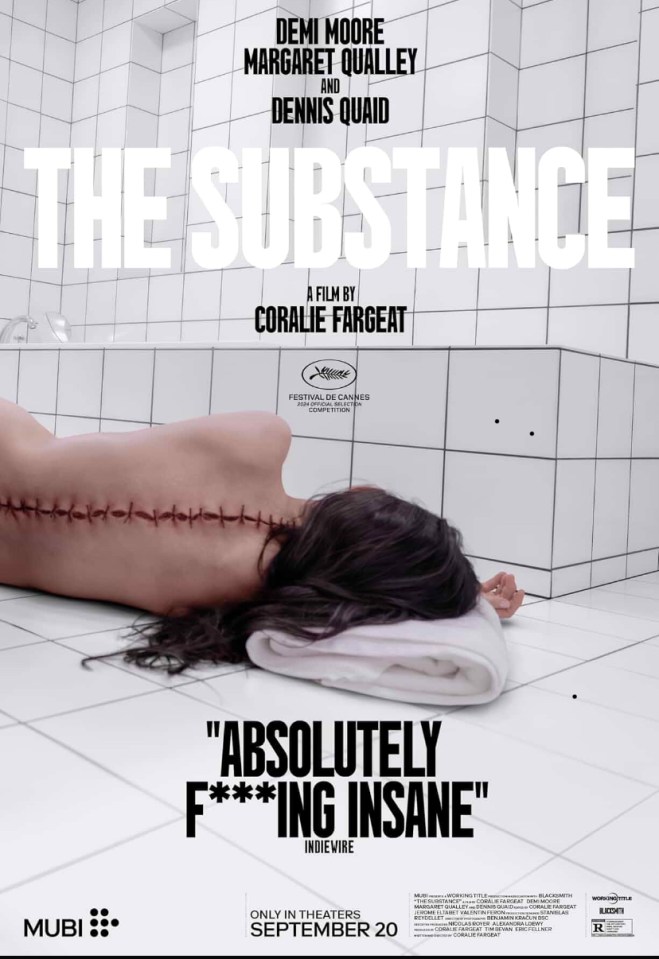
‘Essential’, ‘Unforgettable’, ‘Body Horror Classic’, ‘Feminist Cult Classic’, ‘Dark Comedy’, are some of the quotes being thrown around about ‘The Substance’, a new film by Coralie Fargeat, starring Demi Moore. The best description I’ve seen is the line in the teaser from New York Magazine, “An enraged scream in cinematic form”. Having been released during the season of America’s self immolating election, ‘The Substance’ is a testament to society’s desire to go backwards into thin fantasy worlds created to protect us from looking at ourselves.

The film is relentless and brutal and without compromise. Many viewers may be repulsed, or even traumatized, although I question if anything on the screen matches the daily horror displayed on the evening news. The film juxtaposes the sleazy spectacle of Donald Trump style beauty pageants with explosions of rage that reminded me of the movie ‘Carrie’, as well as the tortured physical metaphors often portrayed in the films of David Cronenberg.

Blending horror and comedy in a surrealistic mix of ‘pumped up’ visual extremes we see in television commercials and popular magazines, ‘The Substance’ pushes up against cinema’s most powerful operatic limits. The intent is to forcibly shock the viewer awake. Its images are grotesque and direct, and anyone not altered in their presence is either unconscious or braindead.

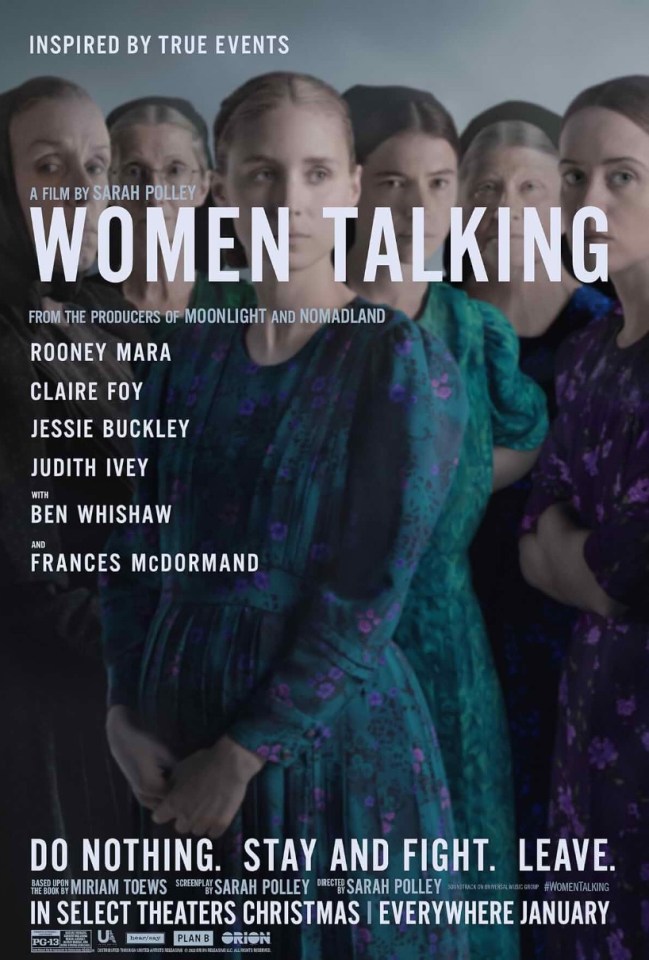
In the face of extremes of hate and violence pushed by those who wish to rule and profit, the floodgates of truly political art have opened in the mainstream. Films like ‘Barbie’, ‘Women Talking’ and ‘Poor Things’ speak directly to the atrocities of female oppression. ‘The Substance’ is one of those, and it isn’t trying to be reasonable or gentle in a world where the spectacle of politics has taken us to the edges of absolute chaos.

During the drawn out, horrifying and over-the top final cataclysm in ‘The Substance’ there’s a close up shot of a terrified little girl covered in blood. She’s been dressed up to echo the exotic sexual fantasies paraded before her on the stage, and her face displays the full horror children witness everyday in a world trapped in its fantasies and dominated by its own irrational fears.

Women Talking

In (2023) I managed to see most of the movies nominated for the Best Picture at the Academy Awards. (except ‘Elvis’ – I was never much into Elvis and am not particularly fond of biopics in general.)

That was the year ‘Everything Everywhere All At Once’ won the award.

Sarah Polley’s film ‘Women Talking’ was awarded ‘Best Adapted Screenplay’

I thought it deserved ‘Best Picture’ – at least.

When I saw it at the theater I wept tears from the beginning to the end. I just watched it again on Prime Video, and it had much the same effect, although I was able to draw back just a little bit and appreciate the pure technical perfection of the film. (It won the Movie Of The Year from the American Film Institute.)

No film in my memory has affected me so deeply. I’ve elevated it to my top three favorite films of all time. (It falls between ‘Wings Of Desire’ for its depth, ‘Drive’ for its technical perfection – ‘Women Talking’ has both, and the best acting ensemble I’ve ever witnessed). I haven’t seen a better movie before or since.

Coming into this election and all of the struggles it has brought to the surface, ‘Women Talking’ perfectly exposes the deepest and most universal issues at play in this nation and in the world.

Civil Wars

I just finished the remarkable new book by Nancy Pelosi, The Art Of Power. It was on the one hand an inspiring first hand account of indomitable courage and determination in the face of difficult odds and a history of the major political struggles I’ve witnessed since 1987. On the other hand it’s an account of a time of civility in politics and government that has frayed and all but collapsed since the rise of Trump.

I feel both pessimistic and useless in the face of what’s coming. I now find myself reading books about the lead up to wars; Eric Larson’s The Demon of Unrest, about the five months preceding the first American Civil War, and The Proud Tower, by Barbara’s Tuchman, about Europe and America before World War One. Each marked the necessary transition from one state of civilization to the next. I find that reading history helps me out of a state of helpless depression, perhaps it helps me to accept that what’s likely to happen has happened before.

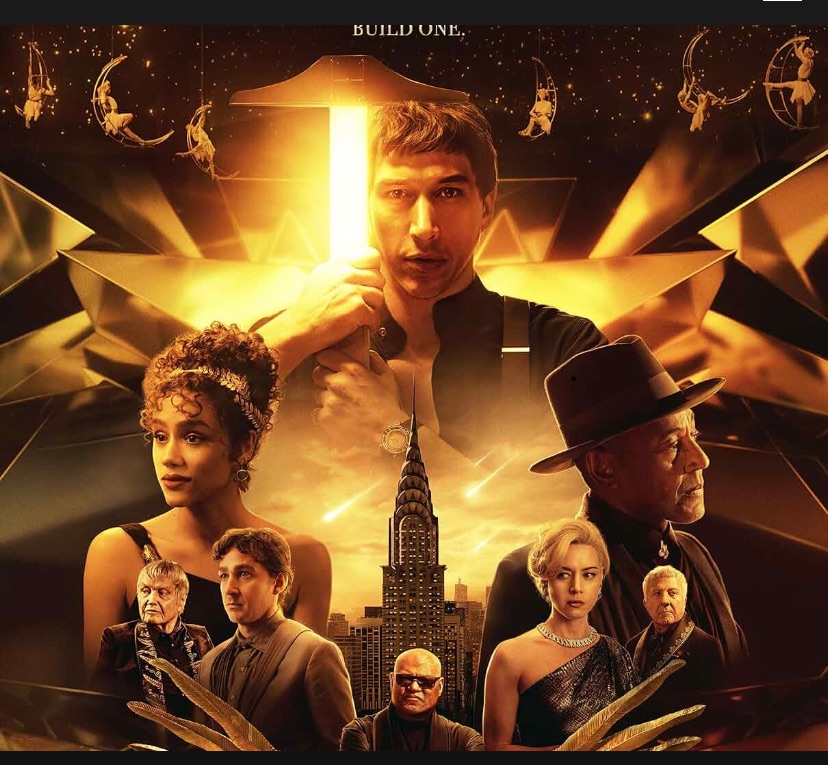
Yesterday I saw Coppola’s new and perhaps final film, Megalopolis, which is a rather surrealistic fable depicting the conflict between creativity and stagnation in a world of decadence and decline. It ends in a rather fanciful and/or hopeful conclusion, where creativity and progress apparently triumphs over our clinging to the past.

I was reminded of the film that has had a strong impact on me this year. Civil War depicts in realistic and down to earth terms a likely scenario should the USA descend once again into bloody conflict. In interviews, both the director and the actress Kirsten Dunst refer to Lee Miller, upon which her character is based, and the subject of the newly released Kate Winslet film, Lee She was a World War Two photographer who bore witness to some of the worst atrocities of that conflict.

I’ve come to believe that the likelihood of an election without violence and a peaceful transition of power is unlikely, no matter who wins, and the only thing you or I can do to alter events is to choose not to participate in the violence in word or deed. We must refuse to spread the hatred and fear being directed by so-called leaders, against the poor, the weak and the ‘others’ in order to advance a bid for supremacy and power. We must recognize the seeds of fascism that are being encouraged everyday, and deny them from taking root within us.

I’ll be driving up to Denver to take a flight to Cleveland to visit family on October 24th and will return to Santa Fe the day before the election. I wonder whether this trip will mark a rise or fall of the world we’ve known. Right now I’m not betting either way.

Things Fall Apart

‘The Morning Show’ on Apple TV is the best and most pertinent political drama I’ve watched since Aaron Sorkin’s ‘The West Wing’. Both deal with power in the hands of people presented as ordinary human beings. Sorkin’s drama was of a different time and climate. It expressed the lingering idealism of the baby boomer generation. In a later show, ‘The Newsroom’, Sorkin explored the confluence of politics and media. As in ‘The West Wing there’s the sense of an omniscient moral order, watched over by benign patriarchal authorities, represented by Jeff Daniels and Sam Waterston, that invariably delivers on the side of truth and Justice (Law and Order).

‘The Morning Show’ is a product of another century, when that very authority is under question and uncertainty reigns in the shadows of every institution. Its political and interpersonal machinations are at least as complex as those in another show of the era, ‘Succession’. Both deal with issues of power and authority, but ‘Succession’ takes a more comedic approach, while ‘The Morning Show’ more aggressively and tragically addresses the real world.

In ‘Succession’ the patriarch and his entourage are portrayed as fools, inhabiting an environment of almost cartoonishly excessive wealth and power. This is not a place where people have jobs, it’s where they have ‘positions’ somewhere within the arcane mazes of control. It’s a world drenched in male ego, where both men and women thrive and survive only by ruthlessly manipulating each other to gain the approval of the king. It’s ultimately a game of abject surrender, in which a gaggle of fools gambol just at the boundaries where comedy and tragedy meet. In the end nothing in that world has substantially changed, and we go home satisfied that everyone pretty much got served what they deserve.

Inspired by the real life sexual abuse scandals that emerged during the MeToo scandals that lead to the fall of power brokers at Fox News, ‘The Morning Show’ doesn’t hold back in aggressively challenging the power of the king and the patriarchy. It takes the path of tragedy, in which the hubris and foolishness of each player is met with individual consequences.

‘The Morning Show’ is about struggle and a heroic journey toward redemption. Every character is brought to the edge of a precipitous fall, and is severely tested with the choice between pure survival and risking everything for the pursuit of clarity. As in classic tragedy a sacrifice of innocence is required in order to bring down the king. No one emerges unscathed.

At the end of the first season we’ve witnessed the inevitable fall, and are left with a little grief mixed with a sense of possibilities. The show leaves us with a hopeful motto, ‘sic semper tyrannies’, which translates, ‘thus always to tyrants’.

photo by Gabriel Melcher

In Defense Of The OSCARS

One of the most prominent features of OSCAR season is the sheer volume of snarky commentaries by everyone from the film snobs of academia and the New York media to the ideological ranting of political junkies on Crooked Media podcasts. Now, I admit I’m a film junky if there ever was one. I fell in love with film in High School and watching Jean Luc Godard movies in college. I’ve been to film festivals. I even helped to get a couple off the ground. I subscribe to MUBI. I live in one of the best little towns in the USA for viewing the full range of diversity in the world of film. I’ve rubbed shoulders with filmmakers and with the snarky elite and have myself been among the snarkiest.

Every year we read and listen to dozens of movie critics complaining about the terrible choices the Academy makes in terms of the ‘art’ of film. Traditionally, reviewers focus on how the nominees are chosen more on the basis of popular taste and promotional hype rather than on true and timeless artistic value. They point out that the awards are more a self-congratulatory celebration of the mainstream industry than a tribute to true quality. More glamour than grit.

Fair enough. The awards are after all a mainstream Hollywood event, and the voting is been done by predominantly male and mostly white industry insiders. The spectacle of wealthy Hollywood royalty in gowns and tuxedos frolicking on the carpet brings up for some a bit of class resentment. Yet, for anyone who enjoys the movies on almost any level the Oscars are like the Super Bowl. (It’s a long ceremony and I confess that I just watch the highlights on YouTube the next day.)

Notably in the past couple of years, and this year in particular the selections have been deliberately widened to include a bit more diversity. In the top categories are films directed by women and minorities, films including both spectacular Hollywood extravaganzas and more modest independent productions, films by old Hollywood hands and first timers, films about both gays and straights, and even that touch the edges of politically sensitive subjects.

But in the year of Trump, to venture into politically relevant waters is to open the doors for even greater explosions of criticism and pent up resentment directed against an industry that has done much to support and maintain a status quo that we’ve all grown uncomfortable with. The movies and television after all are the mirror and lens through which a culture sees itself these days and most of us are addicted to the screen in one form or another.

This is one of the years when I actually managed to see most of the films nominated for major Academy Awards (7 out of 9) and enjoyed all of them to various degrees. Of those nominated for Best Picture my personal favorites were ‘Dunkirk’ and ‘The Shape of Water.’ My favorite performance was Sally Hawkins in ‘The Shape of Water.’ This isn’t what I want to write about.

When I opened my ‘New Yorker’ app the day after the ceremony I came across what struck me as a bitter diatribe against the Oscars by their film critic, Richard Brody. I confess that I found it mostly appalling, and now It’s my turn to snark back. Brody’s essay to my mind appears to abandon an appreciation of the art and spectacle of film to replace art criticism with ideological rant. It struck me as little more than an ideological tantrum filled with invective and spite, perhaps triggered because the author’s choice of best film didn’t get the prize, or maybe it was just part of the collective hangover we all have after a year of Trump, looking for a convenient outlet for letting off steam.

To begin Brody goes after the winners for being ‘flashy’ and ‘showy’ and “flaunting design…and drama.” This represents to him “…the Academy’s brazen self-celebration of the old-school pomp of classic moviemaking, as well as the Academy’s general obliviousness to the moment.” I wonder exactly to what ‘moment’ he is referring, and what, beside ‘design and drama’ is the missing element by which we should judge these films. Movies, after all, are artifacts of design and drama that attempt to evoke feelings of empathy and emotion and maybe a little intellectual awakening. These are the elements of a visual medium that differentiates itself from unpolished ideological bluster. As a popular art form, like opera or theater, it avails itself of whatever formal means is at it’s disposal. Even a director like Godard, who attempted more than anyone to blend film and political discourse, understood that his audience comes to be entertained as well as enlightened. No matter how modest the production value or unpolished the performance, film is an inherently spectacular medium when seen in a theater where the lights are low and the figures on the screen are 15 feet tall.

In his next paragraph Brody credits the Academy for honoring those in the industry that have been subjected to sexual harassment and violence, and then criticizes the presentation for “…keeping the tone of the proceedings cheerful, optimistic, and, above all, commercial.” Then he dumps on Kumail Nanjiani’s “…exhortation of Hollywood professionals to pursue diversity not only because it’s the right thing to do but because it’s profitable to do so.” The real crime of Hollywood is “…the intersection of doing good while getting rich.” When reading this I thought of one of Sam Rockwell’s comments about being in a lot of ‘indie’ films and being happy to have been in one that people actually come to see.

So now we get to the nitty-gritty of Brody’s objections: Hollywood is corrupt because while it may tell some valuable stories, it makes money while doing so.

After praising Francis McDormand for her acceptance speech and tribute to women in the industry, he goes on to dump invective on the film she starred in, Three Billboards in Ebbing, Missouri, which he characterizes as “…cavalierly, brazenly racist, not because it depicts racists but because it treats the very subject of race and the political effect of race on black individuals as a mere backdrop for the personal growth of white characters.” Yes, the film was a drama about angry white people in Missouri, and black characters, although treated sympathetically, were marginal to the plot revolving around three white central characters. Is this now the criteria for ‘blatant’ racism in film? Have you ever been to a small town in the Ozarks?

Then he goes on to stomp on The Shape of Water, which won the Best Film Oscar.

“It’s a movie that struggles, by means of ludicrously and garishly overwrought decorative and narrative complications, to endorse an absolutely minimal baseline of recognition of the “other.” It’s exactly the sort of wan and impotent message of bland tolerance that gets Hollywood to join hands in a chorus of self-congratulation.”

This is to me exhibits a degree of obliviousness to the actual nature of the film medium that I find astonishing. Brody attacks the director, Guillermo del Toro, essentially for his style of addressing current social issues through allegory and fairytale, claiming that this adds a level of sentimentality that avoids the seriousness of real issues. The writer is so wrapped up in his ideological cocoon that he apparently isn’t able to actually see the film he’s watching. The ‘fairytale’ elements of this movie, instead of obscuring the issues, make them more universal and timeless. The ‘sixties’ in this film are a stylized version of the film images of that time, not of the ‘real’ sixties, and by juxtaposing romantic images of our film memories with characters and situations that would not then have been portrayed so plainly del Toro subtly ‘tricks’ us into a fresh way to view the present. And aren’t all movies in some sense ‘fairytale’ reconstructions of real life?

Of course to Mr. Brody this summons a vision of that ‘classic’ Hollywood filmmaking that he apparently abhors. This is a style that approaches its themes much like Opera, incorporating elements of fantasy, stylization and pure emotion in order to construct something that conveys universal feelings and values and stands up to time. He criticizes del Toro’s film for being a ‘surrogate’ version of Guess Who’s Coming to Dinner, which is somewhat ironic given that the movie on the top of his own ‘year’s best film’ list, Gordon Peele’s Get Out pays deliberate homage to that very film, portraying the situation of an interracial relationship, albeit with radically different consequences.

I saw Get Out and liked it. It was an outstanding film, particularly as a first film written and directed by director Gordon Peele. I didn’t think it was one of the best movies I’d seen all year, though I particularly liked the performance by actor Daniel Kaluuya. (I first saw him in the Fifteen Million Merits episode of the series, ‘Black Mirror,” one of the best things I’ve ever seen on the small screen.) “The predatory destructiveness of white people’s self-love for their good feelings…” may indeed be the subject of the film, as Brody claims, challenging white folks inherent sense of privilege and an inability to see the humanity in the “other,” but at the same time it avoids taking itself too seriously. I would also add that by the writer/directors own admission it’s an homage to the Hollywood tradition of Grade B horror films that he grew up with.

We come back to the problem of the movies themselves. “The history of Hollywood is, in part, a history of depredation, of abuse, yet the celebration of Hollywood’s traditions and the assertion of continuity between the classic era and today’s movies was on view in the ceremony from the outset…” Well, yeah. The history of Hollywood is also the history of the evolution of an art form and a mode of storytelling that involves whole communities of artists, technicians, promoters and business people. As with every business in America, there has been and continues to be abuse and injustice, the disenfranchised having to struggle for rights and representation, and its share of the good, the bad and the ugly. There has also been progress, not only in the world of film but in the world that it attempts to mirror.

Finally, Brody refers to the real root of all this resentment, which arises out of “the…shock of life under a depraved new Administration…” and what he perceives as Hollywood’s weak and misdirected response to the depredations that we all now face. Instead of making films that are a direct assault on all of America’s failings and injustices it continues to make movies with the intention of making money. “Ultimately, the self-deception that Hollywood fears most involves the box office, which dropped six per cent in 2017.” The “most frightening foe” for Hollywood, he claims, is Netflix.

True, the structure of the industry is being radically challenged. Streaming services are threatening the Multiplex and the mainstream theaters are seeing a decline in attendance for everything but the cgi blockbusters. At the same time more movies are being made than ever before on every scale and are being seen by many more people in many formats, both inside and outside of Hollywood. The long form of extended television series has given actors and directors a whole new narrative structure to explore. The transport and projection of movies is evolving exponentially. Some aspects of the business will fail and some will thrive, but the people who love and make movies are creative and resilient and what inspires them is a uniquely human endeavor, the telling of stories, and this will always endure.

So if the people who make the movies indulge in a little ‘brazen self-celebration’ in between telling our stories, and they try and entertain us in the process, I don’t begrudge them. Tomorrow a lot of them will get up early and start setting up the lights, the cameras and the magic.

Hollywood’s Brazen Self-Celebration at the 2018 Oscars

Inauguration Day Hunter Thompson

“…my only regret is that I stomped too softly on the bastards.”  – Hunter S. Thompson

So, what did I do on Inauguration Day? Well, I  spent the day at work. My only link to what was going on was an occasional scan of Twitter on my iPhone during breaks and the sounds coming off a YouTube feed on the receiving guy’s computer.

The best moment was just as I was getting out of my car in the morning and the NPR reporter started talking about an “escalation” in the protests involving hordes of black clad demonstrators running down the street breaking windows with hammers and overwhelming the cops who they outnumbered at the time. It brought me back to my own younger days when we trashed the streets of Washington and outran the tear gas from the National Guard as they gathered to take back the city one traffic circle at a time. That was during the bombing of Cambodia. This one is about the inauguration of a human being to be president whom I find so repulsive that I can’t even bear to watch him on tv.

I understand that this sense of angst is more personal than political, harking back to the days of my youth when I had to deal with bullies in my neighborhood and at school. Still, the prospect that I’ll have to reckon with the fact that this abominable fool is pretending to be my ‘leader’ for the next four years is enough to allow me plenty of space to indulge.

Near the end of the day as I searched for more news of the demonstrators and their fates I got caught up instead in a long series of letters from Hunter S. Thompson printed in the Paris Review. This was exactly the therapy I needed in this bizarre space where more than half of America stumbles along in a mind numbing trance struggling to make sense of the insane turn the nation has taken and wondering, “What to do next?”

Ah Hunter, we could certainly use your unvarnished take on our failing dream these days. The closest we can get is Keith Olbermann, another former sports reporter like yourself, who comes from that parallel universe of hyperbole that only sports fans can comprehend, but that so keenly lends itself to political commentary. But Keith lacks your style of genius that rides the fine edge between the serious and the surreal.

But just to read your voice once again in these times we are in somehow reassures me that resistance is possible even in the worst of times. So, I think I’ll pass this on.

“Fuck the American Dream. It was always a lie and whoever still believes it deserves whatever they get – and they will. Bet on it.” 

Paris Review – Fear and Loathing in America from The Paris Review’s Tweet

Download the Twitter app

*   *   *   *   *   *   *   *   *   *
“They won’t see this coming.” – Malcolm Reynolds

To receive Arclist mailings reply to melcher@nets.com with the word SUBSCRIBE in the Subject.

Feel free to pass this on or post on Facebook (or wherever) by copying the following link.

http://arclist.org/

Other sites of interest:

www.photoarc.us

www.gabrielmelcher.com

A Hard Rain Falling

I’ve finished Slavoj Zizek’s book Living in the End Times” and have gone back to reading William Irwin Thompson. I find both of them valuable in aiding the acquisition of a longer view of history that puts the almost universal hysteria and despair of the present in clearer perspective. Even though their respective points of view might appear to be in opposition, Zizek being a materialist and Thompson being more of a mystic, for me the two of them round out the circle of my own understanding about where we are and what may be an appropriate response.

Zizek is a rationalist and a materialist. His understanding of the trends and movements going on in society are strictly derived from a process of carefully weighing alternative ideologies and critiquing them from the platforms of philosophy and psychology. Although his revelations can be both down-to-earth and fairly esoteric, drawing as he does from the traditions of Hegelian Dialectics and the European penchant for seeing signs and symbols, they are unmatched in pointing out the repetitive habits of mind and social behavior that keep us locked under key and most often asleep at the wheel. I find his critique of the Left particularly valuable, as he asks the most important question, “What do we do the day after the revolution.”

Thompson, although partaking of an equally rational tradition steeped in the scholarship, philosophies and science of the West, brings in another level of understanding, one that takes in the background to all of this noise and calls it Myth. His analysis owes much to the radical dissection of media by Marshall McLuhan, the understanding of archetypes and their influence by Carl Jung and leading edge explorations in the studies of biology, brain science and cognition. More importantly Thompson acknowledges the ongoing interplay of myth with history in the spiritual and mystical traditions of both East and West. Zizek would undoubtedly dismiss him as a ‘mystic’ who dabbles in the muddy realms of the unconscious trying to draw meaning from chaos. For me Thompson offers a method for penetrating the fog of time that more fully acknowledges and embraces the irrational and creative forces upon which we all float.

Several recent exposures and references to China brought me back to Pacific Shift,” a book by Thompson published in 1985, in the years just after his The Time Falling Bodies Take To Light” was nominated for a National Book Award. It’s based on a series of lectures given in Europe and is the most concise summary of his major ideas that I’ve read. These lectures were given during the Reagan years and it’s remarkable how well his analysis is both fitting and prophetic.

Here he compares the rise of the Rock concert, with its almost unendurable level of noise and its celebration of the collective, with the similar rise (at that time) of televangelists like Jimmie Swaggart. So, here’s the quote:

“The rise of paranoia, from right-wing fulminations against the Trilateral Commission to Lyndon LaRouche’s hatred of the British Secret Service, is an important signal that the literate, rational citizen of the post-Enlightenment era is being replaced by the subject in a shift from identity through logical definition to identity  through participation and performance. In one form of consciousness identity is seen through similar logical predicates; but in paranoia, identity is seen metaphorically as the participation mystique of common subjects. Looking at the erosion of good pietist values fro electronic evangelical broadcasting, and looking at rock festivals, we can see that democracy is in for some hard times.”

And what have been these past three elections, since the rise of the personal computer, other than a battle between competing rock festivals in a reversion from the rational liberal democracy envisioned by the Greeks to outright civil war between tribes. As with every stage of our technological dream the ‘liberation’ of media from the control of an extremely limited number of channels with similar ideologies has released the dark tides of the mob. Nowadays, every person with a computer or smart phone can tailor the reporting and interpretation of ‘facts’ in any way that appeals to their sense of paranoia or hope.

Among other casualties in this evolution, one that became obvious with the unanticipated (by most in the media) victory of Donald Trump was journalism as it has been practiced for more than a century. The assumption that one can report the news dispassionately, from an objective perch (as much influenced by ideology as any other) has ended the pretense that we are all ‘on the same side’ and that only the ‘truth’ will set us free. For most of us the truth is something that lies behind the facts, something which echoes in a very particular way our own experience and something that offers some hint as to our next step toward the future.

Until we have a firm vision of the society we want to live in we can be bombarded with endless quantities of fact and figures and yet these will never penetrate beneath the surface. Conservatives, in calling up the past as an ideology have made channels like Fox and Conspiracy Theorist websites an extremely compelling destination for those who want to know what’s going on. Liberals and the Left appear to be stuck in cataloging the crimes and misdemeanors of the present and calling for resistance to the ongoing march of ideology, while offering nothing much in the way of an alternative vision for the future. This is simply not enough to carry out a revolution. This is why many more people pay attention to Fox News than to Democracy Now.

I’ve no idea how we will get to where we need to be as a surviving and possibly thriving species although I’ve witnessed some bold and convincing experiments in my day. Slavoj Zizek points to the scientific community at CERN in Switzerland as a remarkable model of the possibility of a civil society that transcends ideology and national boundaries (I recommend the film “Particle Fever” as a truly inspiring journey.) Thompson points to new studies at the edges of biology that show us more and more how each of us is a permeable membrane where the individual and the environment are never really separate. Personally I’ve long admired the artistic and architectural visions of Paolo Soleri.

Perhaps the most we can do in these next four years, when ignorance and demagoguery rule, is to offer continual resistance to the forces that place the survival of capitalism over the survival of the planet. Perhaps this election was needed to more sharply define the stakes we are facing. Perhaps it will force us to get beyond our petty ideological disagreements and recriminations to find  common focus and intent and to imagine a new world beyond capitalism. Whatever we do, the unraveling of a system that cannot possibly last will certainly accelerate, as our elected leader and mascot has little apparent respect for the fragile network of agreements that hold it together.

We should resist and prepare.

A hard rain is falling.

R.E.M.

*   *   *   *   *   *   *   *   *   *

“If you want to find pure gold, you must see it through fire.” – Mumonkan

“You’re part of my crew. Why are we still talking about this?”  – M.R.

To receive Arclist mailings reply to melcher@nets.com with the word SUBSCRIBE in the Subject.

Feel free to pass this on or post on Facebook (or wherever) by copying the following link.

http://arclist.org/

Other sites of interest:

www.photoarc.us

www.gabrielmelcher.com