Where Are We?

Where Are We?

By, Ralph E. Melcher

”It cannot be repeated too often: nothing is more fertile in marvels than the art of being free, but nothing is harder than freedom’s apprenticeship. The same is not true of despotism. Despotism often presents itself as the repairer of all the ills suffered, the support of just rights, defenders of the oppressed, and founder of order. People are lulled to sleep by the temporary prosperity it engenders, and when they do wake up, they are wretched. But Liberty is generally born in stormy weather, growing with difficulty amid civil discords, and only when it is already old does one see the blessings it has brought.”

  • Alexis de Tocqueville, ‘Democracy In America’

I spoke to my son the other day, about the current state of his world. I say his world because I’m old, and this world is barely mine anymore, while he’s not yet middle-aged. He’ll be dealing with the consequences of a world I’ll sooner than later leave behind. I said to him that I thought these times were the worst I’ve ever seen. But then I think, ‘Is this true?’ Has my memory of the pain and the rage my generation lived through merely faded? Perhaps it’s just a shock that so much we fought for is being once again challenged. Perhaps, I’m like my father, who rarely told us stories of his days fighting the last Great War. The stories he told were often laced with humor and self-effacing jest. Perhaps those times I lived through have been so thoroughly buried in satire and revision that they’re barely real in my memory anymore. But I know they were real, and the challenges we faced were no less perilous, although we had less perception at the time of the stakes and dangers we faced.

These times are a shadow of what it must have felt like to be in London during the Blitz in World War Two. Every evening of every day the bombs rained down, some of them intercepted, but a good many getting through. At any time, you might be the next to get hit, and the quality of life you’ve taken for granted could be ended. If you don’t get hit, the next day you have to face going forth to survey the damage. Everywhere is pain and fear, deliberately and with malice, inflicted by one set of human beings against another.

I’ve been reading an analysis of the American character, Democracy In America, written early in the 19th century by a Frenchman, Alexis de Tocqueville. Also, I’ve read accounts and biographies of the lives and struggles of the founders and leaders over these two and a half centuries of America’s existence. I’ve begun to realize that American democracy has always been a rather precarious proposition. It’s been challenged by this and that faction, and defended by those who are courageous and have been willing to stand up in its defense. My life, as was my father’s, was shaped by this battle. He fought against authoritarian dreamers who ruthlessly laid waste to a large part of the world. My cohorts and me, living under the constant threat of nuclear holocaust, stood up against morally corrupt administrations and our nation’s misguided imperialistic obsessions.

My son’s first encounter with political realities was the attack on the World Trade Center on September 11, 2001. He was 10 years old at the time. Since then, he’s been witness to a succession of futile conflicts, begun with great hubris and ending in humiliation and defeat. While these wars were fought, our nation had to face its limitations and question its priorities. At the same time as new freedoms emerged out of our ongoing self-examination, restraints against the power of unlimited wealth were being set aside. Along with the emergence of new forms of media that connected people across every boundary of culture distance, a reaction born out of economic stagnation and the failures of religion began to grow. A succession of demagogues, mostly concerned with the accumulation of power and wealth and the promotion of ideologies, began to thrive upon the inchoate frustrations of the populace. Democracy, as defined in our Constitution, was relegated as an afterthought.

Now we find ourselves in danger once again. Just as in all the wars and civil conflicts of the past, the power of factions has risen to challenge the rights of those who won’t consent to the rule of the minority. We are once again asked to question our basic commitments to diversity, equity, and inclusion which, after all, is at the foundation of our democracy, the core principle which actually defines it.

In my short lifetime I’ve watched dozens of our greatest leaders assassinated, along with many who raised their voices, murdered or suppressed, sometimes by criminals, sometimes by police. I’ve watched the cities burn, and I’ve seen blood in the streets. Many have fallen, standing up to those who would be king. During these dark days of ignorance and cowardice in the world of Trump, there are increasing signs of courage and commitment to the principles that have led and defined us. Every day, the actions of this administration and its sycophants feel like a deliberately inflicted gut-punch. Nevertheless, I see everywhere signs of new life in a population resisting the temptation to surrender to collective despair.

As a nation, having been overnight overcome by its worst tendencies, we’re now seen by many in the rest of the world as an adversary. We aren’t used to being seen as the bad guy, the neighborhood bully, the untrustworthy tyrant, no different from any in a long parade of fallen empires. We’re forced as a nation to awaken from our complacent sleep and become aware of a stark dissonance between our elevated self-image and our present actions as seen by others. At the same time, there are many in this world who carry for us the hope and faith that we will rise once again to our better nature and promise.

(If you are not convinced that we are in a war for democracy, then you may be asleep at the wheel. If there is any doubt, I recommend you look up ‘Foreign Affairs’ on your favorite podcast app, or listen here to an interview with Fiona Hill. It gives the most comprehensive view into the present state of the world that I’ve heard anywhere. You may remember Fiona Hill from when she gave the clearest and most devastating testimony as a witness during the Trump impeachment inquiry. She’s one of our most accomplished diplomats.)

February 22, 2025 at 6:09 AM

We aren’t helpless. All of what’s against us is part of what Naomi Klein calls ‘The Shock Doctrine’, and others call ‘Flooding The Zone’. The object is to bombard people with a sense of constant crisis, so that we become numbed, disoriented, confused and discouraged, and ultimately we loose focus and give in to despair.

A counter to this is embracing a wider vision, one that no longer perceives the world as if our particular national perspective is the only lens available. The world is changing rapidly and far too quickly for anyone to exert enduring dominance and control. We are watching the diminishing of outmoded institutions like the nation state and moving gradually (and painfully) toward a different alignment of the global order. Rather than hurling bombs and nukes back and forth, the economic and political universe, under the pressures of climate change and new technologies is rapidly reorganizing itself.

Resistance to the domination of any religion, ideology, or so-called ‘superpower’ is arising everywhere. In every nation and in every person, all of the old boundaries and alliances are being daily challenged.

We don’t have to be overwhelmed. The whole world is rapidly being forced awake. We must become attuned and direct our attention toward helpful and healing efforts going on in the world. Human beings are endlessly creative. Although we often struggle to open our vision to new worlds and a new order, we’ve never failed to see our way through.

We are no longer isolated. No one is. The world is one interwoven economic organism. Like the Internet, a vast and excellent living protoplasm, woven in networks, designed to reorganize and reroute itself around anything that blocks its way, anything that wounds or damages. Designed to defy apocalypse and to survive.

It has started. We’ve been attacked from within. Blood will be shed. Blood must be shed. That’s the price…the sacrifice. It will be the young on the streets and the old in their homes. The center will not hold, because we all dwell in the periphery. A new center will arise in each of us. The center and the whole will be the same.

Welcome to the Revolution. Welcome to the World.

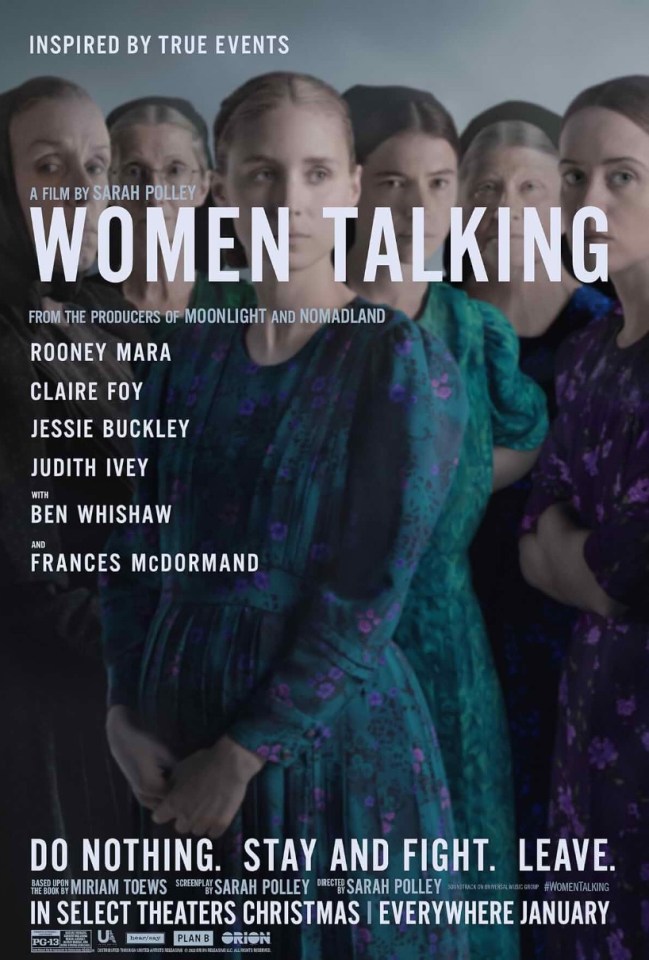
Women Talking

In (2023) I managed to see most of the movies nominated for the Best Picture at the Academy Awards. (except ‘Elvis’ – I was never much into Elvis and am not particularly fond of biopics in general.)

That was the year ‘Everything Everywhere All At Once’ won the award.

Sarah Polley’s film ‘Women Talking’ was awarded ‘Best Adapted Screenplay’

I thought it deserved ‘Best Picture’ – at least.

When I saw it at the theater I wept tears from the beginning to the end. I just watched it again on Prime Video, and it had much the same effect, although I was able to draw back just a little bit and appreciate the pure technical perfection of the film. (It won the Movie Of The Year from the American Film Institute.)

No film in my memory has affected me so deeply. I’ve elevated it to my top three favorite films of all time. (It falls between ‘Wings Of Desire’ for its depth, ‘Drive’ for its technical perfection – ‘Women Talking’ has both, and the best acting ensemble I’ve ever witnessed). I haven’t seen a better movie before or since.

Coming into this election and all of the struggles it has brought to the surface, ‘Women Talking’ perfectly exposes the deepest and most universal issues at play in this nation and in the world.

Halas

In the afternoons, following a day grappling with my high school insecurities, I’d stroll down the street from school to visit my friend Bill Halas at his home. Sometimes I’d bike over there in the evenings. Bill’s mother accepted me as an addition to a household that once included a husband and five older siblings. She and Bill, the latecomer, were both avid cooks and gardeners and active readers, sharing sophisticated tastes in music and art. Bill’s father passed away when he was very young, and when I met him his older siblings had long departed the household. Having an extraordinarily precocious and active mind his life had taken a rather solitary trajectory, his mother being the most reliable companion and sometimes his intellectual adversary. My own teenaged life was made unusual by the experience of being recruited for a special government program that took poor kids with high IQ’s out of their normal milieu and sent them to spend the summer living on college campuses. Our friendship flourished. Together we navigated the complexities of a rapidly changing world in the late 60’s, our bond growing from a shared sense of alienation and a drive for mutual discovery.

We met amidst a shifting cultural landscape with war, race riots, and assassinations unfolding in real time on our television screens. Popular culture was shifting radically from the segregated milieu of radio and the movies. Grasping for alternatives, we immersed ourselves in diverse music genres, from jazz to classical to experimental, and engaged in earnest discussions on philosophy and politics. We wandered the city smoking cigarettes rolled with pipe tobacco. We agreed and disagreed on everything. Sometimes we took his mother’s little Honda on road trips across the northern Ohio countryside, making up poetry inspired by highway signs (‘Pass With Care’).

I was the idealist and Bill was the purist, who took everything down to its roots. When I first met him he was experimenting with hydroponics. When he became interested in weaving he built his own loom and wove his own cloth and made his own hats. When he took up photography he began by studying its history, then building his own pinhole camera. Finally, he took up his brother’s old Nikon and developed the photos in his dad’s basement darkroom. My own nature was less grounded, tending toward the pursuit of imaginative utopian speculation and obscure strains of idealistic thinking. I felt compelled to understand the whole of everything, and very path I took led me down side roads, making it difficult to pursue a single course or become a model student.

Bill’s political awareness was way ahead of my own. He travelled to Chicago with his brother in 1968 to demonstrate at the Democratic convention and brought back photos and first hand accounts from the fringes of the police riot that we’d all watched on television. Later in our high school career we conspired with like minded friends to create an alternative journal that we mimeographed at the local anti-war office. We passed out leaflets and marched in circles chanting slogans in downtown Cleveland and attended meetings of a small radical organization led by a retired teacher and veteran of the Lincoln Brigade who fought in the Spanish Civil War.

888

Our friendship endured beyond high school as we pursued separate paths in college, delving into alternative communities and exploring the back-to-the-land movement. Bill’s quest for self-sufficiency and my search for spiritual revelation led us on distinct journeys. During those years in the early seventies everything everywhere was in flux and was being questioned, and for both of us the quest took us out of the proscribed path of college and career.

After we’d both left school we got together for a road trip east, tracking down old classmates and exploring alternative possibilities. We proceeded to Boston, where we met a friend of Bill on a sidewalk near Harvard Square. A large expansive figure closely resembling the British actor Peter Ustinov (with a beard), he sold carnations on the street, playing a concertina and disarming prospective customers with a performance that came right out of magical fairytales. We spent that evening at his lodgings in the attic of an unheated and condemned three story house in Roxbury. The next morning we crawled out of our sleeping bags to get breakfast at a nearby cafe. Our appetite for squalor satiated, we made our way out of the city and headed back to the Midwest.

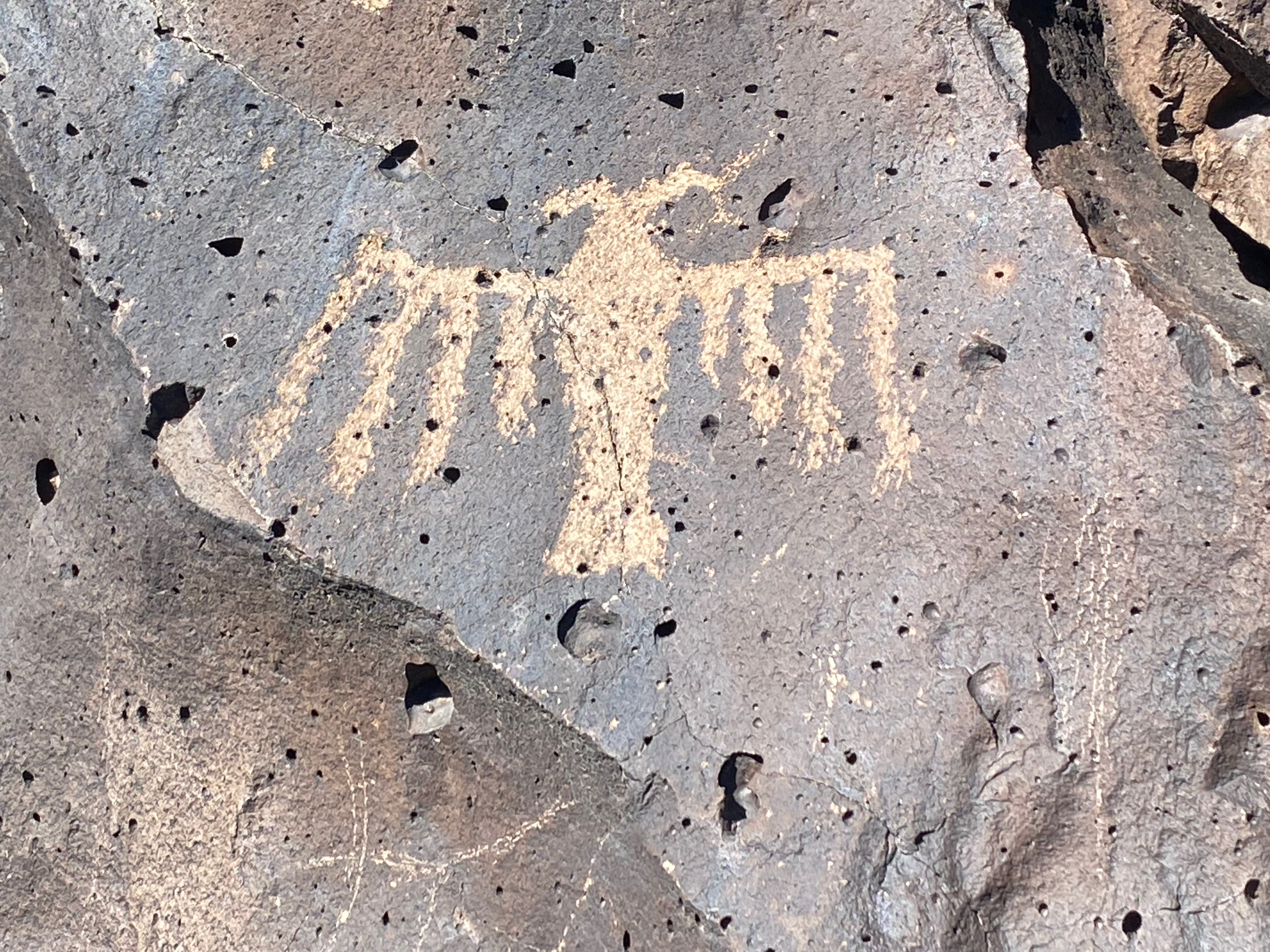
Eventually, after making a long pilgrimage to the West I moved to Denver. Occasionally, while visiting my family back east I’d get together with Bill and he’d demonstrate for me whatever new endeavor had absorbed his interest. Over time these became increasingly esoteric even for my taste, involving dowsing and ley lines evidence for antedeluvian alien carvings left behind in rocks and boulders. He poured over old maps illustrating the mysterious energetic pathways determining the placing of streets and structures in small towns all over Ohio.

Our contacts dwindled over the years, and the last I heard from Bill was through letters filled with further interpretations of ancient artifacts and faces found in the rocks. I’d heard he was in contact with the Edgar Cayce people in Virginia and intended to build his own private settlement on a plot of land that his brother owned in Vermont. After at a year of hearing nothing I found out from his mother that he’d fallen out of communication with everyone. In a last message to his older brother, Bill had mentioned spotting a brown bear on the plot of land. After months of trying to track down his whereabouts the family concluded that he’d disappeared without a trace. For the sake of closure they accepted that he’d probably been eaten by the bear.

I don’t know what really happened to Bill Halas. All I’m sure of is that

All I know is that we shared a moment in time, embarking on uncompromising journeys, determined to face the mysteries of the world, whether in the rocks, the forest, or the primal currents beneath.”

Peter Zeihan As Clickbait

I was recently sent the recent Peter Zeihan book, The End Of The World Is Just The Beginning: Mapping The Collapse Of Globalization. Upon reading it I feel compelled to offer my critique. Aside from the rather dismissive and generally smart-ass style with which the author delivers his doom prophecies, the book is very informative in terms of outlining the complex systems and their interrelationships that currently run the world, and it offers valuable pointers toward highlighting the system’s strengths and weaknesses. At the same time it’s a vivid illustration of the trap of over reliance on statistical data when addressing complex systems. I’ve rarely encountered an argument that rests on so many facts that work against the very case that the book is making. Not only is it full of contradictory and sometimes questionable assumptions, the data that backs the world view the author delivers could equally support the likelihood of continued globalization as it can for its dissolution.

The fulcrum of Ziehan’s argument hangs on two assumptions:

1.) Aging populations and declining birth rates will result in a worldwide demographic collapse that will upset the patterns of production, distribution and consumption that fueled the economic boom times since World War Two.

A 1968 best seller by Paul and Anne Ehrlich,The Population Bomb delivered, in a similarly apocalyptic tone, a revival of the 18th century theory by Thomas Malthus, that the growth of population with the rise of prosperity, particularly among the poor, would inevitably exceed humanity’s ability to grow enough food. While Zeihan’s argument runs exactly in the opposite direction, both prognostications rely on a set of ever-shifting statistics to make their case.1 Food production since the time of Malthus has continually outpaced the growth of population. Problems with global starvation and famine are due less to population increase than to the unplanned consequences of war and the inequitable distribution.

Over the course of my many decades of living on the planet under the constant threat of extinction, I’ve been presented with so many predictions of impending catastrophe that I’ve lost count. From the Rapture to nuclear war to DDT and Y2K and global anarchy, the predictable constant is that in times of anxiety and change these prognostications sell books and provide rich fodder for talk radio. Attempts to reduce enormously complex systems to fit into the terms of one or two basic assumptions invariably fail to meet anyone’s predictive timescales. Demographics are one single factor among countless others that can affect outcomes, leaving aside our ever shifting politics and human resourcefullness, our ever advancing technologies affecting the ways we live and work and talk to one another, and our dawning collective awareness of the effects of climate change, to name a few.

2.) Zeihan’s second assumption is that the American Empire will simply give up on the world ‘Order’ that it has helped establish and maintain since the World Wars. Apparently America will simply conclude that it’s simply too much trouble and expense to continue enforcing the peace and we’ll withdraw into our geopolitical fortress. After all, we’re geographically in a position to grow our own food and make our own shit and let the rest of the world go to hell. Aside from espousing an incredibly arrogant, if not popular view of American exceptionalism, the very fact that our economic prosperity has been fostered by our multicultural ties and the intricate trade and military relationships we’ve constructed over these many decades makes it extremely unlikely that we will or can turn away. Even if we attempted such a thing, undoubtedly other entities or alliances would take our place, and we’d be shuffled a little lower in the deck of international authority.

Which brings us to China2. Having read and listened to a number of accounts from inside China. (I highly recommend the ‘Drum Tower’ podcast from ‘The Economist’ magazine for a more down to earth view of Chinese politics and culture.3) Zeihan spares no opportunity to dump on China, leaving an impression that its the very model of his overall thesis that most of the rest of the world is doomed in economic terms, while the USA and North America will pull through rather nicely. In reality, for anyone that takes a closer look through the paranoid cloud of American propaganda, it appears that China’s problems, both economic and demographic, are practically a mirror image of similar problems being felt in both America and Europe. In many cases the realities in China (the biggest crisis right now is too few opportunities for young people – not too many) are largely distinguished by the fact that, unlike the USA they are actually able to quickly respond in dealing with them. China ain’t going anywhere, and neither is America, or Europe, except perhaps in the fevered ‘click bait’ imagination of people like Zeihan. These major blocks of world power are so inextricably interdependent that the likelihood of any of them being left behind in the foreseeable future is vanishingly small.

For several years I was on the mailing list of ‘STRATFOR’, the organization that Peter Zeihan once worked for. Like Zeihan they have a world view that sticks closely to the ‘geography is fate’ interpretation of world history promoted by conservative scholars like the very prolific Robert Johnson (‘Modern Times’, ‘The Birth Of The Modern’, and histories of America, the Jews, Christianity, Ireland, plus biographies of Churchill, Jesus, Darwin, George Washington and others – a few of which I’ve read and been impressed by.). I agree that, so far, global history has been largely determined by access to the oceans. From the conquest of the great ‘pirate’ empires of the 15th – 16th centuries right up to the rise of ‘globalization’, this view has been accurate. However, we are all now swimming in a different ocean, one that’s linked by the instantaneous communication and management of economics and resources through the ubiquitous ocean of digital media. This is now where business is driven, wars are made, alliances are formed and broken.

I remember Stratfor’s frequent skepticism that Europe could ever manage to hold together. Virtually none of their predictions have held true over the years. The recent Soviet invasion has catalyzed an opposite movement toward increased solidarity rather than further fragmentation. America, meanwhile, is showing increasing signs of weakness as it breaks into regional conflicts and rising paranoia. It has made it almost impossible for the nation to deal substantially with basic problems like poverty, endemic racism and rising political violence. Meanwhile China not only holds together, it exerts increasing global influence as it steps into the weakening breach of American influence in Africa, South America and the Middle East.

Every nation is an ongoing experiment in how to manage growth and change in an increasingly complex web of global relations. Not one gots it completely right or completely wrong, and every error is an opportunity to learn. Peter Zeihan grossly underestimates, in my opinion, the capabilities, creativity and ingenuity of people in general, especially anyone who isn’t living in North America. Unfortunately, in much of his writing I hear echoes of the Trump crowd, mindlessly shouting USA!!!USA!!!USA!!!

The proposition that America will withdraw from the world in some form of neo-isolationism is one that nearly every fact and trend sighted in Zeihan’s book actually makes less, rather than more likely. His theory of collapse, requires a kind of bunker mentality in which every nation stands essentially on its own and only the strongest will thrive or even survive.

History doesn’t tend to move backwards, and the sort of decivilization that Zeihan predicts, in a world as interdependent as the world he describes, no nation, especially one as central to the function of the whole intricate mechanism as the United States, can afford to go its separate way. America’s economy, as much as China’s or England’s or Argentina’s or the Philippines’ or Russia’s, is a ‘global’ economy. Oceans and hemispheres that once divided the world into separate kingdoms and empires are no longer effective barriers against the changes that affect us all.

No one can deny that there will be profound disruptions that will reshape the political, military and economic landscapes in the coming decades. To anyone paying attention, it’s evident that our modes of consumption and governance will be forced to adapt and evolve in ways that we only dimly imagine. We will face wars, famine, pandemics, climate events, natural disasters and shortages of things we’ve taken for granted. Every political entity will be confronted with its own contradictions. In the long run the question is whether these changes and challenges drive us, as global citizens, further apart or force us to recognize our absolute interdependence. Zeihan’s book assumes the former. I don’t necessarily disagree with his statement, “Shortage forces people – forces countries – to look after their own needs.” I would add that history also shows that in the face of shortages and disasters people, and perhaps nations, also awaken to their common needs.

(I have to add that Zeihan’s understanding of global agriculture is particularly weak. Statements like “You can have organic farming or environmentally friendly foods. You cannot have both”, are simply absurd. It’s been demonstrated again and again, in China and America and all over the globe, that the per hectare production of food grown using intensive sustainable methods on smaller scale farms generally exceeds that of the industrialized monoculture farming promoted worldwide and dominated by corporate culture, while leading to much less long term environmental devastation.)

The kind of hair-on-fire apocalyptic messaging delivered by Zeihan and others certainly sells books. Apocalyptic visions have aleways had an appeal in the popular imagination, and are guaranteed to gather attention from Joe Rogan audiences, talk radio hosts, and down various YouTube rabbit holes. The ‘paranoid style of American politics’ 4 has always had particular appeal in uncertain times, when folks are stirred up by the direction things are going.

As for American exceptionalism, that’s so much a refrain in Peter Zeihan’s view of the world, I’m reminded of the Sergio Leone quote:

“I began to understand that ‘America’ in reality belonged to the whole world and not just to Americans. The idea of America had already been invented by the philosophers, the vagabonds, the dispersed of this earth, long before the Spanish ships got there. Those whom we call Americans have only rented it for a time. If they behave badly, we can discover another ‘America’. The contract can be canceled at any time.”

  1. https://worldaffairs.blog/2022/07/09/debunking-peter-zeihans-shocking-and-popular-china-predictions/
  2. https://www.nextbigfuture.com/2023/01/here-is-what-peter-zeihan-got-wrong-on-the-joe-rogan-show.html
  3. Linkhttps://pca.st/podcast/21f082b0-377d-013b-efb0-0acc26574db2
  4. https://harpers.org/archive/1964/11/the-paranoid-style-in-american-politics/

Trial

I just imbibed two healthy pints of Scotch Ale, a small handful of psychedelic mushrooms and a chunk of potent marijuana brownie…while printing 32 greeting cards so that I can replenish my rack at the grocery store and contribute to my gasoline fund for future trips into the present.

I’m hoping that some combination of the above will somehow blast me out of a sense of helplessness in the face of all the craziness and suffering, although I know it’s not really my responsibility and that I’ve done my part to advance this whole contraption…

I’ve been watching VICE NEWS documentaries looking into the darkest corners of the world, watching ‘Severance’ and ‘The Man Who Fell To Earth’, reading a Jonathan Franzen novel about a Christian youth group and reliving so many moments in the deep past in order to write about them, and writing about them, and wondering if this voluntary isolation from all the world matters anything at all.

I can only bear witness:

“This happened…this is what I felt.”

Can’t Get You Out Of My Head

Reflections On The Work Of Adam Curtis

Adam Curtis considers his films to be strictly journalism. 

Having unlimited access to the vast archives of the BBC library, Curtis snips and cuts the myriad fragments of visual history to arrange them around themes guided by his own narrative and analysis. To relegate these works to the narrow field of conventional reporting would be to entirely miss their import and effect. The subjects of his films dive deeply into the wilderness of inherent contradictions between reality and the artificial reproductions of reality, between fact and imagination, between linear narrative and memory, and the many ways we rearrange our perceptions of reality to serve our own agendas. His most recent work, the six part series titled Can’t Get You Out Of My Head focuses on the dialectic between historical and psychological forces that drive individuals into increased feelings of isolation and helplessness and the barriers to effective collective action.

The emotional power of well selected images poised in sharp juxtaposition has been  explored as long ago as in the montage techniques pioneered by early filmmakers like Sergei Eisenstein. The use of montage takes us out of the illusory realms of objectivity and well into the territory of ideological expression. Directors like Jean Luc Godard and the ‘underground’ filmmakers of the sixties made radical use of the technique to purposely challenge the conventions of narrative film. While their work was perceived at the time as radical, our immersion in the frenetic medium of television makes them appear prophetic. The rapid disorienting shift between scenarios, the intrusion of seemingly unrelated sequences in commercials and the use of sound as compliment and contrast has increased our ability to shift attention rapidly from one image to another without loosing the narrative thread. Adam Curtis takes advantage of the growing sophistication of our visual language while pushing the form further with each successive work, encouraging us to take larger leaps along with him.

(My favorite film makers of the sixties were the French New Wave’director Jean Luc Goddard and the English director, Nicholas Roeg. Being a contrarian by nature I was always thrilled at the premier of a Godard film on my college campus and particularly pleased when a third to half of the audience walked out in bewilderment or disgust. This I deemed an indication of the film’s success. Both Godard and Roeg used techniques of radical montage to pit direct and sometimes disjointed, emotionally charged images against the linear revelations of plot. Godard went the farthest, often rejecting the very structure of ‘beginning, middle and end’ in films like 2 Or 3 Things I Know About Her, Sympathy For The Devil and See You At Mao. Nicholas Roeg managed to corral these techniques into challenging narratives interrupted by out of synch and out of time sequences taking the viewer out of the linear present into realms of memory, imagination and pure emotion. His use of popular musical icons as actors in films like Performance and The Man Who Fell To Earth became immensely popular with the psychedelic generation. 

At least since 1992 with Pandora’s Box, followed by the more ambitious Century Of The Self and into the present Adam Curtis has employed montage with increasing ambition to deliver films that offer historical analysis along with imagery that comes across with devastating emotional impact. To Curtis the purpose of journalism is not merely to report, but to explain. His method is to distill and arrange out of the many sounds and images of a given historical period a presentation of coherent themes that persuade the viewer that his interpretation matches the reality. Journalism in this sense is the art of persuasion. 

Human beings are addicted to narrative. If presented with a random set of images our minds will eventually assemble them into stories. If we stare at a wall long enough our minds will weave narratives out of the imperfections in the paint. This is a key to the methods of psychological testing that is critiqued in much of Curtis’ work. Ironically perhaps, it’s the key to his own art and his approach to journalism. When the reporter in a war zone decides to point the lens of their camera they are continually selecting the elements of their own narrative. When Adam Curtis wades through the BBC archives the images he selects are made to fit the preconceived patterns of a story he wishes to tell. 

Episode four of his most recent work is titled ‘But what if the people are stupid.’ It’s primary theme is how our disillusionment with institutions born out of the emphasis on individualism in the sixties and seventies morphed into a retreat into nationalism in the eighties and nineties. Curtis pulls together accounts that range widely across the period, from the unsuccessful coup of the Gang Of Four in China to the somewhat tragic life of a transexual pioneer in England, the rise of Al Queda in Iraq, disappointment in the wake of the Live Aid effort and events that led to the crushing of protests in Tiananmen Square. All of these events are bracketed by accounts of psychological experiments carried on by Daniel Kahneman in the seventies leading to the thesis that people’s choices aren’t made primarily on a rational basis but are determined by their previous experiences and how they effect the deeper, mostly subconscious structures in the brain. By focusing on the personal dilemmas and contradictions faced by particular individuals against a backdrop of massive social movements Curtis dramatizes a specific and worldwide shift in our collective experience serving to frustrate our ability to organize coherent resistance to the growing power of elites. This sets us up for the next episode, ‘The Lordly Ones’, which explores the comforting national myths we construct to justify the blunders and atrocities carried out to maintain the rule of dominant capitalist elites over the rest of the world.

On the surface Curtis’ approach resembles that of an historian or archaeologist as much as that of a journalist. All are storytellers and agents of artifice, weaving our perceptions into coherent streams of interpretation and all deal with data fragments from moments gone by. The stories Adam Curtis chooses to tell center on the influence that modern psychology has  had on the manipulative techniques of advertising, the growth and dominance of consumerism, and most importantly the isolation of the individual in the shadow of the capitalist state, rendering concepts such as personal freedom and choice almost entirely irrelevant.

We’ve become helpless as collective societies to effectively act to change our circumstances. Instead, our every activity is measured, tabulated and arranged in predictive models that serve to anticipate and then to manipulate our behaviors. Human behavior has been programmed into machinery that uses algorithms to further the power and wealth of economic elites. Only by breaking free of the conceptual prison of the techno-capitalist state can we even begin to imagine a future that meets actual human needs.

Perhaps we expect that journalism and documentary gives us a more accurate glimpse of the real and the true. What we should have learned in an age of propaganda, ‘fake news’ and the Internet is that in the selection and manipulation of images just about any version of ‘reality’ can be made to appear as truth. In the view of Adam Curtis the true value of journalism is to ‘make sense’ of the world in new and original ways that evolve continually with our continual appetite for the new. This is the only way that we can cast off the oppressive chains of the past. We might do well to make his revolution our own.


Thoughtmaybe.com for access to a full catalogue of Adam Curtis Documentaries and many other worthwhile films.


An outstanding interview with Adam Curtis at: Jacobin.com