We aren’t helpless. All of what’s against us is part of what Naomi Klein calls ‘The Shock Doctrine’, and others call ‘Flooding The Zone’. The object is to bombard people with a sense of constant crisis, so that we become numbed, disoriented, confused and discouraged, and ultimately we loose focus and give in to despair.
A counter to this is embracing a wider vision, one that no longer perceives the world as if our particular national perspective is the only lens available. The world is changing rapidly and far too quickly for anyone to exert enduring dominance and control. We are watching the diminishing of outmoded institutions like the nation state and moving gradually (and painfully) toward a different alignment of the global order. Rather than hurling bombs and nukes back and forth, the economic and political universe, under the pressures of climate change and new technologies is rapidly reorganizing itself.
Resistance to the domination of any religion, ideology, or so-called ‘superpower’ is arising everywhere. In every nation and in every person, all of the old boundaries and alliances are being daily challenged.
We don’t have to be overwhelmed. The whole world is rapidly being forced awake. We must become attuned and direct our attention toward helpful and healing efforts going on in the world. Human beings are endlessly creative. Although we often struggle to open our vision to new worlds and a new order, we’ve never failed to see our way through.
We are no longer isolated. No one is. The world is one interwoven economic organism. Like the Internet, a vast and excellent living protoplasm, woven in networks, designed to reorganize and reroute itself around anything that blocks its way, anything that wounds or damages. Designed to defy apocalypse and to survive.
It has started. We’ve been attacked from within. Blood will be shed. Blood must be shed. That’s the price…the sacrifice. It will be the young on the streets and the old in their homes. The center will not hold, because we all dwell in the periphery. A new center will arise in each of us. The center and the whole will be the same.
In (2023) I managed to see most of the movies nominated for the Best Picture at the Academy Awards. (except ‘Elvis’ – I was never much into Elvis and am not particularly fond of biopics in general.)
That was the year ‘Everything Everywhere All At Once’ won the award.
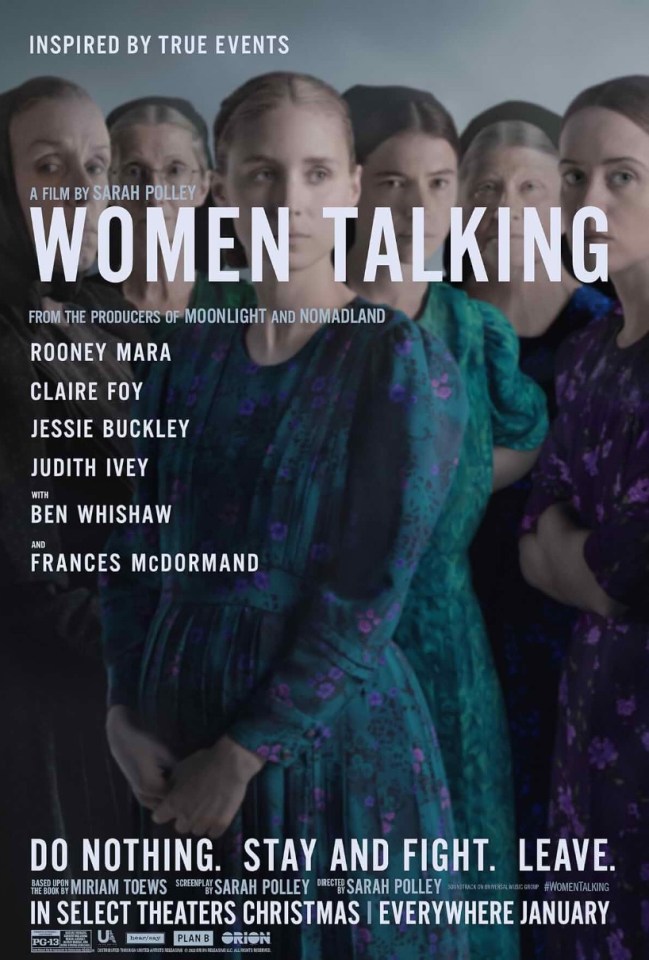
Sarah Polley’s film ‘Women Talking’ was awarded ‘Best Adapted Screenplay’
I thought it deserved ‘Best Picture’ – at least.
When I saw it at the theater I wept tears from the beginning to the end. I just watched it again on Prime Video, and it had much the same effect, although I was able to draw back just a little bit and appreciate the pure technical perfection of the film. (It won the Movie Of The Year from the American Film Institute.)
No film in my memory has affected me so deeply. I’ve elevated it to my top three favorite films of all time. (It falls between ‘Wings Of Desire’ for its depth, ‘Drive’ for its technical perfection – ‘Women Talking’ has both, and the best acting ensemble I’ve ever witnessed). I haven’t seen a better movie before or since.
Coming into this election and all of the struggles it has brought to the surface, ‘Women Talking’ perfectly exposes the deepest and most universal issues at play in this nation and in the world.
I just finished the remarkable new book by Nancy Pelosi, The Art Of Power. It was on the one hand an inspiring first hand account of indomitable courage and determination in the face of difficult odds and a history of the major political struggles I’ve witnessed since 1987. On the other hand it’s an account of a time of civility in politics and government that has frayed and all but collapsed since the rise of Trump.
I feel both pessimistic and useless in the face of what’s coming. I now find myself reading books about the lead up to wars; Eric Larson’s The Demon of Unrest, about the five months preceding the first American Civil War, and The Proud Tower, by Barbara’s Tuchman, about Europe and America before World War One. Each marked the necessary transition from one state of civilization to the next. I find that reading history helps me out of a state of helpless depression, perhaps it helps me to accept that what’s likely to happen has happened before.
Yesterday I saw Coppola’s new and perhaps final film, Megalopolis, which is a rather surrealistic fable depicting the conflict between creativity and stagnation in a world of decadence and decline. It ends in a rather fanciful and/or hopeful conclusion, where creativity and progress apparently triumphs over our clinging to the past.
I was reminded of the film that has had a strong impact on me this year. Civil War depicts in realistic and down to earth terms a likely scenario should the USA descend once again into bloody conflict. In interviews, both the director and the actress Kirsten Dunst refer to Lee Miller, upon which her character is based, and the subject of the newly released Kate Winslet film, Lee She was a World War Two photographer who bore witness to some of the worst atrocities of that conflict.
I’ve come to believe that the likelihood of an election without violence and a peaceful transition of power is unlikely, no matter who wins, and the only thing you or I can do to alter events is to choose not to participate in the violence in word or deed. We must refuse to spread the hatred and fear being directed by so-called leaders, against the poor, the weak and the ‘others’ in order to advance a bid for supremacy and power. We must recognize the seeds of fascism that are being encouraged everyday, and deny them from taking root within us.
I’ll be driving up to Denver to take a flight to Cleveland to visit family on October 24th and will return to Santa Fe the day before the election. I wonder whether this trip will mark a rise or fall of the world we’ve known. Right now I’m not betting either way.
I was recently sent the recent Peter Zeihan book, The End Of The World Is Just The Beginning: Mapping The Collapse Of Globalization. Upon reading it I feel compelled to offer my critique. Aside from the rather dismissive and generally smart-ass style with which the author delivers his doom prophecies, the book is very informative in terms of outlining the complex systems and their interrelationships that currently run the world, and it offers valuable pointers toward highlighting the system’s strengths and weaknesses. At the same time it’s a vivid illustration of the trap of over reliance on statistical data when addressing complex systems. I’ve rarely encountered an argument that rests on so many facts that work against the very case that the book is making. Not only is it full of contradictory and sometimes questionable assumptions, the data that backs the world view the author delivers could equally support the likelihood of continued globalization as it can for its dissolution.
The fulcrum of Ziehan’s argument hangs on two assumptions:
1.) Aging populations and declining birth rates will result in a worldwide demographic collapse that will upset the patterns of production, distribution and consumption that fueled the economic boom times since World War Two.
A 1968 best seller by Paul and Anne Ehrlich,The Population Bomb delivered, in a similarly apocalyptic tone, a revival of the 18th century theory by Thomas Malthus, that the growth of population with the rise of prosperity, particularly among the poor, would inevitably exceed humanity’s ability to grow enough food. While Zeihan’s argument runs exactly in the opposite direction, both prognostications rely on a set of ever-shifting statistics to make their case.1 Food production since the time of Malthus has continually outpaced the growth of population. Problems with global starvation and famine are due less to population increase than to the unplanned consequences of war and the inequitable distribution.
Over the course of my many decades of living on the planet under the constant threat of extinction, I’ve been presented with so many predictions of impending catastrophe that I’ve lost count. From the Rapture to nuclear war to DDT and Y2K and global anarchy, the predictable constant is that in times of anxiety and change these prognostications sell books and provide rich fodder for talk radio. Attempts to reduce enormously complex systems to fit into the terms of one or two basic assumptions invariably fail to meet anyone’s predictive timescales. Demographics are one single factor among countless others that can affect outcomes, leaving aside our ever shifting politics and human resourcefullness, our ever advancing technologies affecting the ways we live and work and talk to one another, and our dawning collective awareness of the effects of climate change, to name a few.
2.) Zeihan’s second assumption is that the American Empire will simply give up on the world ‘Order’ that it has helped establish and maintain since the World Wars. Apparently America will simply conclude that it’s simply too much trouble and expense to continue enforcing the peace and we’ll withdraw into our geopolitical fortress. After all, we’re geographically in a position to grow our own food and make our own shit and let the rest of the world go to hell. Aside from espousing an incredibly arrogant, if not popular view of American exceptionalism, the very fact that our economic prosperity has been fostered by our multicultural ties and the intricate trade and military relationships we’ve constructed over these many decades makes it extremely unlikely that we will or can turn away. Even if we attempted such a thing, undoubtedly other entities or alliances would take our place, and we’d be shuffled a little lower in the deck of international authority.
Which brings us to China2. Having read and listened to a number of accounts from inside China. (I highly recommend the ‘Drum Tower’ podcast from ‘The Economist’ magazine for a more down to earth view of Chinese politics and culture.3) Zeihan spares no opportunity to dump on China, leaving an impression that its the very model of his overall thesis that most of the rest of the world is doomed in economic terms, while the USA and North America will pull through rather nicely. In reality, for anyone that takes a closer look through the paranoid cloud of American propaganda, it appears that China’s problems, both economic and demographic, are practically a mirror image of similar problems being felt in both America and Europe. In many cases the realities in China (the biggest crisis right now is too few opportunities for young people – not too many) are largely distinguished by the fact that, unlike the USA they are actually able to quickly respond in dealing with them. China ain’t going anywhere, and neither is America, or Europe, except perhaps in the fevered ‘click bait’ imagination of people like Zeihan. These major blocks of world power are so inextricably interdependent that the likelihood of any of them being left behind in the foreseeable future is vanishingly small.
For several years I was on the mailing list of ‘STRATFOR’, the organization that Peter Zeihan once worked for. Like Zeihan they have a world view that sticks closely to the ‘geography is fate’ interpretation of world history promoted by conservative scholars like the very prolific Robert Johnson (‘Modern Times’, ‘The Birth Of The Modern’, and histories of America, the Jews, Christianity, Ireland, plus biographies of Churchill, Jesus, Darwin, George Washington and others – a few of which I’ve read and been impressed by.). I agree that, so far, global history has been largely determined by access to the oceans. From the conquest of the great ‘pirate’ empires of the 15th – 16th centuries right up to the rise of ‘globalization’, this view has been accurate. However, we are all now swimming in a different ocean, one that’s linked by the instantaneous communication and management of economics and resources through the ubiquitous ocean of digital media. This is now where business is driven, wars are made, alliances are formed and broken.
I remember Stratfor’s frequent skepticism that Europe could ever manage to hold together. Virtually none of their predictions have held true over the years. The recent Soviet invasion has catalyzed an opposite movement toward increased solidarity rather than further fragmentation. America, meanwhile, is showing increasing signs of weakness as it breaks into regional conflicts and rising paranoia. It has made it almost impossible for the nation to deal substantially with basic problems like poverty, endemic racism and rising political violence. Meanwhile China not only holds together, it exerts increasing global influence as it steps into the weakening breach of American influence in Africa, South America and the Middle East.
Every nation is an ongoing experiment in how to manage growth and change in an increasingly complex web of global relations. Not one gots it completely right or completely wrong, and every error is an opportunity to learn. Peter Zeihan grossly underestimates, in my opinion, the capabilities, creativity and ingenuity of people in general, especially anyone who isn’t living in North America. Unfortunately, in much of his writing I hear echoes of the Trump crowd, mindlessly shouting USA!!!USA!!!USA!!!
The proposition that America will withdraw from the world in some form of neo-isolationism is one that nearly every fact and trend sighted in Zeihan’s book actually makes less, rather than more likely. His theory of collapse, requires a kind of bunker mentality in which every nation stands essentially on its own and only the strongest will thrive or even survive.
History doesn’t tend to move backwards, and the sort of decivilization that Zeihan predicts, in a world as interdependent as the world he describes, no nation, especially one as central to the function of the whole intricate mechanism as the United States, can afford to go its separate way. America’s economy, as much as China’s or England’s or Argentina’s or the Philippines’ or Russia’s, is a ‘global’ economy. Oceans and hemispheres that once divided the world into separate kingdoms and empires are no longer effective barriers against the changes that affect us all.
No one can deny that there will be profound disruptions that will reshape the political, military and economic landscapes in the coming decades. To anyone paying attention, it’s evident that our modes of consumption and governance will be forced to adapt and evolve in ways that we only dimly imagine. We will face wars, famine, pandemics, climate events, natural disasters and shortages of things we’ve taken for granted. Every political entity will be confronted with its own contradictions. In the long run the question is whether these changes and challenges drive us, as global citizens, further apart or force us to recognize our absolute interdependence. Zeihan’s book assumes the former. I don’t necessarily disagree with his statement, “Shortage forces people – forces countries – to look after their own needs.” I would add that history also shows that in the face of shortages and disasters people, and perhaps nations, also awaken to their common needs.
(I have to add that Zeihan’s understanding of global agriculture is particularly weak. Statements like “You can have organic farming or environmentally friendly foods. You cannot have both”, are simply absurd. It’s been demonstrated again and again, in China and America and all over the globe, that the per hectare production of food grown using intensive sustainable methods on smaller scale farms generally exceeds that of the industrialized monoculture farming promoted worldwide and dominated by corporate culture, while leading to much less long term environmental devastation.)
The kind of hair-on-fire apocalyptic messaging delivered by Zeihan and others certainly sells books. Apocalyptic visions have aleways had an appeal in the popular imagination, and are guaranteed to gather attention from Joe Rogan audiences, talk radio hosts, and down various YouTube rabbit holes. The ‘paranoid style of American politics’ 4 has always had particular appeal in uncertain times, when folks are stirred up by the direction things are going.
As for American exceptionalism, that’s so much a refrain in Peter Zeihan’s view of the world, I’m reminded of the Sergio Leone quote:
“I began to understand that ‘America’ in reality belonged to the whole world and not just to Americans. The idea of America had already been invented by the philosophers, the vagabonds, the dispersed of this earth, long before the Spanish ships got there. Those whom we call Americans have only rented it for a time. If they behave badly, we can discover another ‘America’. The contract can be canceled at any time.”
Whenever someone tells me that they’ve arrived at a certain conclusion after doing research on the internet, I feel a certain skepticism arise. What I’ve encountered, too often, is that what people mean by ‘research’ is that they plunged into the endless astral abyss of the online world in search of confirmation for something they already believed, discarding anything that pointed in another direction. This style of journey very easily draws a person into one or another of the countless maelstroms that crowd the vast oceans of ideation and imagery. These are popularly known as ‘rabbit holes’, implying a maze of subterranean tunnels that lead nowhere else but in circles.
In an age of growing animosity and paranoia born out of divergent views of reality, this approach is rarely reliable. Too often it leads to delusion and at worst it can be deadly. When a person is online they’ve essentially parted from this physical plane and entered a bardo state, where every kind of illusion, every spirit, every angel and every demon abides in their own pocket universes, and every separate pocket at some level is connected to every other.
These days there’s a great deal of imaginative speculation around the concept of multiverses. For anyone who has even casually investigated the lore connected with the occult or magical worlds this is certainly nothing new. Neither is it strange territory for anyone familiar with the hallucinatory frontiers revealed by mind altering substances. For the experienced explorer the pitfalls and dangers inherent in crossing the boundaries between worlds are quite familiar.
Actually, we cross those boundaries whenever we open a book, go to the movies, listen to music, turn on television or the radio, or look at a painting or photograph. We do it when we meditate, when we daydream, when we tell each other stories. If we are truly present and open we immerse ourselves in parallel dimensions when in church or temple. Everyone living in the universe of electronic media is used to migrating between radically different realms from second to second as they are bombarded by narratives and counter narratives continually interrupted by commercials and trips to the refrigerator.
We’ve come to consider all of these journeys to be safe and well contained, but this wasn’t always the case. We had to learn how to receive and to navigate as well as to comprehend what we encounter through these myriad windows and doors. Mostly it’s been a matter of submiting to the conscious intent of the authors or composers who guide us through worlds they’ve created. This is an act of trust and surrender, taken more or less with conscious and specific intent and the assumption we’ll be let off the bus more or less at the place from where we embarked.
When the photograph was invented the linear dimensions of time and space were irrevocably breached. The four dimensions of spacetime are reduced to two through an entirely mechanical and alchemical process, independent of the impressionistic intercession of a painting or a drawing. A photograph is more than a mere impression, it’s an actual artifact, in which a particular moment continues to exist, and can be endlessly reproduced and experienced in succeeding moments.
The internet as we know it today didn’t really emerge until the graphic image took its place beside the display of text, along with the innovation of hyperlinks that could connect any image or text or sequence to any other. At that point the dimensional breach first created by the photograph became an explosion that began to tear our world into countlessly proliferating fragments, challenging all of our existing conceptions of civilization and order.
I entered the virtual world in 1984 when I purchased my first Macintosh computer and connected the dial up modem to explore various discussion groups and communities springing up all around the world. Very early on I began to learn about the power and potential toxicity of the words and images I encountered and expressed online. In those days conversation dominated commerce. There were no smartphones. I felt like an explorer on an island newly forming and expanding under my feet. Most of us who were there have some nostalgia for those times gone by.
Two or three generations later not only content and delivery have evolved but whole new languages are being invented online almost daily. The whole world is being absorbed and transformed in its encounter with virtual dimensions. I sometimes wonder if there’s anything of value an old timer can contribute as the tides sweep us all along.
Be careful. Question everything. Beware of obsessive or reactive behavior. Notice how your online activity effects your relationship with the offline world. Have other people in your life. Try to be kind.
It’s all too easy to get lost in an ocean of chaos. We become desperate for a coherent line or narrative that can make sense of it all. There are as many lifelines as there are points of attraction. They are all hard to resist and not all lead in healthy directions. We’ve spent centuries learning the tools of reason, science and intuition, in order to navigate our way through an increasingly complex and conflicted environment. We will need all of these tools to survive. The choices we make in the virtual world are no different from the choices we make in the physical one. Each affects our friendships, our affiliations and our very survival.
For a child a backyard can be the wilderness, or the ocean or an island of mystery. For a young person on foot or on a bicycle the city is almost infinite. For a grownup with a car the city is an endless maze of turns and corners, backstreets and cul de sacs and the lifeless arteries of freeways and bypasses. For those whose life is made mostly of flyovers the city is a patch on the landscape, part of a network of patches connecting airports and terminals and waiting areas.
At each level details are missed or lost.
The child never tires of the cracks in paving stones or the creatures found among the grasses. The mysterious realm outside of safe boundaries is overcome by imagination without limits. A porch becomes a spaceship or the ramparts of a castle. Every angle and corner is explored repeatedly and new wonders are constantly revealed.
The world beyond fences and borders opens to foreign lands and neighborhoods and secret haunts beside creeks and rivers and under bridges. In every direction the familiar gives way to novel possibilities and pathways. There are people and places that reveal themselves like secrets and anyone who dares can find the hidden spaces populated by teenagers and wanderers and sometimes the homeless poor.
Cars take us far away into foreign places while detaching us from what we know or what we can really call home. We are caught up in the proscribed flow of traffic designed to conduct us past the details of place and time. We become tourists or commuters, always just passing through to arrive somewhere other than where we are. We begin to live in bubbles and we call this freedom.
Those who flyover begin to look elsewhere for a sense of being unconfined. Living in prisons of wealth or notoriety we dream of another existence outside or beyond the worlds we know. We dream of space colonies and going to Mars and look upon the earth as a place to transcend or to escape. We look at situations as confrontations or problems to be solved and tend to forget about both the earth and the oceans as places in which to thrive or to simply be.
Meanwhile the waters rise.
Jeff Bezos sees the salvation of the earth in building vast cities in an environment entirely hostile to all biological life. I understand both the impulse and the fascination. I’ve been addicted to dramas about outer space since I was a small boy. I consider myself somewhat of a ‘trekkie’ for whom science fiction is one of my favorite literary genres. Perhaps this is because of the metaphorical value it offers in representing our moral quandaries against the frontier background of an imaginary universe. Maybe it’s merely an offshoot of the magical thinking that filled my adolescent fantasies.
The myth of the frontier we are told, is a necessary creation of the human urge for freedom and novelty. Ironically, the realities of survival in outer space run absolutely counter to all but a momentary sense of real freedom. Whether we journey in a small capsule or a giant artificial metropolis we will find ourselves confined within a tin can in an airless void bombarded by deadly radiation. The rules of existence are many times more restrictive than anything we face on the surface of our own planet. Even if we find other worlds ‘out there’ that are compatible with some form of life the odds are extremely thin that it would be compatible with our own. Ironically, my favorite novel by my favorite writer of ‘hard’ science fiction, ‘Aurora’ by Kim Stanley Robinson, offers a sobering argument questioning the likely success of such an endeavor.
True, the endless mysteries of the universe are irresistible to our insatiable curiosity and I look eagerly forward to their continued exploration and unraveling. However, the idea that we can save or preserve our species’ existence by launching a significant bulk of our population into outer space appears to me increasingly absurd.
Even in terms of mysteries, not to mention frontiers, we live on a planet that’s more than 3/4 covered in water, and we know less about the depths of the oceans than we do about other planets in our solar system. Yet, water is not only the element that makes our carbon based life possible, it’s teeming with the material that makes it sustainable. Our rapidly rising crises of global warming, population density and urban decay are most profoundly influenced by conditions in the oceanic environment. The oceans, congruent with a thin layer of atmosphere, not only generate and regulate global climate conditions, but are the essential medium for the rise and spread of our civilization. It’s the impending rise of sea level that may be responsible for our eminent decline.
Given this rise, which we apparently have little collective will to do anything about, many of the world’s coastal urban areas and a not a few nations and principalities will be underwater by the end of the century. The rise in global temperature has already lead to long term drought, increasingly devastating weather and extreme weather events. The collapse of whole agricultural systems leads to the migration of populations and the civil unrest and wars that result. We are now forced to look toward shorter term and perhaps less visionary solutions than building inhabitable colonies in outer space.
Closer at hand, requiring less expenditure of energy and investment and more attainable with our present levels of technology are solutions that take advantage of the very environmental circumstances in which we are enmeshed. We can build cities on the seas.
While Bezos, Branson and Musk compete to leave the earth completely and Zuckerberg urges us to leave our bodies, current pioneers in the field of cohabitation with the seas are citizens of Africa, Japan, the Netherlands, and Kuwait. The Africans see the promise of the oceans, the Japanese are simply running out of room, the Dutch live in a nation below sea level and the Arabs have an excess of wealth to invest in massive engineering projects to extend their real estate to incorporate ocean, marsh and desert. These are just a few examples of the imagination going into claiming the ocean for future real estate. Similar and diverse projects like this are being proposed or built in many other places.
The problem is that many of these habitats are being built for the very rich as suburbs on the sea, with high end shopping malls, vacation villas and places where the winners in capitalism’s lottery can park their yachts. So far the largest man made presence in the ocean is the Great Pacific Garbage Patch. What needs to be conceived, designed and built should house, clothe and feed many of those displaced by the widening deserts, increasing floods and the resulting migrations and wars over shrinking territory. It’s precisely the widening divide between rich and poor that’s the corrosive leading to society’s unrest and failure.
The oceans are both the source of our lives and the life of our civilizations, and is the one resource that can never be fully subjugated or tamed. Desperate and afraid of what we’ve done to our earth we turn our wealth toward the heavens and are apparently willing to risk everything to escape our collective fate. We spend centuries hunting the keys to the mystery of life and death only to find that the mystery will never surrender to our terms and every attempt to transcend it leads us closer to our inevitable demise. Many of us feel helpless, so we build walls against the rising tides.
To those who wish to escape, I wish them well. Perhaps when they’ve travelled far enough they’ll find and bring back elements that can help us to thrive. To survive they’ll have to carry with them fragments of our living earth, the water and plants and air. Perhaps they will someday return with other treasures. In the process of their cold journeys maybe they’ll uncover secrets that will help us all to live. Will they ever find another place that feels like home? Not likely.
So flee you brave and wealthy men. You’ll remember us and the blue earth, and when you are drawn to return by the ocean’s breath perhaps you’ll be able to teach us the value and necessity of preserving our home. When William Shatner, one of the early captains of our imaginations, returned from his brief journey (via Bezos’ Blue Origin) beyond imagination and into the edges of the real void his tear filled comment was, “This is life and that’s death.”
Decades ago in the late sixties the Italian architect Paolo Soleri proposed the construction of aquatic cities, both free floating and adjacent to continental coasts. His designs are essentially modular in both vertical and horizontal directions. Starting from a central core that incorporates basic living, manufacturing and food production facilities, these cities would grow outward organically in concentric rings around a common core, to incorporate expanding populations and ever evolving priorities.
From his book on urban theory and design,
‘Arcology: The City In The Image Of Man’
”Life came out of the sea when the time was ripe for a next step toward complexity. Then the ecological flood came to cleanse the earth and let the “elected” few re-engage in the homogenesis of the earth. The biological flood invested in the human species is now edging man toward the same seas that eons ago saw the exodus of some of his creatures.”
”Ecologically the seas behave as a many layered medium. One could almost say that the earth has one layer of ecologies and the seas have a whole thickness of ecologies wrapped one around the other. It could also be observed that it is the element itself, water, that makes the biological “thickness” of the seas possible and that it is also the cause of their great homogeneity, stability, balance and diffusion. These elements of relative homogeneity, stability, balance and diffusion are the characteristics that, combined with fluidity, make sea arcology relevant.”
Once I lived on a beach along the west coast of Florida. There was a house, like a shack that had survived hurricanes and floods and now stood alone amid the retirement cabanas and motels. I would sit out on the porch in the shade under a billowing parachute awning and look out at the Gulf that every day showed a different color and mood, sometimes restless, sometimes calm, the warm ocean currents bringing close to shore the food for seagulls and pelicans. Sometimes I would wade out among the waves and look out over a seemingly endless expanse of water and sky, feeling humbled before the face of the deep.
Now I walk beneath the desert sun and think about the ocean. It’s as if it calls me back across these millions of years and many thousand generations. The desert plants echo the shapes of coral and anemone, and I reflect upon the life we lived before learning to scratch out our lives across the land. Now the land needs to heal and we need to relearn the lessons of the sea, of change, and of a life that’s forever born out of water.
I became dismayed and extremely frustrated the other day when somebody for which I carry a lot of respect and affection parroted to me the same right wing propaganda that constantly proliferates on You Tube and Facebook. Both sources are essentially ‘Rabbit Holes,’ programmed to drive gossip, controversy and sensationalism while selling ads.
Between the paranoia and the propaganda, much of it not even generated in this country, our adversaries have gotten America’s number. We are a society that appears to be coming apart at the seams. Only the slightest encouragement is required to cause us to turn on one another like frightened dogs. Since Americans tend to trust our screens more than our actual experience we are VERY ripe for programming and manipulation. Tell a good yarn and it’s certain you’ll create a following. Provide a cliffhanger or sense of constant crisis and you can, like Trump, create a cult.
A cult functions like a cancer on the collective consciousness. Ideology is substituted for facts, programming takes the place of thinking, Individuals begin to function like robots. People once regarded as intelligent humans begin repeating the currently circulating memes and claims in a kind of science fiction nightmare that features suffocating hordes of mindless clones.
When a sufficient number are pulled into the myriad belief systems and ideologies that offer alternatives to the actual processing and evaluation of information, collective decision making becomes almost impossible. There can be no accord, because every position becomes an absolute. The quest for solutions becomes a battle between religions.
So, here we are America, trapped in our own tar pits of misinformation and increasingly obsessive fanaticism. As a nation we appear to be suffering various forms of mass psychosis, shouting at one another from totally different perceptions of reality.
The anxiety of the final days and weeks leading us toward our fate is that we don’t really know how bad is the disease. We know it’s pretty bad, and it’s spreading in waves, mostly driven by social media and those who profit from chaos. Everyday the stories and rumors get more imaginative and ridiculous, while people huddle in groups formed mainly to reinforce their own fears and premeditations.
Perhaps there are still enough Americans out there who are capable of rational decision making, who aren’t afraid of facts and data, who can make the mental leap to figure out that voting out of fear and insecurity will only lead to more of the same.
It’s hard to tell. Rational people find themselves trying to be heard above the noise, and the noise is everywhere. In the year 2020, with pandemic, racial tensions, climate change and election fever all appearing to peak at once, we will be forced to see more clearly, once the dust settles, just who and what peers back at us in the mirror.
This week I approach my seventieth birthday. It’s the same as Thomas Jefferson’s, with whose passions and contradictions I can totally relate, particularly the fact that his vision so far exceeded his grasp. As a privileged and prosperous inheritor of great wealth in an economy based on slavery, as an obssesive tabulator of facts and figures and an elevated member of a race and culture that considered itself inherently superior to all others, Jefferson’s restless mind would not allow him to reside in any fixed station. Instead he imagined an ideal world, nonexistent at the time, where every human being had, by virtue of being, inherent and inalienable rights to pursue satisfaction in whatever way they could. The nation he helped to get off the ground has yet to achieve those ideals, having been saddled, as was Jefferson, with the contradictions between commerce and equality.
Today I took a walk into the center of my city to find a public mailbox and to appreciate the beauty of an early spring day in Santa Fe. The streets were mostly quiet, except for occasional cruisers in huge pickup trucks and a flotilla of motorcycles that wove themselves around the Plaza. A few couples and isolated characters wandered like me past the close galleries and restaurants, museums and churches, appreciating the blossoming trees and the opportunity to pull down our face masks to appreciate their scents in the open air. As I walked I listened to Zen talks given from Mount Tremper in New York via podcasts on my iphone. I contemplated my own conflicts and contradictions and my own position in regards to the present and the future.
In contemplating the inner struggles of the past three years it occurred to me that I could turn things, so to speak, on their head. Instead of seeing only chaos and obstacles culminating in the crashing and devastating halt of the pandemic, I could see all of this as an opportunity. Perhaps, as we each approach a sense of possible and impending mortality, we can sort out the the wheat from the chaff both in our individual natures and in the world at large.
The basic contradiction in American culture, it seems to me, is where the cult of individual freedom clashes with the common welfare, and by extension where the demands of a capitalist system clash with the aspirations of democratic institutions. Perhaps, with the ascendency of the present administration, these contradictions have been put before us in as plain a vision as could be possible. As a nation addicted to celebrity culture and to the pursuit of personal wealth we’ve managed to elevate to the highest level the perfect embodiment of pure ego and self interest, devoid of empathy or of compassion or of any consideration that transcends the possession of pure power and an illusion of control. Some of us have done this out of avarice and some out of fear and pure desperation.
For those of us who have conceived of a different world, governed by the notion that the welfare of one is inseparable from the welfare of the whole, these three years plus have been both a travesty and a challenge. Most importantly, it has daily shown, in our responses and reactions who we really are, at our best and at our worst.
For me, it has fully exposed a current of rage and resentment that I’ve lived with for most of my life, and which I’ve strived to suppress or which has been the engine of my own self judgement. Where does it come from? Perhaps some is inherited through family dynamics or early childhood disappointments and frustrations. Not a little has emerged out of the pure disillusionment of having been raised with the highest ideals only to see them continually subverted within the world I’m forced to navigate. Some of it is a product of an empathic reaction to gross injustice done to others. Whatever it’s origin, this steady undercurrent of rage has in many ways made my life and the experience of those around me more difficult, rather than less.
For this I am deeply aggrieved.
Yet, on the other side of rage is compassion. I’ve long considered his to be my greatest failing. On the one hand, I’ve always experienced an acute sense of empathy with those who suffer in this world. On the other hand I’ve allowed those feelings to feed my sense of outrage against those whom I perceive to be the propagators of that suffering. In my mind and in my emotions I’ve separated those who I perceive as the victims from those I’ve perceived as the victimizers. As our culture has become more and more polarized, between the rich and the poor, the white and the non-white, the powerful and the weak, this has metastasized into what amounts to an internal ‘civil war’ that I find myself fighting on a daily and hourly basis. There are the ‘good’ guys and the ‘bad’ guys, and my vision doesn’t allow for anything between total victory or total defeat.
What has become increasingly clear to me, in this cultural moment when the rug has been pulled out from under both the perpetrators and their victims, is that we are all relatively helpless in the face of forces that are so much larger than our petty struggles over greed and ego. So, now the question becomes whether I can overcome my feelings of rage and resentment, and join once again the collective experience of the human race in a manner that goes beyond ego and ideology, and is nothing more than a reflection of the forces that I perceive as the enemy.
* * *
In the last couple of months the vicissitudes of age have finally caught up with me. The work I do for a living has taken a deep toll on my body. My shoulders are a tight mess, the tips of my fingers have grown numb with the carpel tunnel effects of the former, yesterday when I took out my bike for the first time since the Fall, I had trouble lifting my leg high enough to mount up. My plans for the future and for retirement are, as a consequence, all in serious question. On top of this is the virus and a question about how my previously strong immune system has stood the vicissitudes of age. In short, the question of mortality stands before me as never before.
The lesson that I believe needs to be learned is that the outcomes are out of my hands, and that my responsibility to myself is to live this life as much as I can in a state of acceptance rather than one of eternal conflict. This is admittedly very difficult for someone who feels both like a warrior and a disillusioned idealist. I will always be a warrior. What I need to let go of is the disillusionment. Then I can begin to address the problems and situations in front of me without having to view them through the destructive discoloring of rage.
Who knows, perhaps the possibility of compassion is not even out of reach. Perhaps even that possibility can extend to an America still caught between dream and reality and having to face its own collective demons.
I’ve in the last week picked up a copy of a book composed by Timothy Leary and associates back in 1994, two years before Leary’s death in 1996, and around the time when I was imbedded in the post-psychedelic New Age culture of art and speculation that nested in and around Santa Fe, New Mexico. I’d actually passed by Doctor Tim in person as he toured as guest speaker and celebrity for some sort of exploratory consciousness fair that took place at the city’s main Convention Center.
I am certainly no stranger to Leary’s thought and his writings. From the time when he was advocating from an eminent platform at Harvard for boundary breaking explorations of consciousness via LSD and Psylocibn, to the time when I spent days trying to process my own headlong perceptual journeys out to the boundaries of consciousness and beyond. I travelled along parallel paths while Leary made his way through prison and exile and paranoia and the trials that came along with pop stardom and self deification.
When I walked into my dormitory room at Case Western Reserve one night, getting off on some form of chemically induced revery I heard Leary’s voice come over the radio, telling me to, “Sit down Ralph.” He then took me on a guided verbal tour of my brain, the universe and the whole history of human DNA. It turns out that the ‘Ralph’ in the recording, played that night over the student station was of Leary at Harvard conducting an LSD session with one of his grad students, Ralph Metzner. I didn’t learn this until years later, and in the meanwhile carried it around with me like the inner knowledge of some secret synchronistic initiation, a mystery for which I sought no further solution.
The book I’m reading is one I wasn’t particularly familiar with, lent to me by a friend. It’s called “Chaos & Cyber Culture.” By 1994 Leary as visionary prophet had been largely discredited by both popular and serious academic culture. He had spent time in prison, in Europe and in North Africa, in flight from the American police, hobnobbing with revolutionary elites and movie stars and science fiction writers, hounded by governments and ideologues of the Left and the Right. The 60’s dream of storming the barricades of capitalist/consumer culture had long ago faded or been absorbed and replaced by the high octane quest for new meaning and new wealth accelerated by revolutions in technology and communication.
Society was itself going through the initial stages of the sort of destabilization one encounters on an acid trip. Timothy Leary, along with many former prophets and outlaws and explorers were now mere flotsam in massively circulating currents of change. He was gone before the currents would peak and then break into fading fragments after September of 2001.
The book is a collection of words and images splattered across pages designed in the mode of a psychedelic version of The Whole Earth Catalog. There are dozens of typefaces in all sizes floating in the form of giant quotes and poster graphics and images from the past and the future. There are interviews and conversations with the likes of William Gibson and William Burroughs and David Byrne and all sorts of artifacts assembled around a political documentary and summary of sorts of Leary’s broad visions of past, present and possible future.
Other than in worlds of extreme science fiction I haven’t read anything like this in years. Drawing on history, art, mysticism, biology, psychology, computer science and literature, framed with over-the-top optimism regarding the future of civilization and human consciousness, Leary’s vision has no boundaries, and in reading I grow increasingly aware of how much my vision and that of my culture has narrowed over these past four decades. As a nation and as a world we’ve become increasingly ruled by fear and apprehension, which by nature is a narrowing of consciousness to the primitive state of flight or fight that responds robotically to a wider and wider range of stimuli.
We sit in our cocoons of political power and economic anxiety and anticipate the worst. We are a shell-shocked population with eyes and ears open to more and more information but with less ability to integrate it into something that makes sense. We live in a world of chaos, awaiting signs of the next real ‘strange attractor’ that we hope can assemble all of this mess into meaning. We’ve entered a historic and geological period where the shocks come in accelerating waves of war, recession, natural disasters and forced migrations, and our response is to reach out to the person who promises to protect us and shield us and make it all right. Increasingly we realize that the future can’t be controlled by any power wielded by the few for the supposed welfare of the many. Individually we awake once again to the knowledge that the portraits we perceive of the world around us are painted mostly by ourselves.
At first this makes us all feel incredibly alone, until we make an effort to explore and find new ways to make contact with one another, not as crowds or constituents or mobs or armies, but as fully responsible human beings. Our challenge always, is to create entirely new realities for ourselves, through our storytelling and our imagining, that are fluid and adaptable enough to deal with the constant change that our world throws at us. We have the tools to do it, and our task is to awake to our possibilities and to summon the courage to face and dismiss those who would build walls out of our fear.
Put yourself in a box,
a tin can,
an official one.
Make lists.
Count inventory.
Walk the aisles,
dreaming art and poetry
only at night
and on weekends.
Watch the light
going out.
Take notes
with a short pencil
on a yellow pad:
“This is where I left my mind,
in this particular section
of this particular warehouse
before it was sold
and eaten.”


 Arclist