We aren’t helpless. All of what’s against us is part of what Naomi Klein calls ‘The Shock Doctrine’, and others call ‘Flooding The Zone’. The object is to bombard people with a sense of constant crisis, so that we become numbed, disoriented, confused and discouraged, and ultimately we loose focus and give in to despair.
A counter to this is embracing a wider vision, one that no longer perceives the world as if our particular national perspective is the only lens available. The world is changing rapidly and far too quickly for anyone to exert enduring dominance and control. We are watching the diminishing of outmoded institutions like the nation state and moving gradually (and painfully) toward a different alignment of the global order. Rather than hurling bombs and nukes back and forth, the economic and political universe, under the pressures of climate change and new technologies is rapidly reorganizing itself.
Resistance to the domination of any religion, ideology, or so-called ‘superpower’ is arising everywhere. In every nation and in every person, all of the old boundaries and alliances are being daily challenged.
We don’t have to be overwhelmed. The whole world is rapidly being forced awake. We must become attuned and direct our attention toward helpful and healing efforts going on in the world. Human beings are endlessly creative. Although we often struggle to open our vision to new worlds and a new order, we’ve never failed to see our way through.
We are no longer isolated. No one is. The world is one interwoven economic organism. Like the Internet, a vast and excellent living protoplasm, woven in networks, designed to reorganize and reroute itself around anything that blocks its way, anything that wounds or damages. Designed to defy apocalypse and to survive.
It has started. We’ve been attacked from within. Blood will be shed. Blood must be shed. That’s the price…the sacrifice. It will be the young on the streets and the old in their homes. The center will not hold, because we all dwell in the periphery. A new center will arise in each of us. The center and the whole will be the same.
In (2023) I managed to see most of the movies nominated for the Best Picture at the Academy Awards. (except ‘Elvis’ – I was never much into Elvis and am not particularly fond of biopics in general.)
That was the year ‘Everything Everywhere All At Once’ won the award.
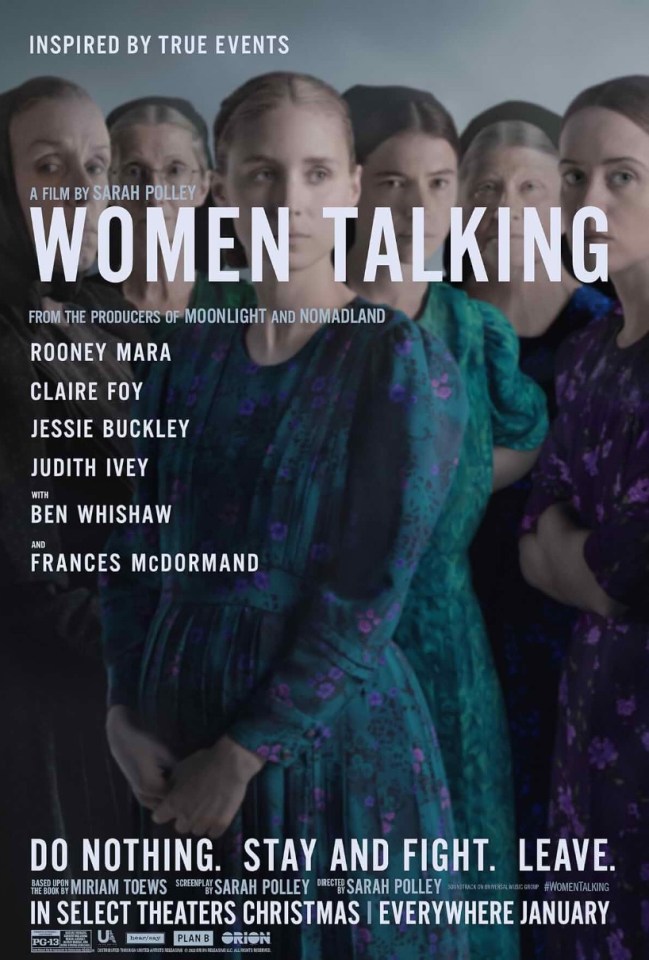
Sarah Polley’s film ‘Women Talking’ was awarded ‘Best Adapted Screenplay’
I thought it deserved ‘Best Picture’ – at least.
When I saw it at the theater I wept tears from the beginning to the end. I just watched it again on Prime Video, and it had much the same effect, although I was able to draw back just a little bit and appreciate the pure technical perfection of the film. (It won the Movie Of The Year from the American Film Institute.)
No film in my memory has affected me so deeply. I’ve elevated it to my top three favorite films of all time. (It falls between ‘Wings Of Desire’ for its depth, ‘Drive’ for its technical perfection – ‘Women Talking’ has both, and the best acting ensemble I’ve ever witnessed). I haven’t seen a better movie before or since.
Coming into this election and all of the struggles it has brought to the surface, ‘Women Talking’ perfectly exposes the deepest and most universal issues at play in this nation and in the world.
Last night felt to me like a religious ritual and a call to final battle. Watching an aged Bill Clinton was to me like listening to the incantation of a high priest who, more than anyone, represented for me the political aspirations of my generation. Through all of the struggles with Newt Gingrich and all the scandals and persecutions I remember Clinton saying that his only real enemy was the Christian Right. In this we are the same.
I’ve watched the darkness in the soul of America growing ever since I was a teenager, and it’s always been the same darkness, based in the foul stench of religious intolerance. For me, having been a dedicated Christian in my youth, this has always felt like the deepest form of betrayal. With The Party Of Trump it’s reached its ultimate embodiment. To contemplate its victory is to consider the collapse of everything in this world I believe worthwhile.
I was ready to give up. Whatever this is, it is reviving my spirit. Like Bill Clinton, I’ve grown old and I’m dying and this feels to me like my final battle. The stakes couldn’t be higher.
I just finished a science fiction novel called ‘The Player Of Games’ by Iain M. Banks. It depicts an encounter between an enlightened culture and a decadent empire that’s based on war and domination. After last night I woke up at 2:00 in the morning and was compelled to finish the book, in which an existential clash between civilizations is resolved through the playing of an intricate game from which only one culture emerges intact.
I don’t believe in coincidences. The stakes of the game we are in are way beyond the usual politics. As Buttigieg put it, we are facing the ‘politics of darkness’. This is a religious war, and this convention is nothing less than an act of exorcism.
Whatever the outcome, I don’t expect to live through another administration. I’ve pretty much lost my voice and my health is fading, so I’ve become almost useless in this fight. All that remains is my attention and whatever rituals I can maintain to keep me sane. My whole life has been wrapped up in this war, and I know that no wars are final, but I’m resolved to keep in the game until the end.
In the afternoons, following a day grappling with my high school insecurities, I’d stroll down the street from school to visit my friend Bill Halas at his home. Sometimes I’d bike over there in the evenings. Bill’s mother accepted me as an addition to a household that once included a husband and five older siblings. She and Bill, the latecomer, were both avid cooks and gardeners and active readers, sharing sophisticated tastes in music and art. Bill’s father passed away when he was very young, and when I met him his older siblings had long departed the household. Having an extraordinarily precocious and active mind his life had taken a rather solitary trajectory, his mother being the most reliable companion and sometimes his intellectual adversary. My own teenaged life was made unusual by the experience of being recruited for a special government program that took poor kids with high IQ’s out of their normal milieu and sent them to spend the summer living on college campuses. Our friendship flourished. Together we navigated the complexities of a rapidly changing world in the late 60’s, our bond growing from a shared sense of alienation and a drive for mutual discovery.
We met amidst a shifting cultural landscape with war, race riots, and assassinations unfolding in real time on our television screens. Popular culture was shifting radically from the segregated milieu of radio and the movies. Grasping for alternatives, we immersed ourselves in diverse music genres, from jazz to classical to experimental, and engaged in earnest discussions on philosophy and politics. We wandered the city smoking cigarettes rolled with pipe tobacco. We agreed and disagreed on everything. Sometimes we took his mother’s little Honda on road trips across the northern Ohio countryside, making up poetry inspired by highway signs (‘Pass With Care’).
I was the idealist and Bill was the purist, who took everything down to its roots. When I first met him he was experimenting with hydroponics. When he became interested in weaving he built his own loom and wove his own cloth and made his own hats. When he took up photography he began by studying its history, then building his own pinhole camera. Finally, he took up his brother’s old Nikon and developed the photos in his dad’s basement darkroom. My own nature was less grounded, tending toward the pursuit of imaginative utopian speculation and obscure strains of idealistic thinking. I felt compelled to understand the whole of everything, and very path I took led me down side roads, making it difficult to pursue a single course or become a model student.
Bill’s political awareness was way ahead of my own. He travelled to Chicago with his brother in 1968 to demonstrate at the Democratic convention and brought back photos and first hand accounts from the fringes of the police riot that we’d all watched on television. Later in our high school career we conspired with like minded friends to create an alternative journal that we mimeographed at the local anti-war office. We passed out leaflets and marched in circles chanting slogans in downtown Cleveland and attended meetings of a small radical organization led by a retired teacher and veteran of the Lincoln Brigade who fought in the Spanish Civil War.
888
Our friendship endured beyond high school as we pursued separate paths in college, delving into alternative communities and exploring the back-to-the-land movement. Bill’s quest for self-sufficiency and my search for spiritual revelation led us on distinct journeys. During those years in the early seventies everything everywhere was in flux and was being questioned, and for both of us the quest took us out of the proscribed path of college and career.
After we’d both left school we got together for a road trip east, tracking down old classmates and exploring alternative possibilities. We proceeded to Boston, where we met a friend of Bill on a sidewalk near Harvard Square. A large expansive figure closely resembling the British actor Peter Ustinov (with a beard), he sold carnations on the street, playing a concertina and disarming prospective customers with a performance that came right out of magical fairytales. We spent that evening at his lodgings in the attic of an unheated and condemned three story house in Roxbury. The next morning we crawled out of our sleeping bags to get breakfast at a nearby cafe. Our appetite for squalor satiated, we made our way out of the city and headed back to the Midwest.
Eventually, after making a long pilgrimage to the West I moved to Denver. Occasionally, while visiting my family back east I’d get together with Bill and he’d demonstrate for me whatever new endeavor had absorbed his interest. Over time these became increasingly esoteric even for my taste, involving dowsing and ley lines evidence for antedeluvian alien carvings left behind in rocks and boulders. He poured over old maps illustrating the mysterious energetic pathways determining the placing of streets and structures in small towns all over Ohio.
Our contacts dwindled over the years, and the last I heard from Bill was through letters filled with further interpretations of ancient artifacts and faces found in the rocks. I’d heard he was in contact with the Edgar Cayce people in Virginia and intended to build his own private settlement on a plot of land that his brother owned in Vermont. After at a year of hearing nothing I found out from his mother that he’d fallen out of communication with everyone. In a last message to his older brother, Bill had mentioned spotting a brown bear on the plot of land. After months of trying to track down his whereabouts the family concluded that he’d disappeared without a trace. For the sake of closure they accepted that he’d probably been eaten by the bear.
I don’t know what really happened to Bill Halas. All I’m sure of is that
All I know is that we shared a moment in time, embarking on uncompromising journeys, determined to face the mysteries of the world, whether in the rocks, the forest, or the primal currents beneath.”
I just imbibed two healthy pints of Scotch Ale, a small handful of psychedelic mushrooms and a chunk of potent marijuana brownie…while printing 32 greeting cards so that I can replenish my rack at the grocery store and contribute to my gasoline fund for future trips into the present.
I’m hoping that some combination of the above will somehow blast me out of a sense of helplessness in the face of all the craziness and suffering, although I know it’s not really my responsibility and that I’ve done my part to advance this whole contraption…
I’ve been watching VICE NEWS documentaries looking into the darkest corners of the world, watching ‘Severance’ and ‘The Man Who Fell To Earth’, reading a Jonathan Franzen novel about a Christian youth group and reliving so many moments in the deep past in order to write about them, and writing about them, and wondering if this voluntary isolation from all the world matters anything at all.
Grief is an ocean. It comes to us in waves, every wave possessing a different character and momentum. This is an ocean we all live in from the moment of our birth. The grief of a child is easy to see; in growing up we learn to hide our grief beneath an endless variety of disguises. We weep, we are depressed, we stare at the walls or create art. Some of us learn to project our grief on others in the form of hatred and prejudice. Some of us seek redemption through power and influence. Some become saints and some become monsters.
We’re often told that we can ‘get through it,’ and once we manage to do so the grief will no longer dominate our lives.
I can locate two points in my life where the waves peaked. I was torn between total numbing withdrawal and the painful and cathartic release of the deepest pain. My freedom from the struggle came in the act of unrestrained weeping. Both events were in response to the loss of someone very close and dear to me, one was mostly due to my own regrettable choices and one was a suicide.
This past year I spent mostly in bed or on the couch fighting the onset of cancer (if ‘fighting’ is the proper word). My main occupation, besides taking drugs for sleep and pain, finding new ways to eat, and showing up for chemo, was reading esoteric fiction and Doctor Strange comic books going back to the early sixties. I watched old Star Trek episodes on Netflix and made cannabis tea. My strategy in dealing with the loss of function was partly nostalgic and partly a form of pure escape. It stifled the sense of passing time that was leading me toward some mysterious ending.
I was given a reprieve. Time returned me from a state of suspended possibilities, bringing me new opportunities for choices and a chance to reflect upon my interrupted journey. Release from work and the need to meet schedules set by others put me on a bridge between regret and hopefulness. I’d survived for now but had lost a degree of functionality. It left me with no certainty about where I was headed or where I wanted to land.
It left me reeling between feelings of almost absolute freedom and a deep conviction of failure and incompetence. When I finally arose from my time upon the couch, I faced an altered world. The peak of the worldwide pandemic coincided with the height of my own illness. Everything was changed. The undercurrents of grief and anger had risen to the surface. Everyone appeared to be traumatized in some way. Businesses were closed; streets were full of the homeless and hospitals full of the dying. Nearly everyone now is masked in public, while hidden emotions and collective resentments force their way toward the surface. Politics have split the nation into warring factions, to a degree that the basis of trust that makes a functioning society possible is seriously, and perhaps irrevocably, frayed.
Grief appears to be everywhere.
In spite of all of this I forced myself to climb out of the hole of indecision and aimlessness that had ruled my existence through a year of trauma. I resumed the discipline of sitting every morning in meditation, observing my mind in a mirror. I witnessed the ghosts and demons of repetitive patterns that carry me through both hope and despair. Gradually my life regained a sense of direction and purpose that informed my daily routine of waking, sitting, reading, listening to podcasts while making breakfast, then making the time to write or to practice photography. A feeling of freedom began to ascend over thoughts of self-hatred and despair.
In the ocean in which we swim only change is certain.
A couple of weeks ago I opened a series of doorways into computer hell. I automatically upgraded my computer to the latest operating system software without thinking very much about it. After the upgrade the application in which I did the organizing, processing and printing of my photographs simply ceased to function. Nothing I tried solved the problem. No help was available from either the software provider or the computer maker. The advice of these massive corporations was to wait a month or two until they managed to coordinate with one another.
My forward motion was brought fully to a halt as I spent many hours desperately seeking help online. Instructions provided by people having similar problems not only didn’t work, but their results forced me to take the whole mess to a professional technician. He first encountered the same problems I did, but eventually a workaround was found that not only cost me a lot of cash, but also led to the irrecoverable loss of a good chunk of historical data.
I found myself once again floundering in the waves. I felt incompetent and helpless, angry and depressed in turn. I couldn’t find the inspiration to write while obsessing on the problem. My feelings began to bleed into my relationship with the world of other people. Friends who could see my distress offered well-meaning advice, and the advice was angrily rejected. I felt that I was on my own, that there was no help to be had, that every choice I made led to worse problems. My anger was petty and mean and an expression of accumulated grief for the loss of relationships, the community of work, my bodily functions, and as much as anything the loss of the world I’d grown accustomed to living in.
I’m now in recovery mode, sorting through this relatively minor wreckage, and yet I feel some kinship with those who experience the aftermath of flooding, fires, earthquakes and economic collapse and have to rebuild their lives from the ground up. Although small in comparison, my problems evoke reactions based on far more than the event in itself. I carry with me the sense of everything I’ve personally lost and gained, as well as the victories and losses experienced by people all around me.
In the West we worship our individuality as if it were a Holy Grail, but it’s mostly a fiction. As much as we isolate ourselves and our feelings from others, we are inescapably social beings who share together both joy and pain, immersed in the currents that surround us.
Here I stew alone in my ‘laboratory’, surrounded by computers, camera, iPhone and streaming television, struggling to find my own voice through all of this. The place is small, two rooms with a kitchen alcove and a tiny bathroom. Every move in the past decade has seen me downsizing, sorting through every object that has a story, deciding which to let go. There’s little room in here to live in the past, so I’m forced to live somewhat ruthlessly in the present. Although I stay up on the affairs of my country and of the world, I’m growing more of a protective shell to separate my feelings from the emotional maelstroms provoked by our collective struggles. I often fail. The struggles continue and will never end, but their weight is never mine to carry alone.
Loss is a given, grief is forever, and I swim in the same ocean as all of you. We can’t stop the storms that are coming, but maybe we can learn to swim with the tides.
This week I approach my seventieth birthday. It’s the same as Thomas Jefferson’s, with whose passions and contradictions I can totally relate, particularly the fact that his vision so far exceeded his grasp. As a privileged and prosperous inheritor of great wealth in an economy based on slavery, as an obssesive tabulator of facts and figures and an elevated member of a race and culture that considered itself inherently superior to all others, Jefferson’s restless mind would not allow him to reside in any fixed station. Instead he imagined an ideal world, nonexistent at the time, where every human being had, by virtue of being, inherent and inalienable rights to pursue satisfaction in whatever way they could. The nation he helped to get off the ground has yet to achieve those ideals, having been saddled, as was Jefferson, with the contradictions between commerce and equality.
Today I took a walk into the center of my city to find a public mailbox and to appreciate the beauty of an early spring day in Santa Fe. The streets were mostly quiet, except for occasional cruisers in huge pickup trucks and a flotilla of motorcycles that wove themselves around the Plaza. A few couples and isolated characters wandered like me past the close galleries and restaurants, museums and churches, appreciating the blossoming trees and the opportunity to pull down our face masks to appreciate their scents in the open air. As I walked I listened to Zen talks given from Mount Tremper in New York via podcasts on my iphone. I contemplated my own conflicts and contradictions and my own position in regards to the present and the future.
In contemplating the inner struggles of the past three years it occurred to me that I could turn things, so to speak, on their head. Instead of seeing only chaos and obstacles culminating in the crashing and devastating halt of the pandemic, I could see all of this as an opportunity. Perhaps, as we each approach a sense of possible and impending mortality, we can sort out the the wheat from the chaff both in our individual natures and in the world at large.
The basic contradiction in American culture, it seems to me, is where the cult of individual freedom clashes with the common welfare, and by extension where the demands of a capitalist system clash with the aspirations of democratic institutions. Perhaps, with the ascendency of the present administration, these contradictions have been put before us in as plain a vision as could be possible. As a nation addicted to celebrity culture and to the pursuit of personal wealth we’ve managed to elevate to the highest level the perfect embodiment of pure ego and self interest, devoid of empathy or of compassion or of any consideration that transcends the possession of pure power and an illusion of control. Some of us have done this out of avarice and some out of fear and pure desperation.
For those of us who have conceived of a different world, governed by the notion that the welfare of one is inseparable from the welfare of the whole, these three years plus have been both a travesty and a challenge. Most importantly, it has daily shown, in our responses and reactions who we really are, at our best and at our worst.
For me, it has fully exposed a current of rage and resentment that I’ve lived with for most of my life, and which I’ve strived to suppress or which has been the engine of my own self judgement. Where does it come from? Perhaps some is inherited through family dynamics or early childhood disappointments and frustrations. Not a little has emerged out of the pure disillusionment of having been raised with the highest ideals only to see them continually subverted within the world I’m forced to navigate. Some of it is a product of an empathic reaction to gross injustice done to others. Whatever it’s origin, this steady undercurrent of rage has in many ways made my life and the experience of those around me more difficult, rather than less.
For this I am deeply aggrieved.
Yet, on the other side of rage is compassion. I’ve long considered his to be my greatest failing. On the one hand, I’ve always experienced an acute sense of empathy with those who suffer in this world. On the other hand I’ve allowed those feelings to feed my sense of outrage against those whom I perceive to be the propagators of that suffering. In my mind and in my emotions I’ve separated those who I perceive as the victims from those I’ve perceived as the victimizers. As our culture has become more and more polarized, between the rich and the poor, the white and the non-white, the powerful and the weak, this has metastasized into what amounts to an internal ‘civil war’ that I find myself fighting on a daily and hourly basis. There are the ‘good’ guys and the ‘bad’ guys, and my vision doesn’t allow for anything between total victory or total defeat.
What has become increasingly clear to me, in this cultural moment when the rug has been pulled out from under both the perpetrators and their victims, is that we are all relatively helpless in the face of forces that are so much larger than our petty struggles over greed and ego. So, now the question becomes whether I can overcome my feelings of rage and resentment, and join once again the collective experience of the human race in a manner that goes beyond ego and ideology, and is nothing more than a reflection of the forces that I perceive as the enemy.
* * *
In the last couple of months the vicissitudes of age have finally caught up with me. The work I do for a living has taken a deep toll on my body. My shoulders are a tight mess, the tips of my fingers have grown numb with the carpel tunnel effects of the former, yesterday when I took out my bike for the first time since the Fall, I had trouble lifting my leg high enough to mount up. My plans for the future and for retirement are, as a consequence, all in serious question. On top of this is the virus and a question about how my previously strong immune system has stood the vicissitudes of age. In short, the question of mortality stands before me as never before.
The lesson that I believe needs to be learned is that the outcomes are out of my hands, and that my responsibility to myself is to live this life as much as I can in a state of acceptance rather than one of eternal conflict. This is admittedly very difficult for someone who feels both like a warrior and a disillusioned idealist. I will always be a warrior. What I need to let go of is the disillusionment. Then I can begin to address the problems and situations in front of me without having to view them through the destructive discoloring of rage.
Who knows, perhaps the possibility of compassion is not even out of reach. Perhaps even that possibility can extend to an America still caught between dream and reality and having to face its own collective demons.
I’ve in the last week picked up a copy of a book composed by Timothy Leary and associates back in 1994, two years before Leary’s death in 1996, and around the time when I was imbedded in the post-psychedelic New Age culture of art and speculation that nested in and around Santa Fe, New Mexico. I’d actually passed by Doctor Tim in person as he toured as guest speaker and celebrity for some sort of exploratory consciousness fair that took place at the city’s main Convention Center.
I am certainly no stranger to Leary’s thought and his writings. From the time when he was advocating from an eminent platform at Harvard for boundary breaking explorations of consciousness via LSD and Psylocibn, to the time when I spent days trying to process my own headlong perceptual journeys out to the boundaries of consciousness and beyond. I travelled along parallel paths while Leary made his way through prison and exile and paranoia and the trials that came along with pop stardom and self deification.
When I walked into my dormitory room at Case Western Reserve one night, getting off on some form of chemically induced revery I heard Leary’s voice come over the radio, telling me to, “Sit down Ralph.” He then took me on a guided verbal tour of my brain, the universe and the whole history of human DNA. It turns out that the ‘Ralph’ in the recording, played that night over the student station was of Leary at Harvard conducting an LSD session with one of his grad students, Ralph Metzner. I didn’t learn this until years later, and in the meanwhile carried it around with me like the inner knowledge of some secret synchronistic initiation, a mystery for which I sought no further solution.
The book I’m reading is one I wasn’t particularly familiar with, lent to me by a friend. It’s called “Chaos & Cyber Culture.” By 1994 Leary as visionary prophet had been largely discredited by both popular and serious academic culture. He had spent time in prison, in Europe and in North Africa, in flight from the American police, hobnobbing with revolutionary elites and movie stars and science fiction writers, hounded by governments and ideologues of the Left and the Right. The 60’s dream of storming the barricades of capitalist/consumer culture had long ago faded or been absorbed and replaced by the high octane quest for new meaning and new wealth accelerated by revolutions in technology and communication.
Society was itself going through the initial stages of the sort of destabilization one encounters on an acid trip. Timothy Leary, along with many former prophets and outlaws and explorers were now mere flotsam in massively circulating currents of change. He was gone before the currents would peak and then break into fading fragments after September of 2001.
The book is a collection of words and images splattered across pages designed in the mode of a psychedelic version of The Whole Earth Catalog. There are dozens of typefaces in all sizes floating in the form of giant quotes and poster graphics and images from the past and the future. There are interviews and conversations with the likes of William Gibson and William Burroughs and David Byrne and all sorts of artifacts assembled around a political documentary and summary of sorts of Leary’s broad visions of past, present and possible future.
Other than in worlds of extreme science fiction I haven’t read anything like this in years. Drawing on history, art, mysticism, biology, psychology, computer science and literature, framed with over-the-top optimism regarding the future of civilization and human consciousness, Leary’s vision has no boundaries, and in reading I grow increasingly aware of how much my vision and that of my culture has narrowed over these past four decades. As a nation and as a world we’ve become increasingly ruled by fear and apprehension, which by nature is a narrowing of consciousness to the primitive state of flight or fight that responds robotically to a wider and wider range of stimuli.
We sit in our cocoons of political power and economic anxiety and anticipate the worst. We are a shell-shocked population with eyes and ears open to more and more information but with less ability to integrate it into something that makes sense. We live in a world of chaos, awaiting signs of the next real ‘strange attractor’ that we hope can assemble all of this mess into meaning. We’ve entered a historic and geological period where the shocks come in accelerating waves of war, recession, natural disasters and forced migrations, and our response is to reach out to the person who promises to protect us and shield us and make it all right. Increasingly we realize that the future can’t be controlled by any power wielded by the few for the supposed welfare of the many. Individually we awake once again to the knowledge that the portraits we perceive of the world around us are painted mostly by ourselves.
At first this makes us all feel incredibly alone, until we make an effort to explore and find new ways to make contact with one another, not as crowds or constituents or mobs or armies, but as fully responsible human beings. Our challenge always, is to create entirely new realities for ourselves, through our storytelling and our imagining, that are fluid and adaptable enough to deal with the constant change that our world throws at us. We have the tools to do it, and our task is to awake to our possibilities and to summon the courage to face and dismiss those who would build walls out of our fear.
So, this evening (Monday, Feb. 3rd) the REAL Super Bowl begins. Now that all of the Impeachment drama is coming to a close and the football drama is over for a year and we’ve watched the most expensive commercials ever made, perhaps we can get down to business of moving forward.
For the year’s total anticlimax there’s the State of The Union embarrassment taking place tomorrow, in which the Donald will…who knows what the Donald will do or say? The best approach in dealing with our Asshole in Chief is to ignore him as much as possible and go forward with our lives, using our thoughts and imaginations to conjure more palatable futures.
Rush Limbaugh is dying of lung cancer. That’ll take some of the wind out of the sails blowing toward oblivion. While Senators bloviated, the biggest news this week is that the Thwaite Glacier is getting ready to drop and could quickly raise the ocean levels by up to 3 feet. The impending drop of what scientists have dubbed the ‘Doomsday Glacier’ will only be the first of many. There goes one civilization, to be replaced by necessity with another.
I’ve spent the past three years stewing in the juices of my own anger and it has gotten me nowhere. The daily disaster has driven me to forget that the best way to observe the ongoing bombardment and spectacle of news and information is to step as far back from the sheer noise and confusion as possible. The news of the ‘moment’ is mostly made to sell personality and product rather than offering much in the way of useful information. What happens in the moment isn’t as important as our collective mediated response to it. The Reality we perceive in this digital world is of necessity always second hand.
We are each in the business of assembling a world that corresponds to our own predilections. For myself I’ve chosen to accept information primarily through online digital conversations, rather than merely accepting what is ‘broadcast.’ Avoiding antiquated mediums like television and radio or newspaper, I seriously engage with information only after it’s been processed through trusted networks of intelligence and discrimination, carefully evaluating the materials with which to assemble my own picture of the world. I’m a subscriber to reality, mostly through print and podcasts, and an occasional glance at headlines from selected inputs on Apple News or Flipboard or the front pages of newspapers.
When I encounter, as in the laundromat, televised news formats in real time I’m conscious that what I’m receiving is an agenda that has more to do with commerce than truth. This stuff, including all forms of mass public broadcast, from out and out propaganda to public radio, is safe to consume only to the degree that one is aware that every broadcaster has their own agenda. Whatever presents itself as absolute truth is only ideology.
Everyone I know who merely consumes ‘The News’ on television or radio appears to be driven crazy by it.
As a consuming culture many Americans are being consumed by cynicism, doubt and despair. The world we’ve constructed in our minds is one in continual emergency, to which we must react without being given a trusted set of tools to react with. Too many of us are swimming and drowning in a pool of helplessness where new alarms are shouting every day, “Danger! Danger!” After years of daily bombardment we are shell shocked and numb, unable to pierce the fog that obscures the future. Christians and New Agers await the Apocalypse, white supremacists look forward to their ‘boogaloo,’ conspiracy fetishists obsess over every revelation while screwing themselves into increasingly paranoid fantasies, and the rest of us deal with a growing sense of apprehension and dread.
Meanwhile, the world trundles on within webs of mind boggling complexity and we are swept along in rushing rivers of karma and consequence. So easy to imagine that we are either victims, or else we are fighting a constant war for particular outcomes. So easy for me to spew words into the void like weapons, effecting only to increase the chaos instead of offering clarity or hope.
Well, it’s a new year and I’ve been mostly silent lately, after what has felt to me like constant struggle against overwhelming odds. It’s true that there is struggle. The need for change is obvious. The change that’s needed however, can only come about through a change of channels. I’ve been paying too much attention to the idiots waving the flags, and too little time spent in a world where human beings are meant to live, one that’s woven through our minds and our imaginations, where we tell each other stories and look at dire situations as problems to be solved. This is the only kind of world where we have a chance to live beyond our fears. It’s the only world where we can construct the necessary bonds that will hold this ship together.


 Arclist