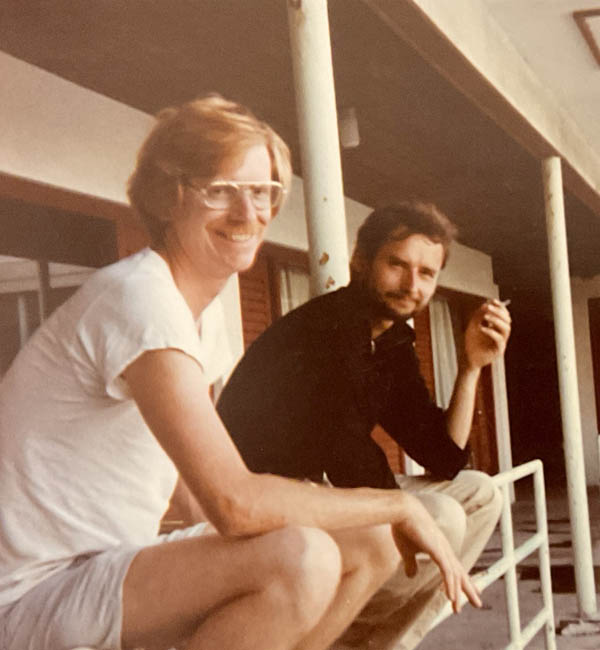
He was tall and very thin, with the striking red hair and fair skin of a person of Irish descent and temperament. He’d grown up in rural Appalachia. At some point in his college years the breadth of his awareness expanded dramatically and he, along with many of our post war generation, became a vocal reformer, a gadfly, and a revolutionary in spirit.
In the years following he migrated to Detroit, here he became a union organizer in the auto industry. He took from his reading and studies an insightful, yet contrarian view of the American state. He told me once of accompanying a group of activists to Cuba to experience the new order as well as effects of America’s animosity from the inside. They were invited to a dinner in a hotel ballroom one evening when the lights all went out, due to a blackout. In the darkness a single match was lit, and it was Fidel Castro lighting up a cigar.
Around the time that America retreated from Vietnam and the Nixon administration collapsed in disgrace, Michael met and married his first wife, and they began raising a daughter. The nation had begun to enter a period of serious disillusionment, and a reactionary backlash arose to the progressive advances as well as the excesses of the sixties. The wave of cultural disruption that fueled the Civil Rights and anti-war movements brought down barriers of racial and class divisions that trace back to the nation’s founding. New music, the advent of television and the liberal college education of a generation of middle class white students, thanks to the GI Bill, accelerated the Civil Rights and anti-war movements. Deep fissures widened between opposing visions of America’s history and its role in the world. Many of us were feeling both frustrated and rudderless, and actively searched for alternatives to the faltering assumptions of our elders.
Leaving Michigan, at the same time I left Ohio, the young family moved west, looking for better opportunities in growing communities like Denver, that appeared less calcified in their sense of the possible. We joined a growing community, led largely by a cohort of politically aware refugees from the culture wars. We coalesced around a dynamic and inspiring spiritual leader from a different country with a different (non-Christian) tradition. It was a common phenomenon in that era. Whatever reservations we might have had about the religious basis of the community, it inspired the communal energy and the organizational experience in its members that accomplished remarkable results. It was in the midst of all of this enlightened energy where I met Michael.
I don’t remember the details of our meeting, but from the beginning we recognized a shared vision for our future and a set of interests that flowed naturally into an immensely supportive partnership. We were both political contrarians and irritants to group thinking. We both of us had a consuming interest in the growing and equitable distribution of food and resources in a healthy society that cared for the land. Over a short time our friendship blossomed into a deep sense of brotherhood. To me he was like an older brother with a deeper experience of the world. My literary interests and his political experience complimented one another. We worked on projects together, starting our own ‘community garden’ on a slice of vacant public land (now covered by condominiums). We commiserated with each other’s successes and failures. We were not always in agreement and both of us carried strong opinions, and although never reluctant to challenge one another, and at times we could put people off by our stubborn positions, the disagreements between never violated our trust in one another, and were always more illuminating than destructive.
Finally time and change caught up to us. The community began to break up, along with our marriages. Michael pursued his dream and his roots, moving to North Carolina, starting a small farm and a new family in tobacco country. I stayed in the west, eventually moving to Santa Fe, but I managed to visit him more than once, hiking through the Appalachian countryside or canoeing down the French Broad River near Asheville. Once, when he was studying law he gave me an instructive walking tour of Durham and its politics. Eventually he became a lawyer. I visited with him and other friends in North Carolina, where I was introduced to southern quisine (scrapple) and country dancing. I watched Michael’s son grow up. Much later on, when taking the southern route on my way to visit friends on the East Coast, we briefly got together on an afternoon near Raleigh. Our lives had gone through various dramas and we’d fallen out of frequent contact. Two years ago he came to Santa Fe with his wife and part of his extended family, and after a long hiatus we renewed our connection.
Last year he was diagnosed with cancer. The last couple of times I spoke with him he was optimistic, but soon after he went into a rapid decline. When I was told he was dying I regretted that I’d been so distracted with my own situations that we hadn’t talked more often. Now he’s gone. His wonderful wife has told me that he always called me his brother and kept me in his heart. A feeling we shared. We were indeed brothers in arms, and farmers, and students of the world together.
In Peace.
For Michael Smith
(Revolutionary, Farmer, Teacher, Lawyer, Family Man)
Jan 7, 1945 – May 15, 2026
R. Melcher
Discover more from Arclist
Subscribe to get the latest posts sent to your email.

