By Ralph E. Melcher
”We tell ourselves stories in order to live.”
Born into a conservative Republican family in Sacramento California, Joan Didion started writing at the age of five. She was shy, and because the family moved from place to place to follow her father, an army finance officer during World War Two, she grew up with the sensibilities of an outsider. Raised to favor limited government, low taxes, balanced budgets and non interference in citizen’s private lives, her first vote was for Barry Goldwater. When the Republican Party in the time of Ronald Reagan began to stray from its principles, she became the first and only one in her family to register as a Democrat. In her book, Political Fictions she comments, ”That this did not involve taking a markedly different view was a novel discovery, and one that led me to view the ‘American Two Party System’ with…a somewhat doubtful eye.” She eventually became a reporter, an essayist, and an accomplished novelist. In all of these genres she brought an extraordinary precision of language and a passion for delving into the deeper currents that shape the stories Americans believe about themselves.
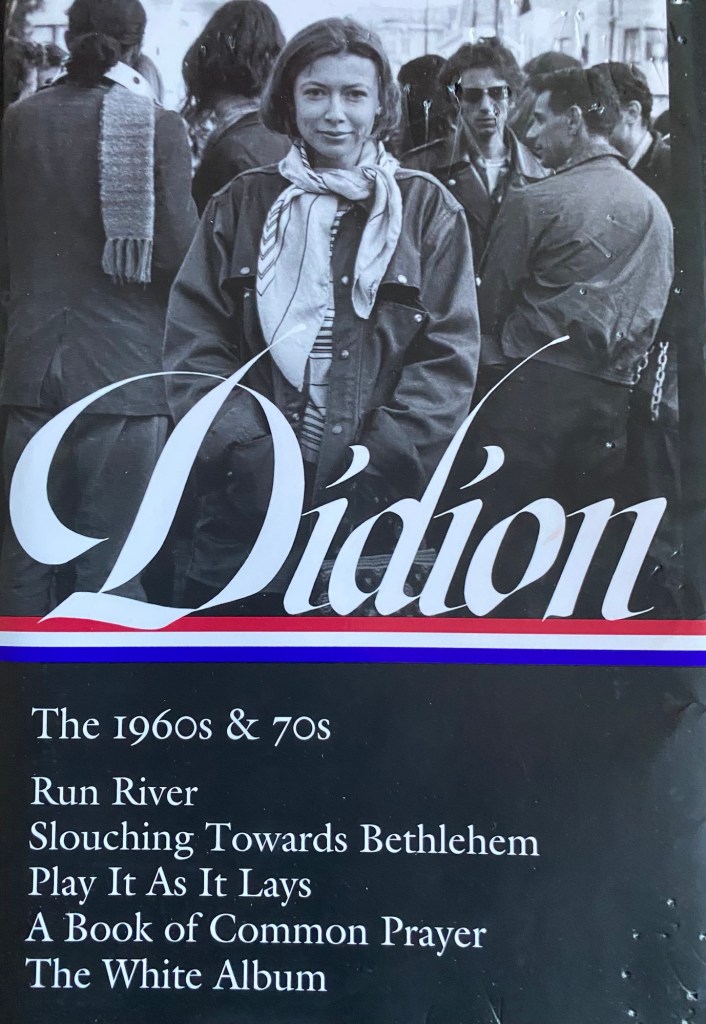
I recently picked up a copy of Didion: The 1960s and 70s, the Modern Library’s anthology of work she published in those decades. The collection includes her first three novels and two books of essays. They’re dispatches from an era of disruption, told in cool rhythms of sharply analytical prose, often tinted with a tone of ironic skepticism, never taking cover in speculation or fantasies, and never looking away from unpleasant truths. These were the works that brought Didion originally to my attention. Not only written in immaculate and original prose, they provide a chronicle, from a uniquely personal point of view, of a time when every American myth was being challenged, and the culture was taking a plunge toward dissolution.
During those tumultuous decades a number of prominent novelists and journalists, including Norman Mailer, Tom Wolfe, Hunter Thompson and Truman Capote began to incorporate the techniques of fiction with the reporting of events in the real world. The movement took on the name of the New Journalism. It challenged the conventional pretense of objective reporting, employing stylistic structures of fictional storytelling that used dialogue for dramatic exposition, moved through nonlinear time and constructed dramatic narratives drawing readers viscerally into the scenario. We were made privy to the writer’s thoughts and reactions to events, aware that these stories were told through the experiences of particular people with particular styles and points of view. Joan Didion took to these techniques with a natural grace and skill, combining the precise selection and description of details with penetrating commentary that illuminated the significance of the moment. With a high literary sensibility she engages both the imagination and the intellect. The specificity and color of her style approaches the cinematic.
Leading the anthology is her first novel, Run River, the story of a family living in Sacramento that carries a hint of the home sickness Joan Didion was feeling while living in New York City. It carries echoes of her own childhood, depicting the loneliness and uncertainty of people who are unsure of their place in the world. At its center is the drama of a troubled marriage, against an emotional backdrop of restlessness in the face of change. Characters are caught between familiar rural values and the pressure of an oncoming real estate boom. Lives follow the shifting seasons of river culture, the waters bearing witness to the social currents that push against people, sometimes leading to tragic outcomes. The novel’s compelling rhythms of prose and dialogue display the early talent of an accomplished storyteller, employing distinctive techniques for summoning time and memory, precursors to all of the work that will follow.
The title essay of the collection, Slouching Toward Bethlehem, is taken from The Second Coming, a poem by William Butler Yeats that speaks of anarchy and the loss of innocence as things fall apart. It recounts the writer’s forays as a reporter into the thickets of a burgeoning ‘hippie’ scene in San Francisco’s Haight Ashbury district in 1967. Hordes of young people were arriving in flight from their families, rejecting what they saw as the conformity and hypocrisy they identified with middle America. Where they land is in a fragile community filled with dreamers and their followers, lost and struggling to thrive amidst the rock and roll, the poverty and the reveries of LSD. This account was published in The Saturday Evening Post, and it introduced much of the nation to the social upheaval that was gathering on their doorsteps. All of the pieces in the collection appeared in popular newsstand publications like the Post, New York Times Magazine, Holiday, Vogue and The American Scholar . Among these essays are accounts of crime in suburbia, sketches of celebrities like John Wayne and Joan Baez, California think-tanks, the experience of living in Los Angeles and working in Hollywood, growing up in Sacramento, visits to Hawaii, deciding to leave New York City, and the inner process and discipline that one brings to writing itself.
The times in which these essays were written were not easy for Joan Didion. In ‘Goodbye to All That‘ she describes her life in New York City, when she was young and writing for Vogue and ‘in love’ with the city and when ”Nothing was irrevocable: everything was in reach.” After eight years she was desperate and feeling the loneliness and longings of an exile. She married the writer John Gregory Dunne and they moved to Los Angeles. The last years in New York had left her feeling empty and withdrawn, struggling with feelings of doubt and despair, overwhelmed with anxiety, and questioning her purpose. She’d ‘mislaid’ the plot, not only in her own life but in whatever gave meaning to the chaos she perceived in the world around her. Through it all she continued to write, and one can see these essays as beacons on a long and painful return to herself.
In ‘A Preface‘ she offers a view of herself as a writer. She describes, with a hint of irony, her own strengths and limitations, claiming that as a reporter her main advantage is in being ”…so physically small, so temperamentally unobtrusive, and so inarticulate that people tend to forget that my presence runs counter to their best interests.” She warns us that ”…writers are always selling somebody out.” Given what she shows us in these efforts, the ‘somebody’ she refers to includes herself.
Themes of loss and displacement are carried forward in her second novel, Play It As It Lays, the tale of Maria, a woman whose life begins in a failing Nevada gambling town and ends up in Hollywood, where everyone and everything is shuffled around like pieces in a card game. After a series of tragedies, separations and failures we witness her disassociation from all those around her, until closing the door on all of the pain of the past, she also severs her connections with the present, and ends up sequestered in a mental institution. This journey through an intricate maze of relationships and disappointments unfolds in a series of short revealing scenes and flashbacks, delivered like cuts in a movie. (The book was eventually made into a film.) The author exhibits her personal familiarity with the harrowing descent across the boundaries of anxiety and despair.
The third novel, A Book Of Common Prayer, partly draws from personal impressions of traveling with her husband, John Gregory Dunne, to Columbia and El Salvador in the eighties. (Accounts of these journeys are found in ‘The White Album‘ and her book, ‘Salvador.’) The mysterious origins of a character are gradually unveiled through the accounts of a witness, an anthropologist who marries into the ruling family of a politically unstable Latin American country. She befriends the wealthy American who arrives in the country as a tourist, choosing to stay long term, apparently waiting for someone’s arrival. We follow a narrative through changing points of view, moving from the accounts of the narrator, then into flashbacks that reveal intimate moments in the woman’s past. As the clues to her solitude gradually reveal a history of loss and tragic disappointment, we come to realize what she’s waiting for is unlikely ever to arrive. In the oppressive atmosphere of a decaying civil order, the country descends into a spiral of political violence, and we are helpless witnesses, along with the narrator, unable to alter the fate of someone who invests her existence in an unlikely version of reality.
The second essay collection, ‘The White Album‘ , gives us in the title essay, an account of the trying period when she was raising a daughter and carrying on with life as a normal person, but losing the narrative thread that made the world make sense. While living in a large old house in the Hollywood section of Los Angeles, Didion reported on murder trials, met a member of the Manson family, hung out with the Doors, interviewed Huey Newton and Eldridge Cleaver and covered campus uprisings. In 1968 she was named a Los Angeles Times “Woman of the Year”, but was growing increasingly depressed and withdrawn. The summer of 1968 brought the My Lai massacre and the assassinations of Martin Luther King and Robert Kennedy, followed in short order the next spring by the Manson murders. At the time she grew desperate, checking herself into an outpatient psychiatric clinic after suffering an attack of vertigo and nausea and feeling like she would pass out. Included in the essay is a full transcript of a very harrowing psychiatric diagnosis. Around the same time she was diagnosed with latent signs of multiple sclerosis, which remained latent for the rest of her life. She continued to struggle with anxiety and depression for the next three years. Most of the essays in this collection were written and published after this period. One could consider them to be a journalistic record of a person who is in recovery, reconnecting with the stories that keep us alive.
The second section, titled “California Republic” is filled with collected snapshots and vignettes of people and life in the state of her birth. She writes about Bishop James Pike, the California water system, the Governor’s Mansion, the Getty Museum, the highway Operations Center and Hollywood charities. In the last piece she relates an encounter with the suburban Jaycees of Santa Monica, who represent for her ”…the true underground, the voice of all those who have felt themselves not merely shocked but personally betrayed by recent history…“ as they perform a social ritual to times that appear to have passed, getting together weekly to solve America’s problems.
In the three essays in the “Women” section Didion displays the core values she invests in her own work and the standards she considers fundamental to the mission of artists and writers. ‘The Woman’s Movement‘ is a critique of ‘second wave’ feminism’s tendency to follow deterministic models that confine women to a ‘class’, defined solely by the circumstances of their oppression. Seeing the world solely in terms of ‘struggle’ holds women back from living as fully realized human beings. Her position is further defined in the piece on Doris Lessing, whom she characterizes as ”…a writer of considerable native power,”_under the undue influence of ”…the guiding delusion of her time.”_ This she defines as an assumption that human behavior can be altered through versions of collective conformity. By creating characters that are mere representations of ideas Lessing abandons the irreducible ambiguities of human behavior and gets drawn into the trap of ideology. For Didion ”…fiction is in most ways hostile to ideology.” By contrast, in the essay on Georgia O’Keeffe, Didion extols a woman who embodies the true obligation of the artist: to courageously pursue her own vision in the face of both critics and admirers. She calls O’Keeffe ”…a straight shooter, a woman clean of received wisdom and open to what she sees.” Her art embodies the principle that style is character. She quotes the painter when speaking of the creative process, ”I believe that to create one’s own world in any of the arts takes courage.” Whether one agrees or disagrees with Didion’s arguments, these three essays, insisting that artists must free themselves from cultural dogmas to release their imaginations, constitute a personal manifesto by a fiercely independent thinker. ”Some women fight and others do not. Like so many successful guerrillas in the war between the sexes, Georgia O’Keeffe seems to have been equipped early with an immutable sense of who she was and a fairly clear understanding that she would be required to prove it.”
In the section called, “Sojourns,” Didion assumes a more contemplative posture, reflecting on the sense of growing alienation she felt while living in New York, and the several trips she took to Hawaii for restoration and recovery. She writes of the history of the Royal Hawaiian Hotel and of the National Memorial Cemetery of the Pacific, which contains American casualties of World War II, and where the Vietnam dead are first shipped on their way back home. She visits Schofield Barracks, portrayed in the novel From Here To Eternity by James Jones, visiting the sites mentioned in the book and reflecting on the times of war that have left shadows in the present. She gains some solace in reflecting on the things that last and those that are left in the past, and reflecting that this is just the way life goes.
“In Hollywood,” is a commentary on the insider culture of the studios, where economics rule over art, and the studio heads treat movie making like a casino game played among deal makers, usurping the pursuit of glamour and fame. “In Bed” is an account of her frequent migraines, “On The Road” describes traveling on a book tour, “On the Mall” offers a history of shopping malls, and “In Bogota” relates her impressions while attending a film festival in Columbia. The final essay in this section offers a meditation on the Hoover Dam, as embodying the inflated dreams of America, ”…the several million tons of concrete that made the Southwest plausible, the fait accompli that was to convey, in the innocent time of its construction, the notion that mankind’s brightest promise lay in American engineering.”
The book concludes with two short pieces. In the title essay, “On The Morning After The Sixties” Didion reflects on being a child of her time, part of a ‘silent’ generation that identified relentlessly with the personal, choosing to live ‘outside of history’, accepting that humanity at large was not perfectible. They believed that the meaning of life wasn’t to be found in social action but in the acceptance of our own finitude. They’d experienced a world enveloped by a war that was largely driven by attempts at social engineering. They were bewildered by my own generation, the Boomers, watching as we threw ourselves into trying to ‘make the world a better place’. The counsel she offers is not to get so caught up in the sweeping movements of history that we lose ourselves completely.
In the final coda, “Quiet Days In Malibu,” she tells us of life with her husband and daughter, living in a house near the beaches and beneath the Santa Ana winds. It was a time when they knew the neighbors and life wasn’t always easy deal with radical changes in the weather, but people looked out for one another. She tells us of Amado Vasquez, a grower of rare orchids, who tended his greenhouse up the canyon. After her family moved away, an enormous brush fire, pushed by 100 miles per hour winds ravaged the coast, destroying many homes along the Pacific Coast Highway. Returning for a visit, she sees that the greenhouse has burned, but Amodo is moving to a new location to begin once again. The fire had stopped within 123 feet of the house the family had lived in for five years, before they moved on to Brentwood Park in L.A..
Why have I returned so avidly to Joan Didion at this time? For one thing it’s simply a pleasure reading these sentences, like driving across a familiar landscape that consistently presents new revelations. When I encounter her prose I feel like I’m engaged in a lively conversation, where all of my lazy assumptions are challenged, and my eyes are pried open to new ways of looking into my own past. The tale she tells of writing and struggling to make sense of the chaos and cruelty of an era feels familiar. The unique blend of personal memoir and reflection brings her reporting to a level that illuminates both the mood and meaning of the time. I find her writings only improve with rereading, shedding light on terrain we both travelled.
From The White Album:
”We tell ourselves stories in order to live…We look for the sermon in the suicide, for the social or moral lesson in the murder of the five. We interpret what we see, select the most workable of the multiple choices. We live entirely, especially if we are writers, by the imposition of a narrative line upon disparate images, by the ‘ideas’ with which we have learned to freeze the shifting phantasmagoria which is our actual experience.”
Joan Didion went on to write two more novels and ten books of essays and nonfiction. Along with her husband, John Gregory Dunne, she wrote four major screenplays. Her novel, Play It As It Lays, was made into a film. She continued to report on American myths and values and wrote memorable accounts of her personal life, including The Year Of Magical Thinking and Blue Nights about the tragic deaths, in the same year, of her husband and daughter. The Year Of Magical Thinking won the 2005 National Book Award and was later made into a stage play.
Discover more from Arclist
Subscribe to get the latest posts sent to your email.

